

WhatsApp Privacy Settings 2026: Complete Security Checklist
WhatsApp holds your most private conversations — family chats, work discussions, photos, documents. Yet most users never touch the privacy settings, leaving their profile photo, status, and “last seen” visible to strangers. In 2026, WhatsApp’s privacy controls are better than ever, but only if you actually configure them.
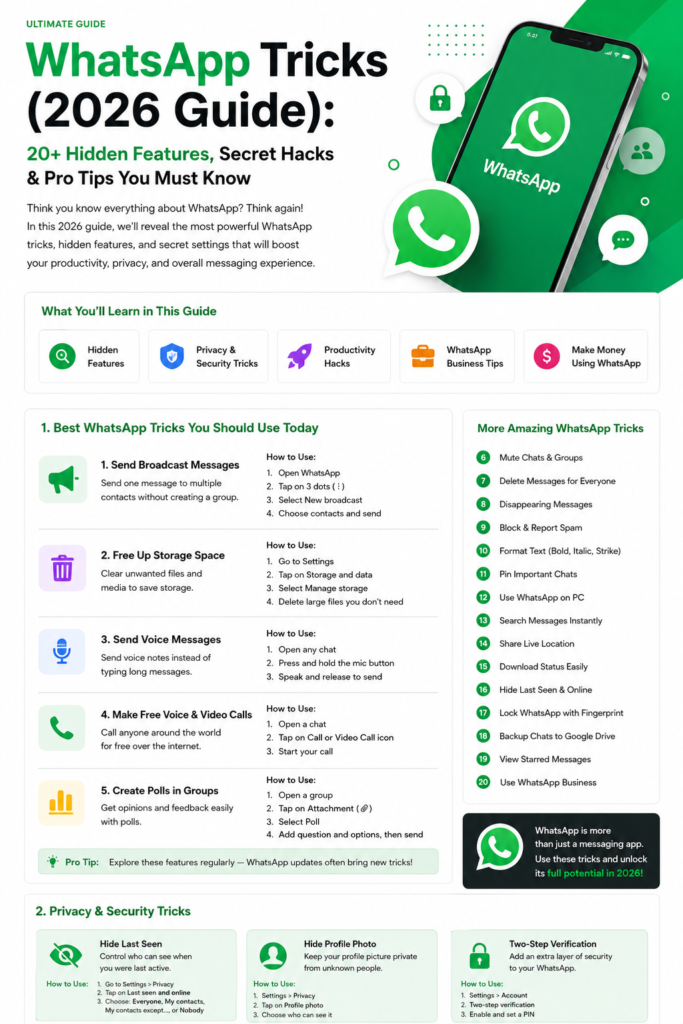
This is your complete WhatsApp privacy and security checklist: every important setting, where to find it, and what to choose. Ten minutes of setup today protects years of conversations. For more hidden features, see our WhatsApp hidden features guide and the 20 pro tricks guide.
Step 1: Lock Down Who Sees Your Info
Go to Settings → Privacy. This single screen controls most of your visibility. Here is what to set:
- Last seen and online: Set to “My contacts” or “Nobody.” Strangers do not need to know when you are awake. You can also hide “online” status separately while keeping last seen for contacts.
- Profile photo: “My contacts” at minimum. A public profile photo lets anyone — including scammers — download your picture.
- About: “My contacts.” Your about line often contains personal details people forget are public.
- Status: “My contacts” or “My contacts except…” to exclude specific people. Remember: anyone who can view your status can screenshot it.
- Read receipts (blue ticks): Turning these off stops senders seeing when you read messages — but you also lose read receipts for others. Your call; many privacy-conscious users disable them.
Step 2: Control Groups and Calls
- Groups: Set to “My contacts” so random strangers cannot add you to spam or scam groups. This single setting blocks the most common WhatsApp annoyance.
- Live location: Share only when truly needed, for the shortest duration, and only with trusted contacts. Never share live location in groups.
- Silence unknown callers: In Privacy → Calls, enable “Silence unknown callers.” Scam and spam calls get silenced automatically while still appearing in your call log.
Step 3: Chat Lock and Disappearing Messages
Chat Lock for Sensitive Conversations
Long-press any chat → Lock chat. Locked chats move to a separate locked folder, hidden from the main chat list and protected by your phone’s biometric lock. Use it for financial discussions, private family matters, or anything you would not want seen if someone borrows your phone.
Disappearing Messages
Enable for chats where history should not pile up: open the chat → contact/group name → Disappearing messages → choose 24 hours, 7 days, or 90 days. You can also set it as the default for all new chats under Privacy → Default message timer.
Important honesty note: disappearing messages do not prevent screenshots or forwarding before they vanish. They reduce your digital footprint; they do not make a chat leak-proof.
Step 4: Secure Your Account Itself
Privacy settings mean nothing if someone hijacks your account. Do these three things:
- Enable two-step verification: Settings → Account → Two-step verification → Turn on. Set a 6-digit PIN. This is the single most important security step — without it, someone with access to your SMS can take over your WhatsApp. WhatsApp’s official two-step verification guide explains how it works.
- Never share verification codes: WhatsApp will NEVER ask for your 6-digit registration code. Anyone asking for it — even claiming to be “WhatsApp support” — is a scammer. This is how most account hijacks happen.
- Check linked devices regularly: Settings → Linked devices. Remove any device you do not recognize. If you use WhatsApp Web on a shared computer, always log out when done.
Step 5: Media and Backup Privacy
- View-once media: For sensitive photos or videos, tap the “1” icon before sending — the media can be opened once and then disappears. Again, screenshots are still possible, so use it for convenience, not for truly sensitive material.
- End-to-end encrypted backups: Your chats are encrypted in transit, but cloud backups (Google Drive/iCloud) historically were not. Turn on end-to-end encrypted backup under Settings → Chats → Chat backup. Set a password or 64-digit key and store it somewhere safe — lose it and the backup is unrecoverable.
- Auto-download: Turn off auto-download for media on mobile data (Settings → Storage and data). This saves storage and stops unwanted media from landing in your gallery. Pair this with good phone management habits to keep your device clean.
Step 6: Run the Privacy Checkup
WhatsApp includes a built-in Privacy Checkup (Settings → Privacy → Privacy checkup) that walks you through the key settings in guided steps. Run it every few months — WhatsApp adds new privacy features regularly, and defaults can change with updates.
Spotting WhatsApp Scams in 2026
Privacy settings cannot protect you from your own clicks. Watch for these:
- “Hi, this is your bank / courier / a relative in trouble” — unexpected urgent messages asking for money or codes are scams. Verify through a separate channel.
- Job offers and investment schemes from unknown numbers — the fastest-growing scam category on WhatsApp.
- Forwarded “free” offers (free recharge, lottery wins) that ask you to forward to 10 contacts — classic chain scams that harvest your contacts.
- Fake WhatsApp Web QR codes on phishing sites — only scan QR codes from the official web.whatsapp.com page.
Rule: if a message creates urgency + asks for money, codes, or personal details, stop and verify independently.
FAQs
1. Is WhatsApp really private? Messages are end-to-end encrypted, meaning WhatsApp itself cannot read them. But metadata (who you message, when) is visible, and backups need encryption enabled separately. It is private enough for everyday use when configured properly.
2. Can someone read my WhatsApp without my phone? Only through linked devices (WhatsApp Web/Desktop) or account hijacking via your SMS code. Check linked devices regularly and enable two-step verification to block both.
3. What does Chat Lock actually do? It moves the chat to a locked folder hidden from your chat list, requiring fingerprint/face unlock to open. Notifications from locked chats also hide message previews.
4. If I turn off read receipts, can I still see others’ blue ticks in groups? In group chats, read receipts always show regardless of your setting. The setting only affects one-to-one chats.
5. Are disappearing messages truly gone? They are deleted from devices after the timer, but recipients can screenshot, copy, or forward content before it disappears. Treat them as footprint-reduction, not a guarantee.
6. What happens if I forget my two-step verification PIN? WhatsApp periodically asks for the PIN to help you remember it. If you fully forget it, you can reset it via your registered email (if you added one) — which is why adding a recovery email is important.
7. Can admins see my messages in WhatsApp groups? No — group messages are also end-to-end encrypted. But any member can screenshot and share them, so never treat group chats as truly private.
8. Should I use WhatsApp’s encrypted backup? Yes, if you care about privacy. Without it, your chat backup on Google Drive or iCloud is not protected by end-to-end encryption. Enable it under Settings → Chats → Chat backup.
9. How do I know if my WhatsApp is hacked? Signs: messages you did not send, unknown linked devices, contacts receiving spam from you, or being logged out unexpectedly. Immediately check linked devices, enable two-step verification, and re-register your number if needed.
10. Is WhatsApp Business less private than regular WhatsApp? Messages are equally encrypted. The difference: businesses may use third-party tools to manage chats, which can see those conversations. Check a business’s privacy practices before sharing sensitive info.
Conclusion
WhatsApp privacy in 2026 is a 10-minute project: restrict who sees your info, lock sensitive chats, enable disappearing messages where appropriate, turn on two-step verification, encrypt your backups, and run the Privacy Checkup regularly. None of these steps are difficult — they are just rarely done.
Do the checklist today, then share this guide with family members who need it most — they are usually the ones with everything set to public. What is the first setting you changed? Tell us in the comments.

Pingback: WhatsApp Business App 2026: Setup, Catalog & Broadcasts
Pingback: 15 WhatsApp Hidden Features & Tricks (2026)
Pingback: WhatsApp Disappearing Messages 2026: Setup Guide
Pingback: WhatsApp Group Admin Tips 2026: 10 Settings Every Admin Should Know - AppTricko
Pingback: WhatsApp Usernames 2026: How to Reserve Yours
Pingback: Meta AI on WhatsApp: 7 Useful Things You Can Do
Pingback: How to Use WhatsApp Chat Filters in 2026
Pingback: WhatsApp Backup in 2026: Save, Restore & Transfer Chats
Pingback: WhatsApp Payments 2026: How to Send Money Safely
Pingback: WhatsApp Multi-Device 2026: Use 1 Account on 4 Phones
Pingback: Two WhatsApp Accounts on One Phone (4 Methods)
Pingback: Message on WhatsApp Without Saving Number (2026)
Pingback: Hide Last Seen on WhatsApp 2026: Hide It From Anyone