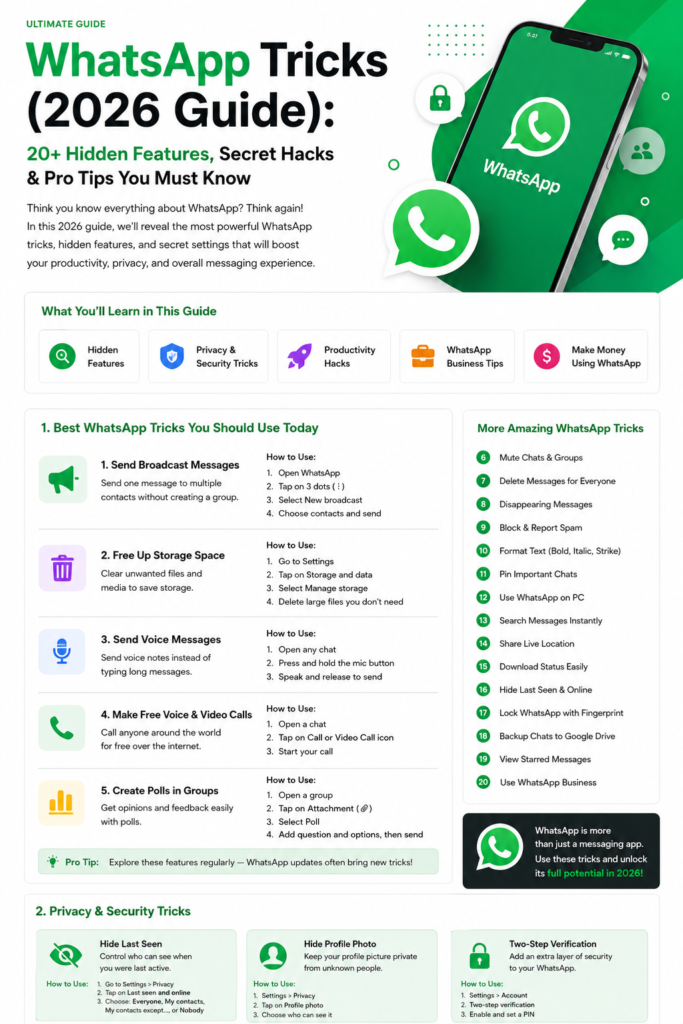
WhatsApp messages are easier to scan when important details stand out. You can format message text with simple characters—without installing a font app or text generator. This guide explains the supported styles, the exact symbols to type, how to use the formatting menu, and what to check when formatting does not appear.
WhatsApp’s official Help Center documents bold, italic, strikethrough, monospace, bulleted and numbered lists, quotes, and inline code. Availability of some newer options can vary by app and platform, so keep WhatsApp updated and check the current Help Center if a shortcut is missing.
WhatsApp text formatting codes at a glance
Type the opening and closing markers directly around the text. Do not add spaces between the marker and the words.
- Bold: one asterisk on each side:
*important* - Italic: one underscore on each side:
_important_ - Strikethrough: one tilde on each side:
~old price~ - Monospace: three backticks on each side:
```ORDER-123``` - Inline code: one backtick on each side:
`ORDER-123` - Bulleted list: begin a line with
-or* - Numbered list: begin a line with a number, period and space, such as
1. - Quote: begin a line with
>
How to make text bold in WhatsApp
Place an asterisk immediately before and after the words. For example, type Please arrive at *9 AM*. The words between the asterisks appear bold after sending. Use this for a deadline, appointment time, important instruction or a short heading.
How to write italic text
Put an underscore on both sides of the phrase. For example, type _Please confirm your booking_. Italics work well for a brief clarification or gentle emphasis. Avoid putting underscores inside identifiers or file names when you do not intend to format them.
How to use strikethrough
Surround the words with a tilde. For example, Price: ~₹500~ ₹399. This displays the crossed-out amount and the replacement amount. Use it only when the earlier price is genuine; do not imply a discount that is not real.
How to use monospace and inline code
Monospace uses three backticks before and after the text, for example ```AB-2048```. Inline code uses a single backtick on each side, for example `AB-2048`. Both use a fixed-width style and can help distinguish a short reference, command or code-like string.
Do not use chat formatting as a way to share sensitive information. Avoid sending passwords, one-time passcodes, banking credentials or private recovery codes in a chat, even if you display them in monospace.
How to create bullet and numbered lists
For a bulleted list, start each item on a new line with a hyphen and a space (or an asterisk and a space):
- Meeting point
- Arrival time
- Documents to bring
For a numbered list, start each line with a number, a full stop and a space:
- Open WhatsApp.
- Open the relevant chat.
- Type your message and send it.
Keep the marker at the beginning of the line and include the space after it. If WhatsApp displays the symbols literally, update the app and consult its Help Center; support for newer formatting options may differ across clients or rollouts.
How to add a quote and inline code
To format a quote, start a new line with a greater-than sign followed by a space, then type the quoted sentence. For example, type > Please share the updated file. This can help distinguish a quoted statement from your own reply.
For inline code, put a single backtick immediately before and after a short string, such as `INV-2048`. This is different from monospace, which uses three backticks. These formats are useful for exact text, but they do not encrypt or protect the information.
How to format text without typing symbols
WhatsApp also provides text-selection formatting shortcuts on supported clients. Type your message, select the words you want to change, and choose a formatting option from the menu if it appears. The exact gesture and menu labels can vary by device and app version. WhatsApp’s Help Center currently describes double-clicking selected text in the message field on WhatsApp Web and Mac desktop for its listed menu options.
If you do not see a formatting option, use the typing shortcuts above or check the latest instructions for your platform. The formatting menu may not expose every list or quote feature.
Can you combine WhatsApp text styles?
You can combine some styles by nesting their markers correctly. For example, *_Important update_* combines bold and italic. Keep the markers paired and close them in the reverse order in which you opened them. Test a short sample in a private chat if a combination does not render as expected.
Why WhatsApp formatting may not work
- There is a space inside the markers: use
*hello*, not* hello *. - The marker is missing: check that both the opening and closing characters are present.
- The list marker is not at the start: begin a fresh line with the marker and a following space.
- The wrong backtick count is used: monospace uses three; inline code uses one.
- The app is outdated: update WhatsApp and retry.
- The recipient’s client differs: rendering can vary with app version or feature availability. Check the message on an updated client.
- You are formatting a profile field: message formatting is not a general font setting for contact names, group names or every profile field.
Practical WhatsApp formatting examples
Group announcement
Use one short bold heading, then list the details on separate lines. Keep dates, locations and action items easy to scan.
Meeting notes
Use a numbered list for action items and bold the owner or due date. Star the message if you need to find it later.
Small-business customer message
Use bold for the product name and current price, and a bullet list for delivery or booking details. Make sure any crossed-out price is an authentic previous price.
You can also organise useful personal notes in your WhatsApp message-yourself chat, find older details with our guide to searching WhatsApp messages, or improve short updates with these WhatsApp Status tips.
Frequently asked questions
1. How do I make WhatsApp text bold?
Put one asterisk immediately before and after the words, like *Hello*. WhatsApp displays the enclosed text in bold.
2. How do I make text italic on WhatsApp?
Put an underscore on both sides of the text, like _Hello_, without spaces between the markers and the word.
3. What symbol is used for strikethrough?
Use a tilde on both sides, like ~old text~. The enclosed words appear crossed out.
4. How do I change WhatsApp text to monospace?
Put three backticks before and after the text. For a short inline-code phrase, use one backtick on each side instead.
5. Can I create bullet points in WhatsApp?
Start each new line with a hyphen and a space, or an asterisk and a space. If it remains plain text, update the app and check feature availability for your client.
6. How do I send a numbered list?
Start each item on a new line with a number, a period and a space, such as 1. First step.
7. How do I quote a message using text formatting?
Start a new line with > followed by the text you want to display as a quote. This is different from using WhatsApp’s reply-to-message feature.
8. Can I combine bold and italic?
Yes. One example is *_Important_*. Keep the markers correctly nested and directly next to the text.
9. Can I format text on WhatsApp Web?
Yes. WhatsApp’s Help Center documents text formatting on WhatsApp Web and Mac desktop, including a selection shortcut for supported styles. Exact menu options can vary.
10. Can I turn off WhatsApp text formatting?
WhatsApp’s Help Center says there is no option to disable this formatting feature. If you do not want a phrase formatted, avoid the matching marker pattern or reword it.
Final thoughts
WhatsApp formatting is simple once you remember the symbols: asterisks for bold, underscores for italics, tildes for strikethrough, backticks for monospace or inline code, and line starters for lists and quotes. Use formatting sparingly, keep messages concise, and verify newer options on your own app. For the latest platform-specific instructions, refer to the official WhatsApp text-formatting guide.