
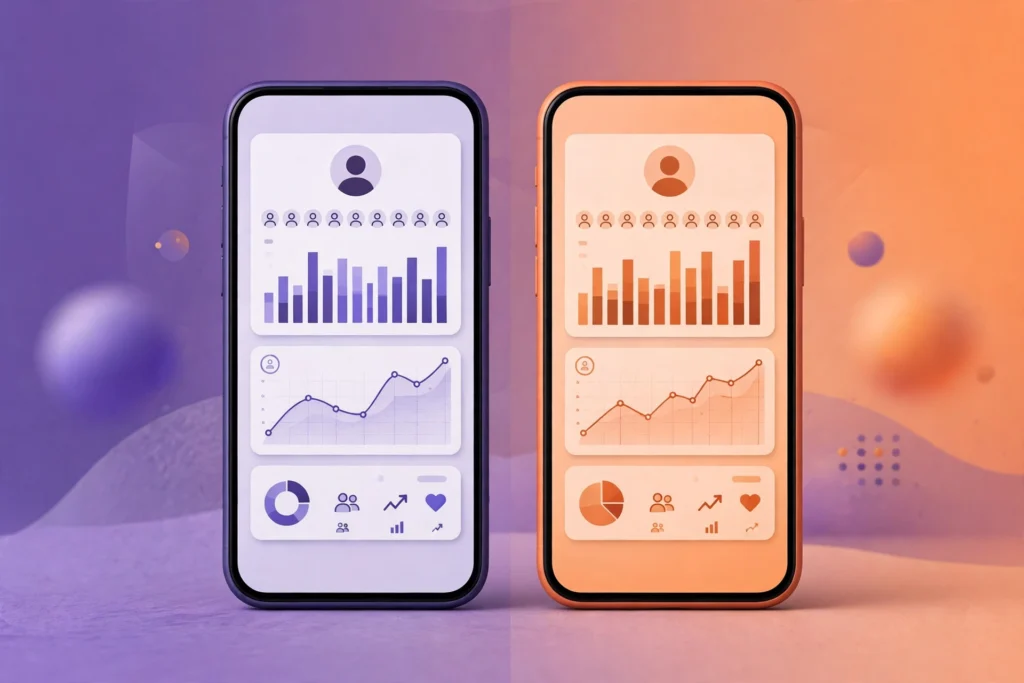
You’ve outgrown a personal Instagram account — maybe you’re posting reels regularly, brands are noticing, or you just want real analytics instead of guessing. Instagram offers two professional account types, Creator and Business, and picking the wrong one leads to months of small frustrations: missing buttons, blocked features, or a music library that suddenly shrinks. Here’s an honest comparison so you choose right the first time.
What Are Professional Accounts, Anyway?
A professional account is simply an Instagram account switched into “Creator” or “Business” mode. Both unlock the same core toolkit: Insights (analytics on reach, followers, and content performance), the ability to boost posts as ads, branded content tools, and access to the professional dashboard. The differences are in the details — category labels, contact options, messaging tools, shopping features, and music access.
Switching between professional types is free and can be reversed, but moving from a private personal account to professional makes the account public. So this decision is low-stakes — but getting it right saves you from discovering limitations at the worst moment (like mid-campaign).
Whichever you pick, your growth still depends on fundamentals: understanding the Instagram reels algorithm and knowing how to measure your engagement rate matter far more than the account label.
Creator Account: Best for Personal Brands
Instagram describes Creator accounts as best for public figures, content producers, artists and influencers. Choose this type when the account represents you as an individual and your main goal is publishing content, building an audience or working with brands.
- Professional dashboard and Insights: professional accounts get access to the dashboard and performance insights. Instagram does not publish a reliable rule that Creator accounts receive a separate, universally better analytics set.
- Profile identity: choose a category that describes your work, such as digital creator, artist or blogger. You can generally control whether the category label appears on your profile.
- Brand collaborations: eligible creators can use Instagram’s branded-content and creator partnership tools, subject to account and market eligibility.
- Music: do not assume every trending track is available. Music rights, country, post type and account status can affect the audio picker. Check the track’s availability and permitted use before publishing or promoting a Reel.
Business Account: Best for Companies and Services
Instagram recommends Business accounts for retailers, local businesses, brands, organizations and service providers. Choose this type when the account represents a company, shop, clinic, restaurant or service operation.
- Business identity: use a category and public contact details that help customers understand and reach the business. Review which phone number, email or address will be visible before displaying contact options.
- Customer actions: eligible businesses may connect supported partner tools for actions such as booking, ordering or reservations. Availability depends on the provider, location and account.
- Shopping and product catalogs: commerce tools are subject to Meta’s commerce eligibility, product, market and account requirements. Do not assume that switching to Business automatically unlocks a Shop or product tagging.
- Ads and management: professional accounts can promote eligible content. Meta Ads Manager and Business Suite access depends on connected assets, permissions and setup—not simply the label on the Instagram account.
- Music: Instagram says certain business accounts and certain types of posts may not access the licensed music library. Meta Sound Collection is an alternative for commercially usable audio.
Who Should Pick Which? 7 Real Scenarios
Choose Creator if you are:
- An aspiring influencer or content creator — you post reels, want trending audio, and monetize through brand deals. Choose Creator because it matches a personal creator brand—not because it guarantees every trending track.
- A freelancer, coach, or consultant — your face is the brand; you convert through DMs and content, not a storefront.
- An artist, musician, or performer — you need full audio access and category labels that describe creative work.
- A meme or theme page owner — growth comes from shareable reels with trending sounds.
Choose Business if you are:
- An online or local store — product tagging and Instagram Shopping turn your profile into a storefront. Non-negotiable.
- A restaurant, salon, clinic, or service business — customers need call buttons, directions, and booking links. Pair this with a well-optimized profile and your Instagram becomes a discovery engine.
- A brand running serious ad campaigns — if you’re spending real money on Meta ads, you want the Business account’s Ads Manager integration.
Edge case: a personal brand that also sells products (say, a fitness coach with a supplement line)? Choose the account type that represents the profile: Creator for your personal brand, Business for the company. Check product-tagging and music eligibility separately before making either feature central to your plan.
One more scenario: social media managers handling client accounts. Use the account type that matches the client—Business for a company or service, Creator for an individual personal brand—and manage permissions through Meta’s connected business assets.
How to Switch (It’s Reversible)
Switching is straightforward, but check privacy first: professional accounts cannot be private. If your personal account is private, switching to professional makes it public and may accept pending follow requests.
To switch in the app:
- Go to your profile, tap the menu (☰), then open Settings and activity.
- Under For professionals, tap Account type and tools (wording can vary by app version).
- Choose Switch to professional account, then pick Creator or Business.
- Select your category, and decide whether to display it on your profile.
You can change between Creator and Business later. Before switching a private personal account, review pending follow requests and the public contact details you plan to display. For the current steps, read Instagram’s official guides to professional accounts and setting up a professional account. For music restrictions, see its licensed music library guidance.
3 Myths That Refuse to Die
- “Business accounts get less reach.” Instagram has repeatedly said account type doesn’t determine distribution — content quality and engagement do. People notice reach drops after switching because they changed their posting behavior at the same time, not because of the label.
- “You need 10K followers for the professional dashboard.” The dashboard and basic Insights are not universally gated by a 10K follower threshold; individual monetization and commerce features can have separate eligibility rules.
- “Switching resets your algorithm standing.” Your content history and audience stay intact. What changes is the account type and associated setup; review available features after switching. As a bonus, switching unlocks the professional dashboard with account-status checks — useful for spotting restrictions before they hurt you.
One thing account type can’t fix: posting at dead hours. Whatever you choose, pair it with a smart posting-time strategy for your audience.
Wrap-Up: The 30-Second Decision Rule
Ask yourself one question: do you sell products or take bookings through Instagram? If the profile represents a company, shop or service, choose Business. If it represents you as a creator or public figure, choose Creator. Then check music, commerce and booking eligibility inside your own account. You’re a person building an audience? Creator. You’re a shop, restaurant, or service? Business. It takes a minute to switch and you can reverse it anytime, so don’t overthink it — pick the one that matches what you do, then get back to making content worth following.

Pingback: Does Instagram Notify When You Screenshot? 2026 Rules