
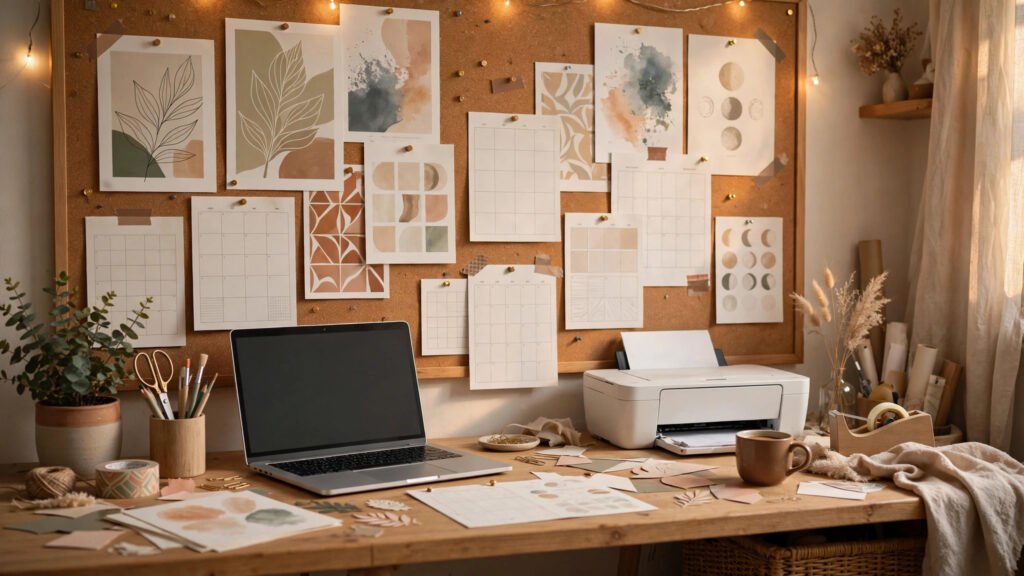
Of all the “sell digital products” ideas online, printables are one of the most beginner-friendly: digital files that customers download and print themselves — planners, wall art, calendars, checklists, kids’ worksheets. You design the file once, list it on Etsy, and every sale after that is nearly pure profit. No inventory, no shipping, no printer on your desk.
But let’s be honest up front: Etsy has thousands of printable shops, and most sell a handful of downloads. The sellers who earn real money treat it like a small business — picking a narrow niche, designing well, and optimizing their listings. Here’s the realistic path, step by step.
Why printables work for beginners
Three things make printables beginner-friendly. Zero startup cost: you can design everything with free tools and list on Etsy for a small listing fee. Skills you can learn in weeks: if you can use Canva, you can make printables. Truly passive after launch: unlike custom design work, a good listing sells while you sleep — much like other digital products, but with Etsy’s built-in buyer traffic doing the marketing.
Step 1: Pick a narrow niche that sells
Don’t start with “what can I design?” Start with “what do people already buy?” On Etsy, the niches with proven demand include:
- Planners and organizers: budget planners, meal planners, wedding planning checklists, teacher planners.
- Wall art: nursery prints, minimalist quotes, boho abstract sets — sold as instant-download bundles.
- Kids’ printables: chore charts, reward charts, educational worksheets, party games.
- Business templates: social media templates, invoice templates, real-estate flyers.
Browse Etsy’s search results in your niche and look for shops with hundreds of reviews on similar items — reviews signal buyers, not just browsers. Go narrow: “planners” is a bloodbath; “ADHD-friendly daily planner for college students” is a market you can actually serve.
Step 2: Design the product
You don’t need expensive software. Canva’s free tier handles 90% of printable design: clean layouts, good fonts, and professional-looking pages. A few design rules that separate sellers from strugglers:
- Clean beats fancy. Buyers print these at home — busy backgrounds waste their ink and look bad. White space is your friend.
- Test-print everything. Print every page on a regular home printer before listing. Colors shift, margins crop, and typos hide on screen.
- Bundle for value. A 20-page planner bundle at $9.99 outsells a single-page checklist at $1.99 — higher perceived value, same design effort.
If physical products interest you too, print-on-demand uses the same design skills with a completely different fulfillment model.
Step 3: Open your Etsy shop
Opening a shop is straightforward at Etsy’s Help Center (etsy.com), which documents current fees and policies — read the seller handbook before you list, because Etsy’s fee structure (listing fees, transaction fees, payment processing) determines your real profit:
- Shop name: short, memorable, niche-related. Check that the name isn’t trademarked.
- Listings: use all available photo slots — mockups of your printable in a styled room or on a desk sell far better than flat screenshots.
- Keywords: Etsy’s search is your storefront. Put your exact buyer phrases in the title’s first 55 characters and fill all 13 tag slots with specific long-tail phrases (“minimalist budget planner printable,” not “planner”).
- Pricing: check what comparable bundles sell for — usually $3–$15. Price too low and buyers assume low quality.
Step 4: Deliver files buyers love
The product isn’t just the design — it’s the whole experience:
- Include clear printing instructions. A simple one-page PDF explaining paper size, print settings, and how to resize saves you from refund requests.
- Offer multiple sizes. US Letter + A4 at minimum; wall art should include common frame ratios (4:5, 3:4, 2:3).
- High resolution only. 300 DPI, no exceptions. Blurry prints become one-star reviews.
How the money actually works (no hype)
Here’s the honest math. A $7.99 printable bundle on Etsy nets you roughly $6 after Etsy’s fees. Sell 10 a month and that’s about $60 — nice pocket money, not a salary. The realistic path to meaningful income is a catalog: 30–50 quality listings in one niche, each pulling steady sales, with seasonal spikes (wedding season, back-to-school, New Year planners) doing the heavy lifting.
Nobody can promise you a figure — anyone who does is selling you something. What printables do offer is a genuine low-cost way to learn e-commerce: design, SEO, pricing, and customer service, all on one platform.
Honest caveats before you start
- It’s slower than gurus claim. Designing, listing, and optimizing 30 products realistically takes 2–3 months.
- Etsy fees add up. Listing fees, transaction fees, and payment processing take a real cut — price accordingly.
- Copyright is a minefield. Never use Disney characters, song lyrics, brand logos, or “inspired by” designs — Etsy removes listings and closes shops for infringement.
- Reviews are everything. One star review from a buyer who didn’t read the instructions can tank a listing. Over-communicate in your listing text and instructions.
The bottom line
Selling printables on Etsy in 2026 is genuinely one of the most accessible online businesses: nearly free to start, no inventory, and real profit per sale. The realistic playbook is unglamorous — pick a narrow niche, design clean useful files, optimize your listings for Etsy’s search, and build a catalog. Do that patiently and you’ll have a small asset that earns while you sleep.
Have you opened an Etsy shop, or are you designing your first printable? Share your niche in the comments — and keep following AppTricko.