How to Find Mockingbirds in GTA 6: The Complete Guide (2026)
Quick Answer: How to find mockingbirds in GTA 6: start on Key Lento, right around Jason’s house, or on the small island west of Naval Air Station Goose Key. GameSpot’s wildlife guide lists those as the best Mariana County spots, with the western part of Draper Island in Kelly County and the north and east of the mainland in Lummox County as the other two. Look for a small gray-brown songbird with a long tail and white wing patches, perched high on a branch or wire and singing loudly. Study it with binoculars (hold L2 or LT, zoom with the D-pad, hold R1 or RB until the meter fills) to log it for 100% completion. Mockingbirds are study-only birds, so there is no hunting, no Bret payout and no carcass to sell.
Grand Theft Auto VI launched on November 19, 2026 for PlayStation 5 and Xbox Series X/S, and its wildlife log tracks 255 animals — with 100 studied species needed for 100% completion. Sixty of those animals are birds, and one of the most familiar of them is the northern mockingbird. It is Florida’s state bird, a small gray-brown songbird famous in the real world for copying the songs of other birds, and in GTA 6 it is entry number 38 of the 60 birds in the log. The in-game description reads: “A small gray-brown bird famed for its intelligence and mimicry, northern mockingbirds can be seen squabbling in forests across Leonida, particularly in northern regions.” This guide explains how to find mockingbirds in GTA 6 step by step: the three spots the guides agree on, how to tell a mockingbird from the blue jay and the robin that share its bushes, the study steps that actually log one, and the honest limits — including the things no guide has published yet. Everything below comes from the published guides, and every gap is labelled as a gap rather than filled in with a guess.
How to Find Mockingbirds in GTA 6: The Three Spots
The table below is the short version. Everything after it is the step-by-step detail. The spot facts come from GameSpot’s all-animals wildlife guide, the PowerPyx all-birds list, the Dexerto northern mockingbird wiki page and the Audubon field guide to Leonida’s birds.
| Fact | What the guides say |
|---|---|
| Animal | Northern Mockingbird, bird number 38 of 60 in the Birds tab |
| Habitat | Forests, most of all in the north; also open areas with shrubs and trees |
| Best spots | Key Lento anywhere, or the island west of Naval Air Station Goose Key; western Draper Island; north and east Lummox mainland |
| Rarity | Common — one of the easiest birds in the log to find |
| Threat | Not dangerous — a small songbird that squabbles with other birds |
| Hunting | Study-only — not on Bret’s 61-animal hunting list |
| Study | Binoculars, hold L2 or LT + R1 or RB |
| Behaviour | Perches high on branches, wires and fences; sings loudly, often copying other birds; squabbles in forests |
| Log entry | “A small gray-brown bird famed for its intelligence and mimicry, northern mockingbirds can be seen squabbling in forests across Leonida, particularly in northern regions.” |
A few honest notes before the spots. First, there is no dedicated mockingbird guide anywhere. The search results for this topic return GameSpot’s wildlife list with one table row per county, the PowerPyx all-birds list, a Dexerto wiki page, the gamesdb birds database and the Audubon field guide — and the WIRED piece about GTA 6 being a birder’s paradise, in which a real birder spotted northern mockingbirds north of the city. No site has written a how-to-find guide for mockingbirds on its own. That is the whole point of this article: it is the first guide that treats mockingbirds as a topic of their own. Second, the spots are county-level, not pinned points. GameSpot says “either anywhere on Key Lento or the island west of Naval Air Station Goose Key” for Mariana County, “western part of Draper Island” for Kelly County and “best located toward the north and east of the mainland” for Lummox County. That is a search area, not a walk to a marker — but the mockingbird is a common bird, and Key Lento is small, so the search is short. Third, mockingbirds are study-only. They are not among the four huntable birds in GTA 6 — those are the Leonida Wild Turkey, the Leonida Wild White Tom, the Mottled Duck and the Mosaic Mottled Duck — so there is no Bret payout, no carcass price and no Target Deck for one. And fourth, the mockingbird is the Florida state bird. The northern mockingbird has been Florida’s state bird since 1927, which is exactly why it is everywhere in Leonida — and why it is one of the first birds most players will log without even trying.
What a Mockingbird Looks Like
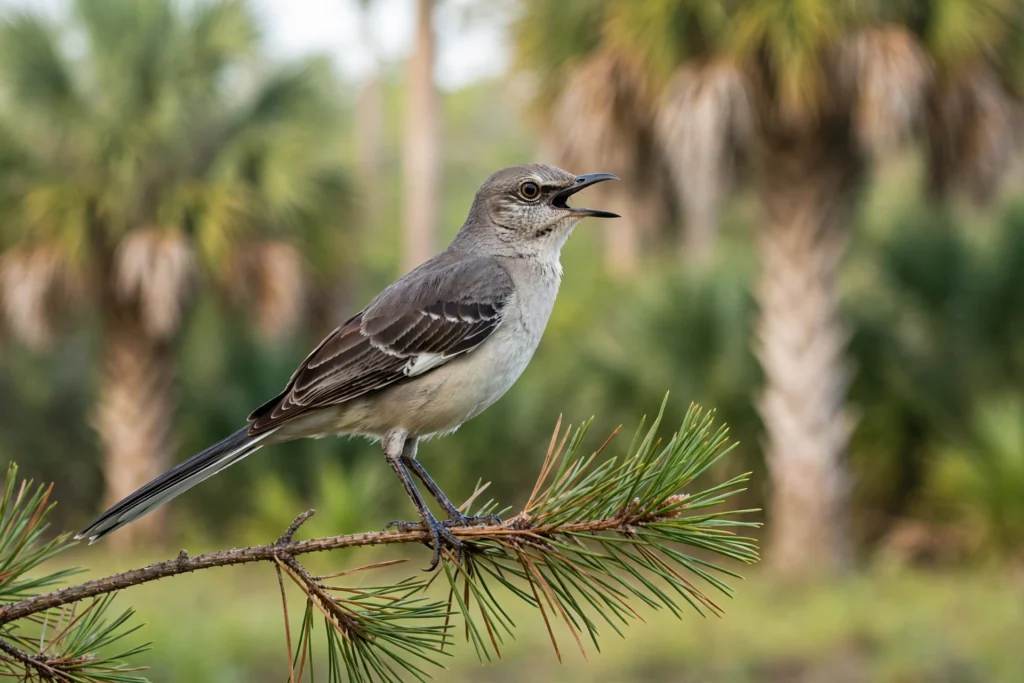
The mockingbird is a small gray-brown bird, and the field marks are the long tail, the pale belly and the white wing patches. Its upperparts are gray, its belly is almost white, and its long tail is dark with white outer feathers. The giveaway in flight is the pair of white patches on the wings — they flash clearly when the bird takes off or lands, and no other common songbird in Leonida shows them the same way. It also has a thin dark line through the eye and a slightly downcurved bill. On the ground it hops and flicks its tail upward; on a perch it sits upright and sings.
The sound is the fastest way to find one. In the real world, a mockingbird can learn more than 200 songs — its own, plus the songs of other birds, car alarms, sirens and anything else it hears often enough — and it repeats each phrase several times before moving on to the next. No guide has confirmed the in-game call yet, so treat this as a tip rather than a fact, but if you hear a loud, varied song coming from the top of a bush or a telephone wire, with the same phrase repeated three or four times, stop and look up. A mockingbird sings from the highest perch it can find, and it sings all day — and in the real world, males sing at night too, especially on bright moonlit nights. If the bird on the wire is gray, long-tailed and singing its heart out, you are probably looking at a mockingbird.
One more identification trap to avoid. Before you study a bird, the game shows only its group name — and small gray-brown birds all look alike at a distance. The blue jay is the one most players confuse with the mockingbird at first glance, because it is roughly the same size and also perches in the open. But the blue jay is bright blue with a crest and a black necklace, while the mockingbird is plain gray-brown with no crest at all. The American robin has a red-orange breast. The mockingbird has neither colour — gray on top, pale underneath, white wing patches, long tail. If it is gray and singing, it is a mockingbird.
Before You Go: What You Need
Mockingbirds reward a walk and a pair of binoculars more than anything else, so get these three things right before you start searching.
Bring binoculars, and you already have them. The binoculars unlock automatically early in Chapter 1, before the very first mission, and they live in the bottom-right equipment slot of the weapon wheel. Hold L1 or LB to open the wheel, highlight the binoculars with the right stick, and release. Then hold L2 or LT to look through them, use Up and Down on the D-pad to zoom, centre the reticle on the bird, and hold R1 or RB until the study meter fills. Mockingbirds perch high and they are small, so you will usually spot one on a wire or a treetop long before you could walk up to it — the binoculars are the only reliable way to study one at that distance. If you have not picked the game up yet, a Grand Theft Auto VI for PS5 is the obvious starting point, and the mockingbird is one of the most satisfying birds to log first because it is so common once you know where to look.
As an Amazon Associate, we earn from qualifying purchases.
Bring your ears too. The mockingbird is named for its mimicry, and its song is the loudest clue in the game. No guide has confirmed the in-game call yet, so treat this as a tip rather than a fact, but if you hear a loud, varied song with repeated phrases coming from the top of a bush, stop and scan the branches. A BENGOO G9000 gaming headset helps here — Leonida’s ambience is full of insects, traffic and waves, and headphones make a distant bird song much easier to pick out than TV speakers do.
As an Amazon Associate, we earn from qualifying purchases.
Go north, not to the city. Mockingbirds live in forests and open areas with shrubs, “particularly in northern regions” according to the in-game log entry. Every guide agrees on the habitat: forests, most of all in the north. The wading birds guide covers the same northern ground for herons, egrets, ibises and spoonbills, and the mockingbird shares those woods — it is simply far more common than the rest. Do not waste time scanning Vice City rooftops or the Leonida Keys beaches. Pick a forested spot in the north, walk slowly, and listen for the song.
How to Study a Mockingbird
The study steps are the same for every bird in GTA 6, and they are the only way to log a mockingbird — there is no other interaction with one.
- Find the bird first. Walk the spot slowly and listen. A mockingbird sings from a high perch — the top of a bush, a fence post, a telephone wire or a low branch — and the song is loud enough to hear from a long way off. If you hear it, stop moving and look for the gray bird on the highest perch nearby.
- Open the binoculars. Hold L1 or LB to open the weapon wheel, highlight the binoculars in the bottom-right equipment slot with the right stick, and release. The binoculars unlock automatically early in Chapter 1, before the first mission, so you already have them.
- Zoom in and hold the study. Hold L2 or LT to look through the binoculars, use Up and Down on the D-pad to zoom, and centre the reticle on the bird. When the Study prompt appears, hold R1 or RB until the meter fills. The game logs the bird as Northern Mockingbird, entry 38 of 60 in the Birds tab.
- Check the log. Open the pause menu, go to Progress, then Animals, then Birds, and confirm the mockingbird entry is filled in. One hundred of the 255 animals studied counts toward 100% completion, and the mockingbird is one of the easiest of the 60 birds to tick off.
- Do not shoot it. Mockingbirds are study-only. They are not on Bret Vogel’s 61-animal hunting list, so there is no carcass to sell, no Bret payout and no Target Deck for one. Shooting a mockingbird wastes ammo and logs nothing.
If the study prompt does not appear, you are probably too far away or the bird is behind a branch. Move closer slowly — mockingbirds are not especially shy, but sprinting straight at one will spook it — or study from the binoculars at a longer zoom. If the bird flies off, stay where you are: mockingbirds are territorial and often return to the same perch within a minute or two.
Spot 1: Key Lento — The Easiest Mockingbird in the Game
Key Lento is the best place to find your first mockingbird, and it is also the place the Audubon field guide starts its whole 60-bird route. The ornithologist Nicholas Lund, writing for Audubon, found his first birds in Jason’s Key Lento backyard — American Crow, House Sparrow, Monk Parakeet, Brown Pelican, Laughing Gull, Herring Gull and Double-crested Cormorant — and the WIRED birder’s piece reports northern mockingbirds a little further north, in the pine-covered areas past the city, alongside American robins and red-cockaded woodpeckers. GameSpot agrees: for Mariana County it lists the mockingbird as “either anywhere on Key Lento or the island west of Naval Air Station Goose Key”.
Here is the route:
- Start at Jason’s house. Walk out into the backyard and the streets around it, and scan the wires, fences and low trees. The crows guide starts in exactly the same place, because the same backyard holds half a dozen common birds at once.
- Walk the whole island slowly. Key Lento is small, and GameSpot’s “anywhere on Key Lento” is literal — the bird is not tied to one garden or one street. Walk the residential streets, the scrubby edges and the tree lines, and listen for the song. If you hear a loud, repeating song from a rooftop or a wire, you have probably found one.
- Check the pines and the scrub. The in-game log says mockingbirds squabble “in forests across Leonida”, and on Key Lento that means the pine stands and the scrubby patches between the houses. The woodpeckers guide puts the red-bellied woodpecker near Jason’s house too, and the blue jay as well — so a slow walk around the house can log three birds in one trip.
- Study from the binoculars, not on foot. Mockingbirds perch high. Do not try to walk up to one — hold L2 or LT, zoom with the D-pad, and hold R1 or RB until the meter fills.
If Key Lento gives you nothing after a full walk, try the island west of Naval Air Station Goose Key, which GameSpot lists as the other Mariana County spot. It is a small island off the west side of the base, reachable by boat or by swimming from the Key Lento side, and the same open-forest habitat applies. No guide has published a pinned point on the island, so walk its tree line and listen for the song.
Spot 2: Draper Island — The Kelly County Spot
Draper Island is the second confirmed spot, and the only one GameSpot pins to a part of an island rather than a whole county. For Kelly County it lists the mockingbird as “western part of Draper Island”. Draper Island sits off the Kelly County coast, and the western side is the forested half — the side the log entry means when it says “forests across Leonida, particularly in northern regions”.
Here is the route:
- Get to Draper Island. Take a boat from the Kelly County coast — the same kind of small boat run the speedboat guide covers — or swim from the nearest shore if you are close. The island is small enough to walk in a few minutes.
- Work the western tree line. Walk the western half of the island slowly, scanning the trees and the scrub. The mockingbird’s song is the best guide here: in a quiet island forest, a loud repeating song carries a long way, and it will tell you where to look before your eyes do.
- Check the wires and the fences. Mockingbirds love a high perch with a view, and on a small island that means any wire, fence post or dead branch at the edge of the trees. If a gray bird with a long tail is sitting on the highest thing around and singing, study it.
- Combine the trip. Draper Island is also on the route for other northern birds, so a slow walk with the binoculars out is rarely wasted. The whooping cranes guide covers the wetlands on the same side of the map, and the osprey guide covers the coastal raptors that share these shores.
If the western half of Draper Island is quiet, give it a few in-game hours and come back. Birds in GTA 6 move around their habitat rather than sitting on fixed perches, and a mockingbird that is not on the western tree line at noon may be singing from it at dawn. No guide has published a time-of-day window for mockingbirds, so this is a practical tip, not a confirmed rule — but patience beats a second trip to a different island.
Spot 3: Northern Lummox — The Mainland Forest
The third spot is the largest and the least precise: GameSpot lists the mockingbird for Lummox County as “best located toward the north and east of the mainland”. That is the log entry’s “particularly in northern regions” in plain language — the northern forests of the mainland, where the pine woods are thickest.
Here is the route:
- Head for the northern mainland. Drive north and east in Lummox County, toward the forested country around Mount Kalaga National Park. The park itself is the best-known forest in the game, and the Audubon field guide’s birder found northern mockingbirds in the pine-covered areas north of the city, alongside red-cockaded woodpeckers.
- Walk the forest edges, not the deep woods. Mockingbirds like edges — where forest meets clearing, road or field — because that is where they sing from a high perch and watch their territory. Walk the roads and trails at the edge of the woods, and listen.
- Use the song as a compass. In a big forest, the mockingbird’s song is worth more than your eyes. Walk until you hear a loud, varied song with repeated phrases, then stop and scan the tallest nearby perch. The bird will be on it.
- Check the same-trip birds. The northern forests hold the red-bellied and red-cockaded woodpeckers, the blue jay and the turkey vulture cluster east of Farmer Scrumpy’s Apple Orchard — all covered in the woodpeckers guide and the vultures guide. A slow forest walk with the binoculars out can log several birds at once.
The honest limit on this spot is that no guide has published a pinned point in northern Lummox. GameSpot’s “north and east of the mainland” is a region, not a location, and the gamesdb entry only repeats the log line about forests in northern regions. That is normal for a common bird — nobody pins a bird you can find on your own street — but it means this spot is a search, not a walk to a marker. The good news is that the mockingbird is common, so the search is short.
Mockingbird vs Blue Jay vs Robin
Three common songbirds share the mockingbird’s bushes, and they are easy to confuse at a distance. This table sorts them out.
| Bird | Colour | Crest | Tail | Song | Where |
|---|---|---|---|---|---|
| Northern Mockingbird | Gray-brown on top, pale underneath | None | Long, dark with white outer feathers | Loud, varied, repeats each phrase several times | Forests, most of all in the north; Key Lento, Draper Island, northern Lummox |
| Blue Jay | Bright blue on top, white underneath, black necklace | Yes, obvious blue crest | Medium, blue with black bars | Harsh jay-jay calls, mimics hawks | Common across the whole county; Key Lento near Jason’s house, east of Port Gellhorn near the Kelly River North bridge |
| American Robin | Gray-brown on top, red-orange breast | None | Medium, dark | Cheerful carol, repeated phrases | Lawns, parks and gardens across Leonida |
The quick test is colour and crest. If the bird is bright blue with a crest, it is a blue jay. If it has a red-orange breast, it is a robin. If it is plain gray-brown with a long tail, white wing patches and no crest, and it is singing loudly from the highest perch around, it is a mockingbird. And if you are still unsure, study it anyway — the log will tell you what it is, and an unstudied bird shows only its group name until you do.
The Florida State Bird Angle
The northern mockingbird has been Florida’s state bird since 1927, and that is not a coincidence in a game set in a fictional Florida. Rockstar filled Leonida with the birds a real Florida birder would expect — brown pelicans, laughing gulls, great blue herons, ospreys, red-cockaded woodpeckers — and the mockingbird is the most Floridian of them all. The WIRED piece about GTA 6 being a birder’s paradise makes the point directly: the game’s birds are accurate enough that a working ornithologist could identify them by shape and plumage, and the northern mockingbird was one of the first birds he spotted once he drove north of the city.
In the real world, the mockingbird’s fame comes from its voice. A single male can learn more than 200 songs in his lifetime — his own song plus the songs of other birds, and the sounds of his neighbourhood, from car alarms to barking dogs — and he sings them in long, loud sets, repeating each phrase several times before moving on. That is why the bird is named for mimicry, and it is also why the in-game log entry calls it “famed for its intelligence and mimicry”. Real-world mockingbirds are also famously aggressive about their territory: they will dive-bomb cats, dogs and people who come too close to a nest, and they chase much larger birds out of their patch. The in-game log entry’s “squabbling in forests” is the same behaviour, scaled down to a game where the bird cannot actually attack you. None of that is a gameplay mechanic — it is real-world background, labelled as such — but it explains why this plain gray bird is the state bird of Florida and why it is worth logging.
Same-Trip Birds: Log Four Birds on One Walk
Because the mockingbird shares its habitat with half the common birds in the log, a single slow walk can log several species at once. Here is the best combination, starting on Key Lento.
- Northern Mockingbird — the bird this guide is about. Walk Key Lento, listen for the song, study from the binoculars.
- American Crow — the same backyard. The crows guide starts in Jason’s Key Lento backyard, where Audubon’s birder found his first seven birds, and the crow is one of them.
- Blue Jay — bright blue, crested, and common on Key Lento near Jason’s house. If you see a flash of blue on the same walk, study it — it is a different log entry.
- Red-Bellied Woodpecker — also near Jason’s house, and the woodpeckers guide lists it as one of the six GameSpot pinned spots in that area.
Further north, the same walk adds the red-cockaded woodpecker, the turkey vulture cluster east of Farmer Scrumpy’s Apple Orchard and the golden eagle soaring over Mount Kalaga — all covered in the woodpeckers, vultures and eagles guides. The point is simple: do not go out for one bird. Go out with the binoculars, walk slowly, study everything gray, blue or brown that perches in the open, and the mockingbird will usually be the first one you log.
Honest Gaps: What No Guide Has Published Yet
A good guide says what it does not know. Here are the gaps for the mockingbird, stated plainly.
- No pinned map point. No guide has published an exact map pin for a mockingbird. GameSpot’s spots are county-level — “anywhere on Key Lento”, “western part of Draper Island”, “north and east of the mainland” — and the Dexerto wiki page and the gamesdb entry only repeat the log line. The bird is common, so the search is short, but nobody has pinned one.
- No published time-of-day window. No guide says mockingbirds are better at dawn, at night or at any particular hour. In the real world they sing all day and males sing at night, especially on bright moonlit nights, but that is real-world behaviour, not a confirmed in-game schedule.
- No published call or sound cue. No guide has confirmed what the mockingbird sounds like in-game, or whether its mimicry is actually audible. The song tip in this guide is real-world background, not a confirmed mechanic.
- No published Wildland Zoo appearance. The zoo holds escaped and captive birds — peacocks, flamingos, parrots — but no guide lists a mockingbird in the aviary, and the Audubon field guide does not put one there either.
- No hunting interaction. Mockingbirds are study-only. They are not on Bret Vogel’s 61-animal hunting list, so there is no carcass price, no Bret payout, no Target Deck and no pristine-carcass rule for one. The four huntable birds are the Leonida Wild Turkey, the Leonida Wild White Tom, the Mottled Duck and the Mosaic Mottled Duck.
If a later guide pins a mockingbird spot or confirms a time window, this article should be updated. Until then, the three spots above are the best published information there is.
Frequently Asked Questions
How to find mockingbirds in GTA 6 quickly?
Go to Key Lento and walk the streets around Jason’s house, listening for a loud, repeating song from a high perch. GameSpot lists Key Lento as the best Mariana County spot, and it is the smallest search area in the game. If Key Lento is quiet, try the island west of Naval Air Station Goose Key, the western part of Draper Island, or the northern forests of the Lummox mainland.
Where is the best mockingbird spot in GTA 6?
Key Lento, anywhere on the island. It is the only spot GameSpot describes as “anywhere”, it is where the Audubon field guide starts its 60-bird route, and it is small enough to walk in a few minutes. The same walk can also log the American crow, the blue jay and the red-bellied woodpecker.
Can you hunt mockingbirds in GTA 6?
No. Mockingbirds are study-only birds. They are not on Bret Vogel’s 61-animal hunting list, so there is no carcass to sell and no Bret payout. The four huntable birds are the Leonida Wild Turkey, the Leonida Wild White Tom, the Mottled Duck and the Mosaic Mottled Duck. Study the mockingbird with binoculars instead — hold L2 or LT, zoom with the D-pad, hold R1 or RB until the meter fills.
What does a mockingbird look like in GTA 6?
A small gray-brown bird with a pale belly, a long dark tail with white outer feathers, and white patches on the wings that flash in flight. It has a thin dark line through the eye and no crest. It perches high — on branches, wires and fence posts — and sings loudly. Before you study it, the game shows only its group name, so study it to log it as Northern Mockingbird, entry 38 of 60 birds.
Is the mockingbird Florida’s state bird?
Yes. The northern mockingbird has been Florida’s state bird since 1927, which is why it is so common in Leonida. In the real world it is famous for copying the songs of other birds — a single male can learn more than 200 songs — and for defending its territory aggressively. The in-game log entry calls it “famed for its intelligence and mimicry” for the same reason.

Dr Vivek Garg runs drviram.in — a tech blog about AI tools, apps, and online earning. Every guide here is tested hands-on before it is published.