How to Find Whooping Cranes in GTA 6: The Complete Guide (2026)
Quick Answer: How to find whooping cranes in GTA 6: go to the wetlands, not the city. The whooping crane lives in the Grassrivers swamps of Mariana County, in Buckskin Swamp in Kelly County, along the coastal areas of Lummox County, and in Mount Kalaga National Park. Look for a tall white wading bird with black-tipped wings and a red splash on its forehead, standing in shallow water. Study it with binoculars (hold L2 or LT, zoom with the D-pad, hold R1 or RB until the meter fills) to log it for 100% completion. Whooping cranes are study-only birds, so there is no hunting, no Bret payout and no carcass to sell.
Grand Theft Auto VI launched on November 19, 2026 for PlayStation 5 and Xbox Series X/S, and its wildlife log tracks 255 animals — with 100 studied species needed for 100% completion. Sixty of those animals are birds, and one of the rarest and tallest of them is the whooping crane. It is the tallest bird in North America, a white wading bird that was driven nearly to extinction in the real world and brought back by decades of recovery work, including an experimental non-migratory flock established in Florida. In GTA 6 it is a documented entry in the wildlife log, confirmed in the released game by the gta6gang wiki page and by GameSpot’s all-animals wildlife guide, which publishes county-level spots for it. This guide explains how to find whooping cranes in GTA 6 step by step: the four spots the guides agree on, how to tell a whooping crane from the sandhill crane that is not in the game at all, the study steps that actually log one, and the honest limits — including the things no guide has published yet. Everything below comes from the published guides, and every gap is labelled as a gap rather than filled in with a guess.
How to Find Whooping Cranes in GTA 6: The Four Spots
The table below is the short version. Everything after it is the step-by-step detail. The spot facts come from GameSpot’s all-animals wildlife guide, the Promptowy animals compendium, the gta6gang whooping crane wiki page and the GTABase animals database.
| Fact | What the guides say |
|---|---|
| Animal | Whooping Crane, in the Birds tab of the Animals menu |
| Habitat | Wetlands and northern coastal regions |
| Best spots | Grassrivers anywhere; Buckskin Swamp; coastal Lummox; Mount Kalaga National Park |
| Rarity | Rare — one of the rarest birds in the log |
| Threat | Not dangerous — a shy wading bird |
| Hunting | Study-only — not on Bret’s 61-animal hunting list |
| Study | Binoculars, hold L2 or LT + R1 or RB |
| Behaviour | Wades in shallow water, feeds on small fish, frogs and plants; very tall, stands out above the reeds |
| Log entry | Whooping Crane, in the Birds tab of the Animals menu |
A few honest notes before the spots. First, there is no dedicated whooping crane guide anywhere. The search results for this topic return GameSpot’s wildlife list with one table row per county, the gta6gang wiki page, the Promptowy compendium, the GTABase database entry and the gta6info Birds wiki. No site has written a how-to-find guide for whooping cranes on its own. That is the whole point of this article: it is the first guide that treats whooping cranes as a topic of their own. Second, the spots are county-level, not pinned points. No guide has published an exact map pin for a whooping crane the way some guides have pinned the golden eagle or the bald eagle. GameSpot says “Grassrivers — anywhere in this region” for Mariana County, “Buckskin Swamp” for Kelly County and “Coastal areas” for Lummox County, and Promptowy adds Mount Kalaga National Park. That means this is a search, not a walk to a marker — but the search area is small, and the bird itself is enormous. Third, whooping cranes are study-only. They are not among the four huntable birds in GTA 6 — those are the Leonida Wild Turkey, the Leonida Wild White Tom, the Mottled Duck and the Mosaic Mottled Duck — so there is no Bret payout, no carcass price and no Target Deck for one. And fourth, do not confuse it with the sandhill crane. The sandhill crane is not documented in the released game at all — gta6gang marks it “NOT DOCUMENTED SO FAR” — so any grey crane you see in a trailer frame is not the bird in the log. The whooping crane is the only crane entry in GTA 6.
What a Whooping Crane Looks Like
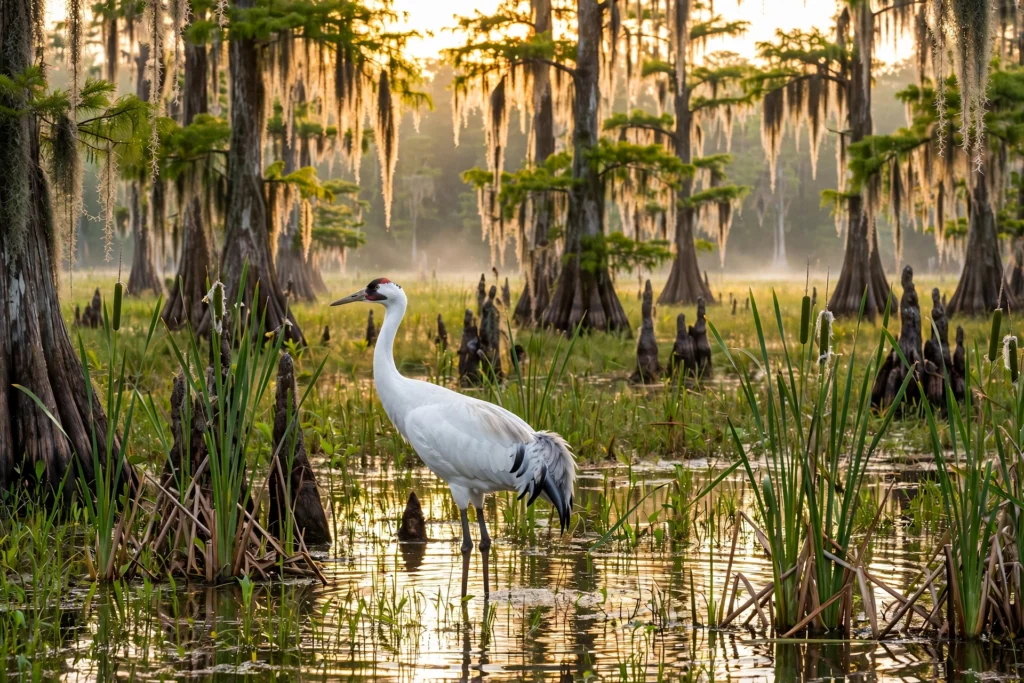
The whooping crane is the easiest wading bird in the game to identify once you know what to look for, because it is white, tall and unmistakable at a distance. GTABase describes it as “a tall, white wading bird with black-tipped wings and a red splash on its forehead”, found in “wetlands and northern coastal regions”. In the real world it stands about five feet tall with a wingspan of around seven and a half feet, making it the tallest bird in North America — and in the game it is just as conspicuous. A white bird that tall, standing in shallow swamp water, shows up from a long way off against the green and brown of the Grassrivers.
Three field marks separate it from everything else in the wetlands. First, the colour: the whooping crane is almost entirely white. The great egret is white too, but it is much smaller and has a yellow bill and black legs, while the whooping crane has a red crown and a black moustache stripe on a white face. Second, the black wingtips: folded wings hide them, but when the bird stretches or takes off, the black tips on the wings are obvious — the great egret has none. Third, the height: at around five feet tall, a whooping crane stands head and shoulders above the egrets, herons and ibises around it. If the white bird in front of you is taller than your character’s waist, you are probably looking at a whooping crane.
One more identification trap to avoid. The trailers show cranes around the 0:21 mark in the wetlands shot, and fans have debated ever since whether those are sandhill cranes or juvenile whooping cranes, because the two look similar in motion and in poor light. The official Game Informer screenshot settles the in-game question: it shows a whooping crane wading in the Grassrivers next to a white-tailed buck, and the gta6gang wiki page confirms the bird in the log is the whooping crane. If you see a grey-brown crane with a red forehead and no white body, that is the sandhill crane look — and the sandhill crane is not in the game. File it as unconfirmed and keep looking for the white bird.
Before You Go: What You Need
Whooping cranes reward patience and good eyes more than firepower, so get these three things right before you start searching.
Bring binoculars, and you already have them. The binoculars unlock automatically early in Chapter 1, before the very first mission, and they live in the bottom-right equipment slot of the weapon wheel. Hold L1 or LB to open the wheel, highlight the binoculars with the right stick, and release. Then hold L2 or LT to look through them, use Up and Down on the D-pad to zoom, centre the reticle on the bird, and hold R1 or RB until the study meter fills. Whooping cranes are shy and they wade in open water, so you will usually spot one from a bank or a road long before you could walk up to it — the binoculars are the only reliable way to study one at that distance. If you have not picked the game up yet, a Grand Theft Auto VI for PS5 is the obvious starting point, and the whooping crane is one of the most satisfying birds to log because it is so rare.
As an Amazon Associate, we earn from qualifying purchases.
Bring your ears too. The whooping crane is named for its call — a loud, bugling “whoop” that carries a long way across open water — and in the real world the call is one of the main ways researchers find the birds. No guide has confirmed the in-game call yet, so treat this as a tip rather than a fact, but if you hear a loud, unfamiliar bugle over the swamp, stop and scan the water. A BENGOO G9000 gaming headset helps here — swamp ambience is full of frogs and insects, and headphones make a distant bird call much easier to pick out than TV speakers do.
As an Amazon Associate, we earn from qualifying purchases.
Go to the wetlands, not the city. Whooping cranes live in shallow water and marshy ground, not on beaches, rooftops or city streets. Every guide agrees on the habitat: wetlands, swamps and northern coastal regions. The wading birds guide covers the same ground for herons, egrets, ibises and spoonbills, and the whooping crane shares all of those spots — it is simply rarer than the rest. Do not waste time scanning Vice City parks or the Leonida Keys. Pick a swamp, walk slowly along the water’s edge, and scan the shallows.
How to Study a Whooping Crane
The study steps are the same for every bird in GTA 6, and they are the only way to log a whooping crane — there is no other interaction with one.
- Go to one of the spots below, on foot, and walk slowly along the edge of the shallow water.
- Scan the water ahead of you for a tall white bird. Look for the white body first — it stands out against the dark water and green reeds.
- Stop at a distance and equip the binoculars from the weapon wheel (hold L1 or LB, pick Binoculars from the bottom-right equipment slot).
- Hold L2 or LT to look through the binoculars, and use Up and Down on the D-pad to zoom in on the bird.
- Keep the reticle on the bird and hold R1 or RB until the study meter fills and the species name appears.
- Check the log under Progress, then Animals, then Birds — the Whooping Crane is one of the 60 bird entries.
Three practical notes. First, do not run. Whooping cranes are shy birds, and running through a swamp scares every bird in it before you get close enough to study one. Walk, stop, scan, look. Second, the bird may be standing still for a long time and then suddenly take a few steps or stretch its wings — that flash of black wingtips is your best confirmation that you have the right bird. Third, if the bird flies off before the meter fills, do not chase it. Wading birds return to the same stretches of water, and the same spot will usually have another one within a few in-game minutes. The study meter only counts while the reticle stays on the bird, so a steady aim matters more than a fast one.
Spot 1: The Grassrivers, Mariana County
The Grassrivers is the best place to start, because every guide that names a whooping crane spot names the Grassrivers first. GameSpot lists it as “Grassrivers — anywhere in this region” for Mariana County, Promptowy lists “Grassrivers, Mount Kalaga National Park”, and the official Game Informer screenshot shows a whooping crane wading in the Grassrivers next to a white-tailed buck. The Grassrivers is the big swamp in the north-west of the map, a maze of shallow waterways, mangroves and reed beds that runs from Watson Bay down toward Hamlet — and it is the same water where the airboat article’s Thorpe Adventures swap and the alligator guide’s hunting grounds sit.
Work the Grassrivers on foot along the banks, not from a boat. An airboat is fast but loud, and it scares the birds before you see them. That slow bank-walking method is the core of how to find whooping cranes in GTA 6: the bird is too shy for a fast approach and too white to miss once you are looking in the right water. Park at the edge of the swamp, walk the bank slowly, and scan each stretch of open shallow water before you move on. The crane feeds in water shallow enough to wade in, so look for white shapes standing in water that is only a few inches deep, usually near the reeds rather than in the middle of a channel. If you find a stretch with egrets and herons, stay there — the whooping crane shares the same feeding grounds, and the wading birds guide lists the same Grassrivers stops for the great blue heron, the great egret, the American white ibis and the roseate spoonbill. Log those while you wait, and the crane will often turn up in the same place.
Spot 2: Buckskin Swamp, Kelly County
Buckskin Swamp is the second named spot, and it is the one GameSpot lists for Kelly County. Buckskin Swamp sits in the south of Kelly County, around the hunting grounds east of Port Gellhorn, and it is already familiar ground from the earlier wildlife guides: the skunk guide’s Adler Creek and Bonanza deck zones are nearby, the rabbit guide’s Starlet Motel woods are to the south, and the Nile monitor guide’s deck zones cover West Buckskin Swamp, East Buckskin Swamp and Pelican Valley. The swamp is a mix of shallow black water, cypress knees and low scrub, and the whooping crane feeds in the same shallow pools as the mottled ducks.
Search Buckskin Swamp the same way as the Grassrivers: walk the water’s edge slowly, scan each pool, and use the binoculars from the bank before you step into the water. The crane is rare here — GameSpot calls the Kelly County listing a single row, not a cluster — so expect to check several pools before one turns up. If the swamp feels empty, leave and come back later in the day or after a sleep; wading birds move between feeding spots, and a pool that was empty in the morning can hold a crane in the afternoon. No guide has published a time-of-day window for the whooping crane, so do not take anyone’s word for a best hour — the honest answer is that the bird is there when it is there, and patience is the method.
Spot 3: Coastal Lummox County
Lummox County is the third named spot, and GameSpot lists it simply as “Coastal areas” — the northern coastal regions that GTABase also names as whooping crane habitat. Lummox is the big northern county, home to Mount Kalaga National Park, and its coast runs along the north of the map. The crane feeds in the shallow coastal marshes and the mouths of the rivers that run into the sea, the same kind of ground where the osprey guide’s Bonanza cluster sits and where the eagles guide’s Mount Kalaga soaring sighting was reported.
The coastal search is wider than the swamp search, so use the map to narrow it down. Look for the marshy inlets and river mouths along the Lummox coast rather than the open beaches — a whooping crane needs shallow standing water to feed in, and it will not be standing on dry sand. Drive the coastal road slowly, stop at each inlet, and scan the water with the binoculars from the car before you get out. The osprey guide covers the same coast for the western osprey, and the two birds share the same hunting ground: if you see an osprey working a river mouth, the shallows below it are worth a scan for a crane.
Spot 4: Mount Kalaga National Park
Mount Kalaga National Park is the fourth spot, and it is the one Promptowy names alongside the Grassrivers. The park sits in Lummox County, around the 840-metre peak in the north of the map, and it is the same ground as the bear guide’s black bear habitat, the fox guide’s Mount Kalaga start and the squirrel guide’s forest method. The crane is not on the mountain itself — it is in the wetlands and river valleys at the foot of the park, where the Kalaga River and its tributaries spread into shallow marsh.
Search the park from the water up, not from the peak down. The rivers and marshes at the base of the mountain are the feeding ground; the pine forest on the slopes is where you will find the woodpeckers instead. Walk the riverbanks slowly, scan the shallow stretches, and check the marshy ground where the river slows and spreads out. The park is also the best place in the game to combine birdwatching trips: the same visit that logs a whooping crane in the valley can log woodpeckers in the pines above it, and the golden eagle soaring over Mount Kalaga is the same bird the eagles guide covers.
Same-Trip Birds: Make One Wetland Visit Count
A whooping crane is rare enough that a dedicated trip can end with an empty log, so plan each visit to log other birds at the same time. The wetlands hold nine wading bird species, and the wading birds guide maps the full five-stop route: Grassrivers, the Key Lento islands, Goose Key and the Marquesas Keys, Buckskin Swamp and Draper Island, and the Wildland Zoo aviary. Every one of those stops can also produce a whooping crane, because the crane shares the same shallow-water feeding grounds as the great blue heron, the great egret, the American white ibis and the roseate spoonbill.
The practical route is simple. Start in the Grassrivers and work the banks slowly, logging every wading bird you see. Cross to Buckskin Swamp and do the same. Then drive north to the Lummox coast and finish in the river valleys below Mount Kalaga. Each stop takes twenty to thirty real minutes if you walk it properly, and the whole route is a single in-game day of birdwatching. Even if the crane does not show, you will have logged four or five other species — and the 100-species target for 100% completion is a numbers game, so every logged bird counts.
Honest Gaps: What No Guide Has Published Yet
Three things about the whooping crane are still unpublished, and this guide will not pretend otherwise. First, there is no pinned exact spawn point. GameSpot’s rows are county-level, Promptowy names two regions, and no guide has published a map pin the way the golden eagle guide has two pinned points east of Farmer Scrumpy’s Apple Orchard. If a pinned spot appears, this guide should be updated. Second, there is no published time-of-day window. No guide says the crane feeds at dawn, at dusk or at night, and the honest answer is that nobody has published one yet — search in daylight, when you can see a white bird at a distance, and do not trust a claimed best hour from a single source. Third, there is no published call cue. The real whooping crane’s bugle is famous, but no guide has confirmed the in-game call, so the listening tip above is a real-world suggestion, not a confirmed mechanic.
The crane is also study-only, which means there are no hunting facts to report at all: no Bret payout, no carcass price, no Target Deck, no rare variant and no W-22 shot to describe. That is not a gap in this guide — it is the nature of the bird. What the guides do confirm is solid: the bird is in the log, it lives in wetlands and northern coastal regions, and the four spots above are the places the published guides agree on. Everything else is a matter of walking the banks slowly and looking for white.
Frequently Asked Questions
Where is the best place to find whooping cranes in GTA 6?
The Grassrivers in Mariana County is the best answer to how to find whooping cranes in GTA 6. Every guide that names a whooping crane spot names the Grassrivers first — GameSpot lists it as “anywhere in this region”, Promptowy lists it alongside Mount Kalaga, and the official Game Informer screenshot shows one wading there. Walk the banks slowly and scan the shallow water.
Are whooping cranes huntable in GTA 6?
No. Whooping cranes are study-only birds. They are not on Bret Vogel’s 61-animal hunting list, so there is no Bret payout, no carcass price and no Target Deck for one. Study it with binoculars to log it.
How do I tell a whooping crane from a sandhill crane?
By colour. The whooping crane is almost entirely white with black wingtips and a red splash on its forehead. The sandhill crane is grey-brown. More importantly, the sandhill crane is not documented in the released game at all — gta6gang marks it “NOT DOCUMENTED SO FAR” — so the only crane in the log is the whooping crane.
Do I need to finish the story to find whooping cranes?
No. All 60 birds are available from the start, and the binoculars unlock automatically early in Chapter 1, before the very first mission. You can walk into the Grassrivers and study a whooping crane in your first hour of free roam.
Does studying a whooping crane count toward 100% completion?
Yes. Studying 100 of the 255 animals in the log counts toward 100% completion, and the whooping crane is one of the 60 birds. Check your progress under Progress, then Animals, then Birds.
How to find whooping cranes in GTA 6 comes down to one thing: walk the wetlands slowly, look for white, and study it with binoculars before it flies. The Grassrivers first, then Buckskin Swamp, then the Lummox coast and the valleys below Mount Kalaga. The bird is rare, the spots are county-wide rather than pinned, and the search will take patience — but the whooping crane is the tallest bird in North America, it is white against green water, and once you have seen one standing in the shallows, you will never mistake it for anything else.

Dr Vivek Garg runs drviram.in — a tech blog about AI tools, apps, and online earning. Every guide here is tested hands-on before it is published.