How to Find Sea Turtles in GTA 6: The Complete Guide (2026)
Quick Answer: How to find sea turtles in GTA 6: take a boat out to the reef off Corsair Key, in the Atlantic off Vice-Dale County — green sea turtles hang around that reef and are happy to let you swim right beside them. Dive down with scuba gear, swim close until the Study prompt appears, then hold R1 on PlayStation or RB on Xbox to log the species. A second spot is the islands near the southern beach of Key Lento. Sea turtles are study-only wildlife: no guide reports catching, hunting or riding them, and there is no shop price, no unique variant and no mission that hands you one.
Grand Theft Auto VI launched on November 19, 2026 for PlayStation 5 and Xbox Series X/S, and its ocean is the most alive part of Leonida. Sea turtles are the calmest thing in it: they glide over the coral, they do not flee when you swim up to them, and they are one of the easiest wildlife entries to log, because the reef they live on is close to shore and the study takes seconds once you are near one. For the official game page, see Rockstar’s Grand Theft Auto VI site. This guide covers exactly how to find sea turtles in GTA 6, where the green sea turtle lives, how the study mechanic works, the loggerhead question, the land turtles that share the same log category, and what else shares the reef with them. If you are new to diving, our guide on swimming and diving in GTA 6 covers scuba gear, controls and the 33 underwater discoveries first.
How to Find Sea Turtles in GTA 6: Step by Step
You do not find sea turtles by standing on the beach at Vice City and waiting. The reliable route is a short boat trip out to the reef, and here is the short version first, with the species-by-species detail in the next sections:
- Get a boat. Jason’s free fishing boat sits at the dock behind his Key Lento house from Chapter 1, and it is the easiest way out to sea. Any stolen speedboat or yacht works too — the point is to get offshore quickly, because the reef is too far to swim to from the beach with your stamina and scuba air intact.
- Sail out from Corsair Key, off Vice-Dale County. Head east into the open water and watch the area name on screen. When it changes to Atlantic Ocean, you are in turtle water, and the reef is close by.
- Look for the reef, not the open water. The turtles hang around the reef itself, closer in than the whales and the deep-water sharks. Dive down and look for coral, sand and the slow, dark shape of a turtle gliding over it.
- Get in the water with scuba gear. Scuba gear unlocks in the Chapter 1 mission Island Dreams, and it is delivered to your boats, so you can gear up on deck. Dive down with R1 on PlayStation or RB on Xbox, and surface with X or A.
- Swim close until the Study prompt appears. The prompt only shows up when you are near the animal, so you have to commit to the swim — there is no studying a turtle from the boat. Hold R1 or RB once Study appears, and the game logs the species.
- Check the log. Open the menu and go to Progress, then Animals, and the species name should be there. Before you study a turtle, the game only shows the group name, Sea Turtle; after you study it, the game names the species and logs it.
That is how to find sea turtles in GTA 6 in the most reliable way. The rest of this guide covers each species and where it lives, the two ways to study one, the scuba gear you need, the land turtles that count toward the same log category, and the other sea life that shares the reef.
Where Sea Turtles Live in GTA 6
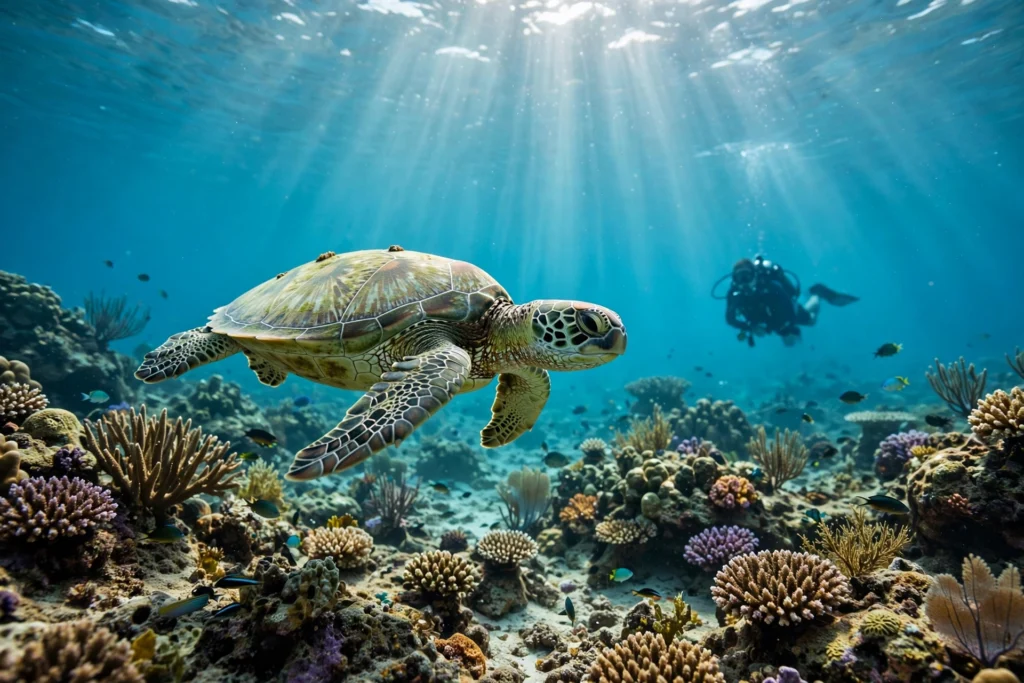
Sea turtles live on the reefs, and the best reef in the game is the one off Corsair Key. A guide that filmed its sea creatures on a PlayStation 5 in the launch version calls the green sea turtle “the friendliest find of the day” and says the turtles “hang around the reef off Corsair Key and are happy to let you swim right beside them.” That is the spot to aim for first: it is the only wild location with filmed footage of a turtle, and it sits in the same stretch of water as the dolphins, the rays and the sharks — which is why this guide also covers what else shares the reef, and the one danger in the water with the turtles.
Treat any map of turtle spots as a starting point, not a fixed spawn. Animals swim around, so a turtle filmed over the reef today can be half a mile away tomorrow. That is why the guides that have actually filmed turtles all give areas, not coordinates — and why the Study prompt matters so much. Swim close, study the animal, and the game tells you what you are looking at. Without the study, you only get the group name, and you cannot be sure which species you have just met.
| Spot | What you see | Notes |
|---|---|---|
| Reef off Corsair Key | Green sea turtles gliding over coral | Wild, free-roaming, best spot in the game |
| Key Lento, islands near the southern beach | Green sea turtle | Second confirmed spot, close to Jason’s house |
| Leonida Keys reefs | Sea turtles on coral reefs | General home range per the wildlife databases |
| Vice Beach, offshore | Loggerhead-sized turtles in the first trailer | A trailer sighting, not a confirmed gameplay spawn |
The reef off Corsair Key is the spot to aim for first. The Key Lento spot is the backup: it is the one GameSpot’s wildlife list gives, and it is right next to Jason’s house, so it is the shortest trip in the game if you are starting from the safehouse. The Leonida Keys reefs are the general home range — the game’s own animal database puts the green sea turtle in the Keys, and Rockstar’s official Leonida Keys screenshot shows one swimming past two divers over a coral reef, with fish and a moray eel around it.
Green Sea Turtle vs Loggerhead: What the Game Actually Logs
There is one piece of confusion to clear up before you go looking: the game logs one sea turtle entry, and it is the green sea turtle. The wildlife database lists a single entry here — the Green Sea Turtle, in the Reptiles and Amphibians category — and describes it as the largest of all hard-shelled turtles, a common sight around reefs and coastal waters, found in the Leonida Keys. If you study a turtle over the Corsair Key reef, that is the entry you will log.
The loggerhead is a different story. A loggerhead sea turtle was among the marine animals identified in GTA 6’s first trailer: in the shot that cuts from Lucia’s prison scene to a boat off Vice Beach, large sea turtles swim past a yacht, and trailer analysts identified them as loggerheads by their size and shell profile. But no post-launch guide has confirmed the loggerhead by name in the game itself. The wiki pages that track it say it plainly: sea turtles are documented in the released game, but the species is not named. The official Rockstar screenshot from the Leonida Keys is captioned as a sea turtle, with no species given.
So the honest position is this: the turtle you will meet and study in the game is logged as the Green Sea Turtle. The loggerhead exists in the trailer and in the real Florida waters the game is modelled on, but until a guide films one and studies it in-game, treat it as a trailer sighting, not a second species to hunt. Do not spend hours looking for a loggerhead that the game may not log separately — study the green sea turtle first, bank the entry, and check the log before you go looking for a second one.
If you are the kind of player who likes to know exactly what you are looking at, a BENGOO G9000 gaming headset helps you hear the underwater audio cues — the bubbles, the distant whale calls, the splash of something surfacing — that tell you marine life is nearby before you can see it.
As an Amazon Associate, we earn from qualifying purchases.
How to Study a Sea Turtle (and Why It Counts)
Finding a turtle is only half the job. The game wants you to study it, and the study is what turns a sighting into progress. Studying works the same way for every animal in Leonida, and it is worth learning properly because it is one of the 100% completion checklist items.
There are two ways to study a sea turtle, and which one you use depends on where you are. From the boat, equip your binoculars from the weapon wheel, hold them on the spot where the turtle is surfacing, and hold R1 on PlayStation or RB on Xbox once Study appears. In the water, swim close until the Study prompt appears, then hold R1 or RB — or aim at the animal with L2 or LT and use the prompt directly. A scoped rifle works for studying land animals too, according to the wildlife guides, but there is no reason to bring a rifle to a turtle: the binoculars do the job, and the harpoon is the only weapon that works underwater anyway.
Two details matter. First, the Study prompt only shows up when you are close, so you have to commit to the swim — there is no studying a turtle from the deck of a yacht. Second, the prompt only appears if you have not logged that species yet, so once you have studied a green sea turtle, the game will not offer the prompt again for another one. That is how you know your log is filling up: the prompts stop appearing for species you already have, and a prompt appearing means the animal in front of you is new.
Studying is also your identification tool. Before you study a turtle, the game only shows the group name, Sea Turtle. After you study it, the game names the species — and that is the only reliable way to tell a green sea turtle from anything else at a distance, since the loggerhead question is still open and both animals would look the same grey-green shape from the surface. Study first, decide what you have second.
The sea turtle sits in the Reptiles and Amphibians category of the wildlife log, which holds only six species in total. That makes it one of the smallest categories in the game — and one of the easiest to finish, since the land turtles in the next section cover most of the rest of it. The turtle is also one of the 255 entries in the Progress menu’s animal list, and studying 100 of those 255 species is what counts toward 100% completion — so the sea turtle is an entry you can bank early, on a single short boat trip.
Getting Ready: Scuba Gear, Boats and the Reef Trip
You can find a sea turtle without scuba gear — they swim near the surface over the reef, and you can spot one from the boat and free-dive down to it. But scuba gear makes the trip far easier, because it lets you stay down, follow a turtle, and study it without fighting for air. Scuba gear unlocks in the Chapter 1 mission Island Dreams, when Kenton Rees sends you diving after sunken treasure. Once unlocked, the gear is delivered to your boats — Jason’s free fishing boat, Kenton’s boat, and any boat you own — so you can gear up on deck with Triangle on PlayStation or Y on Xbox, and the harpoon and metal detector come with it.
The same mission opens up the diving side of the game. There are seven dive sites and 33 underwater discoveries to find, and Kenton pays 400 dollars per gold doubloon you bring him, or 200 dollars at a pawn shop. The harpoon — the Arras Bullhead — is the only weapon that works underwater, and it matters on the reef trip for one reason: the sharks. Tiger, bull and hammerhead sharks cruise the same open water off Corsair Key, and while the free-roam sharks mostly ignore divers, the harpoon is your only defence if one gets curious. Our guide on how to find sharks in GTA 6 covers each species, where they swim, and how to handle them.
A few practical points for the trip. Take the boat, not a jet ski: the reef is a long way out, and a boat gives you a stable platform to gear up and a place to climb back onto. Watch the area name on screen as you sail east from Corsair Key — when it changes to Atlantic Ocean, you are in the right water. Dive in daylight: the reef is far easier to read in sunlight, and the turtles are easier to spot against the sand. And do not shoot first. Turtles are not hunted in GTA 6 — there is no hunting entry for them, no rifle that keeps a carcass intact, and no guide that reports a turtle being killed for a reward. They are study-only wildlife, and the game treats them that way.
If you still need the game itself, Grand Theft Auto VI for PS5 is the standard edition, and it is the one this guide is written from.
As an Amazon Associate, we earn from qualifying purchases.
Land Turtles Are in the Log Too
The sea turtle is not the only turtle in the log. The same Reptiles and Amphibians category holds land turtles, and they are worth knowing about because they are the rest of the category — and because you will meet them without ever getting wet.
The box turtle is the common one. The wildlife lists put it at Bobcat Key or Belpoint Island, anywhere along the coastline — so if you are already driving the Keys, keep an eye on the verges and the sand. The Gulf Coast box turtle is the same animal in a different spot: Bobcat Key, near the airport. The snapping turtle lives in the Grassrivers, anywhere in the swamp, with a denser population around Snappy’s Meat Shack, just off Route 82 leading northwest from Hamlet. The softshell turtle is a Watson Bay animal, generally all over the place there, with a denser population on the small island southeast of Watson Bay, reached by a road that leads out to it.
| Turtle | Where to look | Notes |
|---|---|---|
| Green sea turtle | Reef off Corsair Key; Key Lento southern beach islands | The only sea turtle entry; study it underwater |
| Box turtle | Bobcat Key or Belpoint Island coastlines | Common land turtle |
| Gulf Coast box turtle | Bobcat Key, near the airport | Same animal, different spot |
| Snapping turtle | Grassrivers; densest at Snappy’s Meat Shack off Route 82 | Swamp turtle |
| Softshell turtle | Watson Bay; densest on the small island southeast of the bay | Water turtle, not a sea turtle |
Studying works the same way on land: equip your binoculars, hold them on the animal, and hold R1 or RB once Study appears — or walk up close and use the prompt directly. Land turtles do not run away, which makes them the easiest studies in the game. And because the Reptiles and Amphibians category holds only six species, the sea turtle plus the land turtles gets you most of the way through it in a single session.
The reef off Corsair Key is not a one-animal spot. It is the busiest stretch of water in the game, and the same boat trip that finds you a turtle can log half a dozen other entries — which is why it is worth knowing what else lives there before you sail out.
Dolphins are the most likely neighbours. A pair of them circles over the same reef, and you can spot them from the surface when they jump. Our guide on how to find dolphins in GTA 6 covers both species, the binocular study method, and the guaranteed dolphin tank at the Vice City Oceanarium. Spotted eagle rays travel in little groups over the sand, and from above you can see every spot — they were filmed off Corsair Key and again in the Leonida Straits off Key Lento. The green moray eel winds along the sand on the same reef, and the official Rockstar screenshot puts one on the reef beside the turtle and the divers. Lionfish meet you on Leonida Keys dives, and the same official screenshot catches one next to a diver heading through an underwater cave.
Further out, the water gets bigger. The giant oceanic manta ray swims past Corsair Key, wingtips curling out of the water right beside the hull of a boat — it is far wider than Jason is tall. The goliath grouper cruises low over a rocky seabed in the shallow water off Corsair Key, big enough to make you flinch when it swims past. Jellyfish drift in groups near the surface off Key Lento. And out in the deep water, past the reef, are the sailfish, the mahi-mahi and the North Atlantic swordfish, cruising above the whales.
The rule for the whole reef is the same as for the turtles: swim close, study everything you meet, and check the log after each dive. The Study prompt only appears for species you have not logged yet, so a prompt appearing at all means the animal in front of you is a new entry — and the reef is the one place in Leonida where new entries come at you in groups.
There is one animal on the reef you should know about before you dive in, and it is not the turtle. Tiger, bull and hammerhead sharks cruise the open water off Corsair Key, in the same stretch of sea as the turtles, the dolphins and the rays. The nurse shark is the relaxed one: it glides low over the seagrass in the shallows off Corsair Key, and it is the shark you are most likely to meet near the reef itself.
The good news is that free-roam sharks mostly ignore divers. The guides that filmed the sharks report hammerheads swimming right over and under them, and tiger sharks cruising past with a cloud of small fish around them, without attacking. The turtles are safer still: they are the friendliest animals on the reef, and nothing in any guide suggests a shark has ever gone after one in front of a player.
The practical rules are simple. Do not shoot first — there is no reason to, and the harpoon is slow to reload. Keep the Arras Bullhead ready, not raised: two bolts are reported to drive a shark off, and in the Island Dreams mission one playthrough needed three. If a shark does come at you, swim for the surface and get back to the boat — you cannot outswim one, and the boat is the safe place. And if you want the full picture on each species, our shark guide covers the four filmed species, the blacktip that is listed but not yet filmed, and the scripted Island Dreams attack in detail.
One more thing the reef does not have: a turtle tank. The Vice City Oceanarium on Catalan Key holds manatees, an orca and dolphins, and the guides call it a must-visit for the animal collection — but no guide reports a sea turtle tank there. Do not sail to the Oceanarium expecting to study a turtle behind glass. The reef is the place, and the wild turtle is the only way to log it.
What Sea Turtles Count Toward
The sea turtle is a small entry with an outsized place in the completion list. It sits in the Reptiles and Amphibians category, which holds only six species — so logging the turtle and the land turtles in the previous section finishes most of the category. It is also one of the 255 entries in the Progress menu’s animal list, and studying 100 of those 255 species is what counts toward 100% completion. The turtle is one of the easiest of those 100 to bank, because the reef is close to shore, the animal does not flee, and the study takes seconds.
There is no trophy tied to the turtle specifically, and no guide reports a reward for studying one beyond the log entry itself. That is normal for wildlife in GTA 6: the reward is the entry, and the entries add up. The turtle is also one of the 18 entries on the Aquatic tab of the wildlife log, alongside the dolphins, the whales, the sharks and the rays — so a single reef trip can move several tabs at once.
FAQ
Where is the best place to find sea turtles in GTA 6?
The reef off Corsair Key, in the Atlantic off Vice-Dale County. Green sea turtles hang around that reef, and a guide that filmed them on PlayStation 5 calls them the friendliest find of the day. The backup spot is the islands near the southern beach of Key Lento, which GameSpot’s wildlife list gives for the green sea turtle.
Can you catch or ride a sea turtle in GTA 6?
No. Sea turtles are study-only wildlife. No guide reports catching, hunting or riding one, there is no fishing entry for them, and there is no hunting entry either. You swim up to one, study it with the Study prompt, and it logs in your Progress menu under Animals.
Is there a loggerhead sea turtle in GTA 6?
Not confirmed by name in the game. A loggerhead was identified in the first trailer, off Vice Beach, but the post-launch guides say sea turtles are documented while the species is not named. The game logs one entry — the Green Sea Turtle — so study that one first and check your log before hunting for a second species.
Do you need scuba gear to find sea turtles in GTA 6?
No, but it helps a lot. Turtles swim near the surface over the reef, so you can spot one from the boat and free-dive down to it. Scuba gear, unlocked in the Chapter 1 mission Island Dreams, lets you stay down, follow a turtle and study it without fighting for air — and it comes with the harpoon and metal detector.
Are sea turtles dangerous in GTA 6?
No. Green sea turtles are the friendliest animals on the reef, and they let you swim right beside them. The danger in the same water is the sharks — tiger, bull and hammerhead sharks cruise the open water off Corsair Key — so bring the Arras Bullhead harpoon and head for the boat if one gets curious.

Dr Vivek Garg runs drviram.in — a tech blog about AI tools, apps, and online earning. Every guide here is tested hands-on before it is published.