
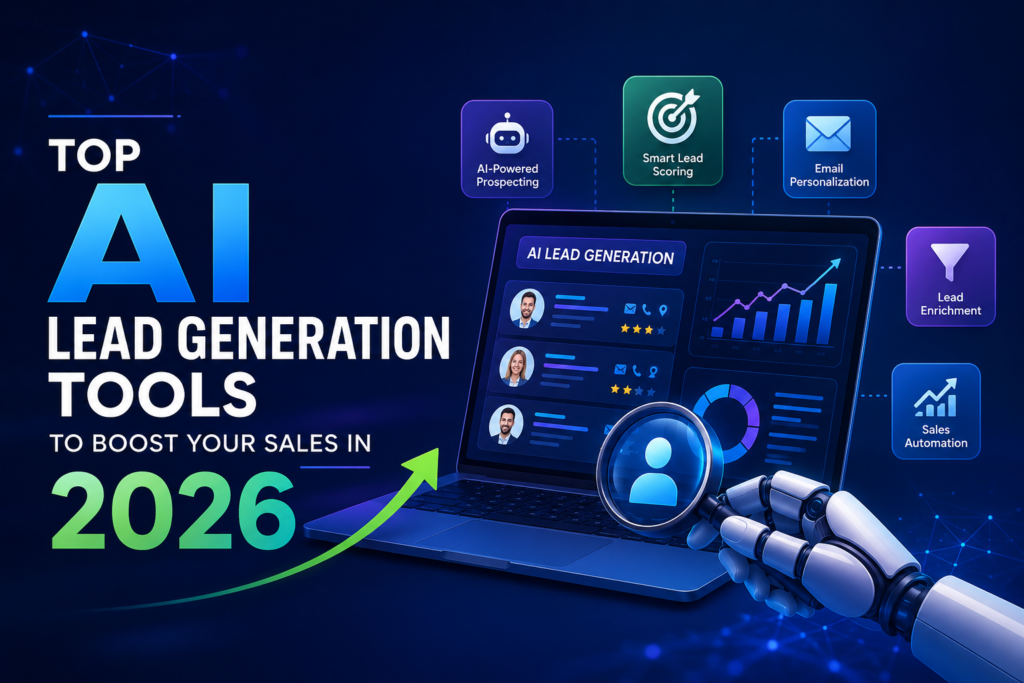
Generating high-quality leads has always been one of the biggest challenges for sales teams, and in 2026 the top AI lead generation tools are changing how that work gets done. Instead of manually searching for contact details and sending generic messages, sales teams now use AI to find high-intent prospects, score them, and personalise outreach at scale.
In this guide, we compare the top AI lead generation tools of 2026, group them by the job they do best, and show you how to choose one by budget, channels, and CRM needs — so you can spend less time prospecting and more time closing.
Top AI lead generation tools at a glance
If you want the short answer, this table ranks the top AI lead generation tools by best use case, price tier, and standout feature. Read on for the detail behind each pick.
| Tool | Best For | Starting Price | Key Feature |
|---|---|---|---|
| Apollo.io | B2B Sales | Affordable | Intent Data |
| Clay | Data Enrichment | Mid-Range | Workflow Automation |
| ZoomInfo | Enterprises | Premium | Buyer Signals |
| Seamless.AI | Prospecting | Mid-Range | Real-Time Data |
| HubSpot | SMBs | Flexible | CRM Integration |
| Drift | Conversational Marketing | Premium | AI Chatbots |
| LeadIQ | Prospecting | Affordable | Contact Capture |
| Instantly | Cold Email | Affordable | Email Automation |
How to pick: start with your use case, not the feature list
The tools in this guide all promise the same thing — more pipeline with less manual work — but they are built for different teams. Pick by the job you need done first:
- Tight budget or small team: start with Apollo.io, Instantly, or HubSpot Sales Hub.
- Data quality and enrichment matter most: look at Clay, Seamless.AI, or LeadIQ.
- Enterprise scale or chat-first sales: ZoomInfo or Drift fit best.
- Cold email is your main channel: Instantly is built for exactly that.
Top AI lead generation tools by use case
The top AI lead generation tools below are grouped by the team and budget they suit best, so you can skip straight to the group that matches you.
Best for small teams and startups: Apollo.io, Instantly, and HubSpot Sales Hub
Apollo.io — Best for: B2B sales teams. Apollo combines a large B2B contact database with AI-powered prospecting, and its key features include a contact database with millions of profiles, AI-driven lead scoring, automated email sequences, CRM integrations, and buying intent signals. Strengths: affordable pricing, a strong prospect database, and easy workflow automation. Watch out for: limited features on free plans.
Instantly — Best for: cold email outreach. Instantly helps businesses scale cold email campaigns using AI, with AI email personalisation, inbox rotation, campaign analytics, and automated follow-ups. Strengths: excellent deliverability features and easy campaign management. Watch out for: it is primarily focused on email outreach.
HubSpot Sales Hub — Best for: small and medium businesses. HubSpot combines CRM, automation, and AI-powered lead management in one platform, with AI email writing, lead scoring, sales automation, and conversation intelligence. Strengths: easy to implement and a strong CRM ecosystem. Watch out for: advanced features require higher-tier plans.
Best for data and enrichment: Clay, Seamless.AI, and LeadIQ
Clay — Best for: advanced lead enrichment. Clay helps businesses enrich prospect data using multiple data sources, with AI-powered data enrichment, workflow automation, personalised outreach generation, and integration with dozens of data providers. Strengths: highly customisable and excellent for outbound campaigns. Watch out for: a learning curve for beginners.
Seamless.AI — Best for: real-time contact discovery. Seamless.AI uses artificial intelligence to help sales teams find verified contact details, with real-time email verification, phone number discovery, AI search capabilities, and CRM integrations. Strengths: a user-friendly interface and fast prospect discovery. Watch out for: data accuracy may vary by industry.
LeadIQ — Best for: sales prospecting. LeadIQ simplifies lead capture and prospect management, with prospect tracking, AI-generated outreach messages, CRM synchronisation, and contact enrichment. Strengths: easy to use, with strong LinkedIn integration. Watch out for: limited customisation options.
Best for enterprise and conversational sales: ZoomInfo and Drift
ZoomInfo — Best for: enterprise sales teams. ZoomInfo offers one of the most comprehensive B2B databases available, with intent data, company insights, buyer signals, and AI-driven recommendations. Strengths: extensive data coverage and powerful analytics. Watch out for: higher pricing compared to competitors.
Drift — Best for: conversational marketing. Drift uses AI chatbots to engage website visitors and qualify leads automatically, with AI chatbots, meeting scheduling, conversational analytics, and personalised website experiences. Strengths: it improves website conversions and reduces response times. Watch out for: premium pricing.
Why AI lead generation matters in 2026
Traditional lead generation methods are becoming less effective. Customers expect personalised experiences, faster responses, and relevant content, and AI helps businesses meet these expectations by:
- Identifying high-intent prospects
- Analysing customer behaviour
- Automating repetitive tasks
- Scoring leads based on conversion likelihood
- Personalising outreach at scale
- Reducing customer acquisition costs
According to industry reports, companies using AI in sales processes often see better conversion rates and faster sales cycles.
What to look for in an AI lead generation tool
Before selecting a platform, consider the following features.
Data accuracy
Outdated contact information can hurt campaign performance. Look for tools with regularly updated databases.
AI lead scoring
Prioritise leads based on purchase intent and engagement signals.
CRM integration
Ensure compatibility with your existing CRM system.
Multichannel outreach
The best tools support email, LinkedIn, SMS, live chat, and phone outreach.
Automation features
Look for capabilities such as workflow automation, follow-up sequences, meeting scheduling, and personalised messaging.
How to choose the right AI lead generation tool
Choosing among the top AI lead generation tools comes down to four honest questions about your team.
What is your budget?
Some platforms are designed for startups, while others target enterprise budgets. Start with what you can afford monthly, then check what that tier actually includes.
What channels do you use?
Consider whether your team relies on email, LinkedIn, phone calls, or website chat — then pick a tool that is strong in those channels rather than one that does everything averagely.
Do you need a CRM?
If you already use a CRM, prioritise integration capabilities. If you do not have one yet, a platform such as HubSpot that bundles CRM and lead management can be the simpler choice.
How important is data accuracy?
Businesses with high outbound volumes should focus on tools with verified contact data and real-time verification, because bad data wastes every email you send.
Common mistakes to avoid
Relying solely on automation
AI should enhance human interactions, not replace them entirely. The best results come from AI doing the research and the first draft, with a person checking the message before it goes out.
Ignoring data privacy regulations
Ensure your campaigns comply with GDPR, CCPA, and CAN-SPAM regulations. Consent, opt-outs, and data handling are your responsibility even when a tool does the sending.
Using generic messaging
Even with AI, personalisation remains essential. A generic template sent to a thousand people performs worse than a personalised message sent to a hundred well-chosen prospects.
The future of AI lead generation
In the coming years, AI tools will become increasingly sophisticated. Expect innovations such as predictive buying signals, real-time intent tracking, voice AI sales assistants, autonomous outreach workflows, and hyper-personalised messaging. Businesses that adopt AI early will likely gain a significant competitive advantage.
The bottom line
The top AI lead generation tools are only as good as the strategy behind them. Start by identifying your goals, budget, and preferred channels, then choose the tool that fits that shortlist — and remember that the most effective lead generation strategy combines powerful AI tools with genuine human connection.
Frequently Asked Questions
What is an AI lead generation tool?
An AI lead generation tool uses artificial intelligence to identify, qualify, and engage potential customers. It automates the repetitive parts of prospecting — finding contacts, scoring leads, and personalising outreach — so sales teams can focus on high-intent leads instead of manual searching.
Which of the top AI lead generation tools is best for startups?
Apollo.io, Instantly, and HubSpot are popular options for startups. Apollo and Instantly are affordable and quick to start with, while HubSpot adds a built-in CRM. Start with a free or low-cost tier and upgrade once your outreach volume grows.
Are AI lead generation tools worth it?
Yes, for most sales teams they are worth it. They can save time, improve lead quality, and increase sales efficiency, and companies using AI in sales often see better conversion rates and faster sales cycles. The return depends on data quality, targeting, and consistent follow-up.
Can AI replace sales teams?
No. AI supports sales professionals by automating repetitive tasks such as research, scoring, and first-draft messages, but human relationships, negotiation, and closing deals remain essential. The best results come from AI and people working together.
How much do AI lead generation tools cost?
Pricing varies widely, from free plans to enterprise subscriptions costing thousands of dollars per month. What you pay depends on the features you need, the size of your contact database, and the number of seats. Always check the current pricing on each vendor’s website before committing.
Do I need a CRM before using an AI lead generation tool?
No, you do not need a CRM first. Tools such as HubSpot include a CRM as part of the platform, while Apollo, LeadIQ, and Seamless.AI synchronise with a CRM you already use. If you already have a CRM, prioritise integration; if you do not, an all-in-one platform avoids double data entry.
How accurate is the data in top AI lead generation tools?
Data accuracy varies by tool and by industry, and even well-regarded tools can have gaps in some sectors. Look for tools with regularly updated databases and real-time verification, and always verify a sample of contacts before running a large campaign.
Can top AI lead generation tools help with cold email?
Yes. Instantly is built for cold email, with AI email personalisation, inbox rotation, campaign analytics, and automated follow-ups, and Apollo also offers automated email sequences. Good deliverability still depends on data quality, sensible sending volumes, and messages that are personalised rather than generic.
Can I try top AI lead generation tools before paying?
Yes. Pricing ranges from free plans to enterprise subscriptions, and Apollo offers a free plan with limited features. Use a free plan to test data accuracy and workflow fit on a small list of prospects before committing to a paid tier.
Are top AI lead generation tools legal to use?
Yes, when they are used compliantly. Your campaigns must follow regulations such as GDPR, CCPA, and CAN-SPAM, which means proper consent where required, clear opt-outs, and careful handling of personal data. The tool does the sending, but compliance remains your responsibility.
Keep reading
If you want to go further with the top AI lead generation tools above, these guides on DrViram.in will help you put them to work:
- Best Free AI Tools 2026 — free AI tools for writing, design, study, and video if you want to test AI on a budget first.
- Online Earning Methods for Beginners 2026 — five realistic ways to start earning online, including freelancing and content creation.
- Earn Money Blogging: SEO Guide 2026 — how to build a blog that ranks on Google and earns through AdSense, affiliates, and sponsorships.
- How to Start Freelancing 2026 — a practical starting guide for offering your skills to clients online.
Official sources
- Apollo official website — Apollo.io pricing, features, and free plan details.
- HubSpot official website — HubSpot Sales Hub features and plans.

Dr Vivek Garg runs drviram.in — a tech blog about AI tools, apps, and online earning. Every guide here is tested hands-on before it is published.
Pingback: How to Install APK on iPhone Without Jailbreaking Safely (2026 guide) - DrViram.in