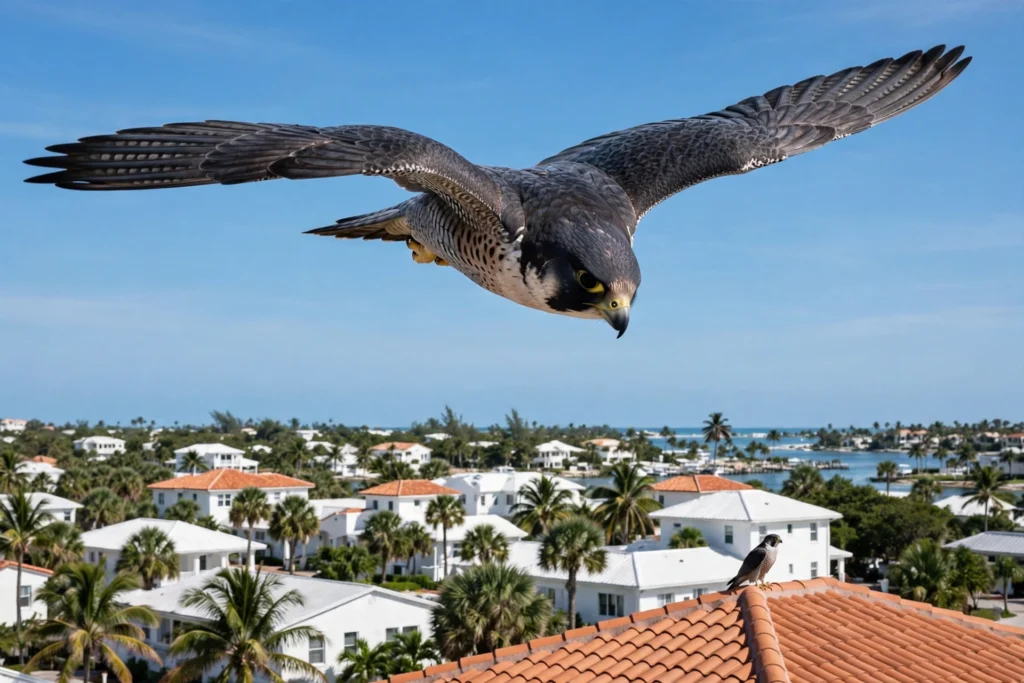
How to Find Falcons in GTA 6: The Complete Guide (2026)
Quick Answer: How to find falcons in GTA 6: look up near Key Lento, close to the Route 1 exit, where the Peregrine Falcon spawns, then work the scattered spawns around Port Gellhorn, Ambrosia and Draper Island — and head to Watson Bay beach near the Palmer Fishing Warehouse for the Crested Caracara, the falcon family’s northern cousin. Study both with binoculars (hold L2 or LT, zoom with the D-pad, hold R1 or RB) from a distance, because falcons flush the moment you get close. No dedicated falcons guide existed before this one — every other source only gives these birds a row in a bigger wildlife list.
Grand Theft Auto VI launched on November 19, 2026 for PlayStation 5 and Xbox Series X/S, and its wildlife log tracks 255 animals — with 100 studied species needed for 100% completion. The birds log alone holds 60 entries, and the falcons are its fastest family: the Peregrine Falcon, the world’s fastest animal in a dive, and the Crested Caracara, a falcon that behaves more like a hawk and walks the ground like a chicken. They are also two of the hardest birds to spot on purpose. They are fast, they are high up, and they sit still for only a few seconds before launching after prey or gliding to the next perch. That is exactly why players can drive through Leonida for hours, hear nothing, see nothing, and still have both falcons missing from their log. This guide explains how to find falcons in GTA 6 step by step: the two falcons and where each one lives, the four spots the published guides actually pin down, the study steps that log the bird, how to tell a falcon from a hawk and an eagle, and the honest limits — including the falcon facts no guide has pinned down yet. Everything below comes from the published guides, and every gap is labelled as a gap rather than filled in with a guess.
How to Find Falcons in GTA 6: The Falcons at a Glance
The table below is the short version. Everything after it is the step-by-step detail. The spot facts come from GameSpot’s all-animals wildlife guide, cross-checked against the IGN Birds guide, the PowerPyx all-birds list and the gta6codes.fr animal pages.
| Falcon | Birds log # | Best spot |
|---|---|---|
| Peregrine Falcon | 40 | Key Lento, close to the Route 1 exit |
| Crested Caracara | 17 | Watson Bay beach, near the Palmer Fishing Warehouse |
A few honest notes before the spots. First, there are only two falcons in this guide, and they could hardly be more different. The Peregrine Falcon is the classic falcon: a compact, fast, city-hunting raptor that takes other birds in mid-air. The Crested Caracara is the odd one out: a falcon by family that lives in northern forests and mountains, walks on the ground, and is identified by the blue tip on its beak. Second, no dedicated falcons guide exists anywhere. The search results for this topic return only the big wildlife lists, the general bird guides and the wiki pages — GameSpot’s county tables, the PowerPyx birds list, the IGN Birds page and the gta6codes.fr entries. That is the whole point of this article: it is the first guide that treats falcons as a topic of their own, and the first to string their spots into a single route. Third, the spots below are not equal. The Key Lento peregrine is pinned to one exit, which means a short drive and a real chance of logging the bird on the first try. The Port Gellhorn, Ambrosia and Draper Island spawns are described by GameSpot as “very scattered”, which means a longer search and no promise at any one spot. And fourth, falcons are study-only animals. They are not on Bret Vogel’s 61-animal hunting list — the only huntable birds are the Leonida Wild Turkey, the Leonida Wild White Tom and the two ducks — so there is no weapon, no carcass and no payout in this guide. You go with binoculars, not a rifle.
Before You Go: What You Need
Falcons reward patience and a slow approach more than firepower, so get these five things right before you leave the safehouse — the right kit makes learning how to find falcons in GTA 6 much easier.
Bring binoculars, and you already have them. The binoculars unlock automatically early in Chapter 1, and they live in the bottom-right equipment slot of the weapon wheel. Hold L1 or LB to open the wheel, highlight the binoculars with the right stick, and release. Then hold L2 or LT to look through them, use Up and Down on the D-pad to zoom, centre the reticle on the bird, and hold R1 or RB until the study meter fills. Falcons sit on high perches and soar far above the road, and they flush the moment you walk up to one — so the binoculars are the only reliable way to log one. If you have not picked the game up yet, a Grand Theft Auto VI for PS5 is the obvious starting point, and Key Lento is where the falcon log fills up fastest.
As an Amazon Associate, we earn from qualifying purchases.
Look up, not around. This is the single biggest difference between falcon hunting and every other bird in this series. Songbirds sit on wires and fences at eye level. Falcons sit on rooftops, telephone poles, high branches and cliff edges, and they spend much of their time in the air. When you reach a falcon spot, stop the car, get out, and scan the sky and the rooftops first — not the bushes. A peregrine stooping after a pigeon is a dark, fast shape dropping out of the sky, and it is gone in seconds. If you only scan at ground level, you will walk straight past it.
Listen for the chase, not the song. Falcons do not sing. What gives a peregrine away is the sudden panic of the birds it hunts: a flock of pigeons or gulls bursting off a rooftop all at once, or a single bird tumbling out of the sky. If you play with a headset, you will hear the commotion first — a BENGOO G9000 gaming headset makes the difference between noticing a scattering flock and driving straight past it. Approach on foot once you see the panic, and keep the engine off.
As an Amazon Associate, we earn from qualifying purchases.
Go in the morning, and plan for it. No guide has published a time-of-day window for either falcon, so this article will not invent one. What is known is that falcons are daytime hunters — they hunt, perch and soar in daylight, and the peregrine’s whole hunting style depends on seeing prey from high up. The practical advice is simple: do this route in daylight, when you can see a dark bird against the sky and the binoculars can actually find what you are looking at. A night search of a perfect falcon spot is a bad bet: you cannot see a falcon against a dark sky, and the binoculars cannot help you find what you cannot see.
Do not bring a gun. Falcons are study-only, and a gunshot does the opposite of what you want: it scatters every bird in the area before you can study one. The binoculars are the tool. Our how to find eagles in GTA 6 guide covers the same slow, quiet approach for the other big raptors, and the same rules apply here.
Spot 1: How to Find Falcons in GTA 6 at Key Lento
This is the best place to start learning how to find falcons in GTA 6, and it is the only spot on this route where the Peregrine Falcon is pinned to a single landmark. GameSpot lists the peregrine in Mariana County as “Key Lento – close to the Route 1 exit”, and the gta6codes.fr entry adds the key detail: peregrines live “in towns and cities, where it preys on other birds”. Key Lento is Jason’s home island, and it is where the falcon hunts the pigeons and gulls that crowd the rooftops. Here is how to work it:
- Drive to the Route 1 exit on Key Lento and park near the exit, not on it. Get out of the car and stand somewhere with a clear view of the rooftops and the sky above the road.
- Scan the rooftops and the telephone poles first. The peregrine hunts other birds in urban centres, so it perches where it can see the pigeons and gulls — on a roof edge, a pole or a high branch overlooking the road.
- Watch the pigeons. If a flock suddenly bursts off a rooftop all at once, a falcon is the usual reason. Follow the panic with your eyes, not your feet, and raise the binoculars the moment you see a dark, fast bird in the air.
- Study it in the air if you can. Hold L2 or LT, zoom with the D-pad, centre the reticle on the falcon, and hold R1 or RB until the study meter fills. A peregrine in flight is a moving target, so zoom in, track it smoothly, and do not rush the hold — the meter needs a steady lock.
- If the sky is empty, wait. Falcons hunt in bursts and then perch. Give the spot a few in-game minutes before moving on, and check the rooftops again before you leave — a perched falcon is much easier to study than a flying one.
Spot 2: Port Gellhorn, Ambrosia and Draper Island
If Key Lento comes up empty, the peregrine’s other published spots are the scattered spawns GameSpot lists for Kelly County: “Very scattered spawns at Port Gellhorn, Ambrosia, and Draper Island.” Scattered is the honest word here — there is no single pinned landmark in any of the three, and no guide has published a fixed spawn point. Here is how to work a scattered spawn:
- Start in Port Gellhorn, the town Jason and Lucia move to in Chapter 2. Work the rooftops and the tall structures around the town centre, the same way you worked Key Lento — scan high, watch the pigeons, and listen for a sudden scattering.
- Move on to Ambrosia and check the same kind of ground: rooftops, poles and high perches overlooking streets where pigeons gather. The peregrine follows its prey, so anywhere pigeons crowd a rooftop is worth a slow scan.
- Finish on Draper Island, which is also one of the published spots for the northern mockingbird — our how to find mockingbirds in GTA 6 guide covers the western part of the island, and the same slow walk that finds the mockingbird can find a peregrine overhead.
- Treat this as a sweep, not a stakeout. Drive between the three areas, stop at each one, scan the sky and the rooftops for a few minutes, and move on. A scattered spawn means the falcon is somewhere in the area, not at a fixed perch — patience across three stops beats camping one rooftop.
Spot 3: Watson Bay Beach (Crested Caracara)
The Crested Caracara is a different bird in a different place. GameSpot lists it in Mariana County as “Watson Bay – on the beach near Palmer Fishing Warehouse”, and the IGN log entry explains why it is here and not in the city: “The crested caracara is a distinctive bird of prey from the falcon family that makes it home in the forests and mountains of northern Leonida. Easily identified by its blue-tipped beak.” Watson Bay is the caracara’s southernmost published spot, and the beach near the Palmer Fishing Warehouse is where to look. Here is how to work it:
- Drive to Watson Bay and head for the beach near the Palmer Fishing Warehouse. Park and walk the beach on foot — the caracara is a ground bird as much as a flying one, and it is easier to spot walking than driving past.
- Look for a large, dark raptor on the ground or on a low perch. The caracara is bigger and slower than a peregrine, and it walks on the ground where other falcons would never land. The blue tip on its beak is the identification mark — zoom in with the binoculars and look for it.
- Check the treeline behind the beach as well as the sand. The caracara lives in forests and mountains in the north, so at Watson Bay it works the edge between the beach and the trees, not the open water.
- Study it the same way as the peregrine: binoculars, zoom, centre the reticle, hold R1 or RB until the meter fills. A caracara on the ground is a much easier study than a peregrine in the air, so take your time and get the lock right.
Spot 4: The Saputka–Kelly Crossroads (Crested Caracara)
The caracara’s second published spot is in Kelly County, east of Port Gellhorn: GameSpot lists it as “Around the crossroads east of where the Saputka River and River Kelly meet, east of Port Gellhorn.” This is the northern caracara country — forests and mountains, exactly where the log entry says the bird makes its home. Here is how to work it:
- Drive east out of Port Gellhorn toward the meeting of the Saputka River and River Kelly, and stop at the crossroads east of the junction. This is open country, so park off the road and work on foot.
- Scan the fields, the fence posts and the low trees around the crossroads. The caracara hunts and scavenges on the ground here, so look low — on fence posts, on the road edge and in the open fields — not just in the sky.
- Look for the blue-tipped beak. At a distance a caracara can look like a dark hawk, and the beak is the tell. Zoom in with the binoculars before you decide what you are looking at.
- Pair this stop with the Port Gellhorn peregrine sweep from Spot 2. The two spots are in the same part of the map, and one slow drive east out of Port Gellhorn can cover the peregrine’s scattered spawns and the caracara’s crossroads in a single trip.
How to Study a Falcon Without Scaring It Off
The study steps are the same for both falcons, and they are the same steps every bird guide in this series uses — but falcons are less forgiving than songbirds, so the order matters more here, and these steps are the last piece of how to find falcons in GTA 6.
- Equip the binoculars from the weapon wheel. Hold L1 or LB, highlight the binoculars in the bottom-right slot with the right stick, and release.
- Hold L2 or LT to look through the binoculars. Use Up and Down on the D-pad to zoom in and out.
- Centre the reticle on the falcon and hold R1 or RB. Keep the reticle on the bird until the study circle fills — if the bird moves out of frame, the meter stops, so track it smoothly.
- Stay still and stay far away. Falcons flush at a longer distance than songbirds, and a falcon that flushes before the meter fills is a wasted sighting. If the bird is perched, study it from where you stand. If it is flying, study it in the air rather than chasing it on foot.
- Check the log. Open Progress, then Animals, then Birds, and confirm the entry is filled in. The Peregrine Falcon is Birds log #40 and the Crested Caracara is #17, both in the same order as the Progress menu. Each one counts toward the 100 studied animals needed for 100% completion, out of 255 total.
Falcon vs Hawk vs Eagle: How to Tell Them Apart
Leonida has three families of big raptors, and they are easy to confuse at a distance. The table below is the field check — read it before you study, not after.
| Bird | Size | Where it hunts | The tell |
|---|---|---|---|
| Peregrine Falcon | Compact, fast | Towns and cities, hunting other birds | Dark, pointed wings; dives at prey in a stoop |
| Crested Caracara | Large, slow | Northern forests and mountains, on the ground | Blue-tipped beak; walks on the ground |
| Red-Tailed Hawk | Medium | Across Leonida, mostly forests | Distinctive cry; broad wings, soars in circles |
| Red-Shouldered Hawk | Medium | Eastern roads from Port Gellhorn toward Thrillbilly Mud Club | Red shoulders; hunts along roadsides |
| Bald Eagle | Very large | Kelly Bridge South cluster | White head and tail; huge wingspan |
| Golden Eagle | Very large | East of Farmer Scrumpy’s Apple Orchard | Dark brown all over; soars over mountains |
| Western Osprey | Large | Near water — Key Lento coast, Lake Leonida | Hovers, then plunges feet-first for fish |
The hawks and the eagles are covered in our how to find eagles in GTA 6 guide, and the osprey has its own guide at how to find osprey in GTA 6. The short version: if it is small, fast and diving at pigeons over a town, it is a peregrine. If it is large, dark and walking on the ground in the north with a blue-tipped beak, it is a caracara. If it is huge and white-headed, it is a bald eagle. And if it is hovering over water and then dropping feet-first, it is an osprey.
Why the Peregrine Falcon Is Worth Finding
The peregrine is worth the search for one reason: it is the fastest animal on Earth. That is not a figure from the game — it is real-world, and the game’s own log entry says the same thing in its own words: “Its rapid diving attacks make it the world’s fastest animal.” In the real world, a peregrine in a hunting dive, called a stoop, has been measured at over 200 miles per hour, faster than any other animal alive, and it uses that speed to strike other birds in mid-air. The game borrows that reputation directly: the peregrine hunts other birds in urban centres, exactly where pigeons and gulls are thickest, and the dive is the whole hunting method. That is also why the falcon is hard to study — you are trying to lock binoculars onto the fastest animal in the game, in the few seconds between the stoop and the perch. The caracara is the opposite story: a falcon that gave up speed for the ground. In the real world, caracaras walk on the ground, scavenge carrion and pick through fields like a crow — behaviour no other falcon shows — and the game’s log entry keeps the same idea by putting the bird in northern forests and mountains rather than in the city sky. Finding both falcons means finding both ends of the falcon family: the fastest hunter in the sky and the one falcon that prefers to walk.
What Falcons Are Not: The Honest Gaps
A good guide says what it does not know, so here are the falcon facts no published guide has pinned down yet — and that is the honest state of how to find falcons in GTA 6 today. There is no published time-of-day window for either falcon — no guide says the peregrine hunts at dawn or the caracara feeds at dusk, so this article will not invent one. There is no published nest location for either bird in-game, and no published Wildland Zoo appearance — the zoo’s walk-through aviary holds herons and other wading birds, but no guide lists a falcon there. There is no published call or sound cue for the falcon: songbirds give themselves away by singing, but falcons are mostly silent, and the only sound cue is the panic of the birds they hunt. The peregrine’s Port Gellhorn, Ambrosia and Draper Island spawns are described as “very scattered” by GameSpot, which means there is no fixed spawn point to give you — the Key Lento Route 1 exit is the only pinned peregrine spot. And falcons have no hunting interaction, no mission and no event: they are study-only, they are not on Bret Vogel’s hunting list, and no Target Deck includes a falcon. One wiki lists the Canada Goose as a fifth huntable bird alongside the turkey, the White Tom and the two ducks, but that does not change anything for falcons — they are not huntable under any listing. If any of these gaps close — a nest is found, a time window is published, a zoo appearance is confirmed — this guide will need an update, and the update will say so.
Frequently Asked Questions
Where is the best place to find falcons in GTA 6?
Key Lento, close to the Route 1 exit, is the best place to find falcons in GTA 6 — it is the only pinned Peregrine Falcon spot in the published guides, and it is a five-minute drive from Jason’s house. For the Crested Caracara, the best place is Watson Bay beach near the Palmer Fishing Warehouse. Start at Key Lento, then work the Port Gellhorn, Ambrosia and Draper Island sweep for the peregrine, and finish at Watson Bay and the Saputka–Kelly crossroads for the caracara.
How do you study a falcon in GTA 6?
Equip the binoculars from the weapon wheel (hold L1 or LB, select the bottom-right slot), hold L2 or LT to look through them, zoom with the D-pad, centre the reticle on the falcon and hold R1 or RB until the study circle fills. Study from a distance and stay still — falcons flush at a longer distance than songbirds, and the meter stops the moment the bird leaves the frame. The entry then shows in Progress, then Animals, then Birds.
Can you hunt falcons in GTA 6?
No. Falcons are study-only animals. Neither the Peregrine Falcon nor the Crested Caracara is on Bret Vogel’s 61-animal hunting list, and no Target Deck includes a falcon. The only huntable birds are the Leonida Wild Turkey, the Leonida Wild White Tom and the two ducks (the Mottled Duck and the Mosaic Mottled Duck). Studying a falcon with binoculars is the only way to log it, and each one counts toward the 100 studied animals needed for 100% completion.
What is the difference between a falcon and a hawk in GTA 6?
The Peregrine Falcon is smaller, faster and hunts other birds in towns and cities, diving at them in a stoop. Hawks — the Red-Tailed Hawk and the Red-Shouldered Hawk — are broader-winged soarers that hunt small mammals along roadsides and over forests. The Crested Caracara is the confusing one: it is a falcon by family, but it is large, slow and walks on the ground in northern forests, so it looks more like a hawk until you see the blue tip on its beak.
Are there any other falcons in GTA 6?
No. The Birds log holds 60 entries, and only two of them are falcons: the Peregrine Falcon at #40 and the Crested Caracara at #17. There is no American Kestrel and no other falcon in the published 60-bird lists from PowerPyx, IGN or GameSpot. The other raptors in the log are the two eagles, the two hawks and the osprey, and each of those has its own guide on this site.

Dr Vivek Garg runs drviram.in — a tech blog about AI tools, apps, and online earning. Every guide here is tested hands-on before it is published.