How to Find Songbirds in GTA 6: The Complete Guide (2026)
Quick Answer: How to find songbirds in GTA 6: start in Jason’s Key Lento backyard, where the blue jay, the house sparrow and the wild monk parakeet all show up within a few minutes of each other — then work Belpoint Island for the scrub jay, the northern forests around Mount Kalaga for the goldfinch and the orioles, and any Vice City street for the house sparrow and the house finch. Study each bird with binoculars (hold L2 or LT, zoom with the D-pad, hold R1 or RB) from a distance, because songbirds flush the moment you get close. No dedicated songbirds guide existed before this one — every other source only gives these birds a row in a bigger wildlife list, and this is the first guide that strings their spots into one route.
Grand Theft Auto VI launched on November 19, 2026 for PlayStation 5 and Xbox Series X/S, and its wildlife log tracks 255 animals — with 100 studied species needed for 100% completion. The birds log alone holds 60 entries, and the songbirds are its most overlooked family: the small perching birds that sing from wires, fences and treetops all over Leonida. They are also the easiest birds to walk straight past. They are small, they are fast, and they sit still for only a few seconds before hopping to the next branch. That is exactly why players can drive through Vice City for hours, hear birdsong the whole time, and still have half the songbirds missing from their log. This guide explains how to find songbirds in GTA 6 step by step: the nine songbirds and where each one lives, a five-stop route through Key Lento, Belpoint Island, Mount Kalaga, Port Gellhorn and Vice City, the study steps that actually log the bird, how to tell the lookalikes apart, and the honest limits — including the songbirds no guide has pinned down yet. Everything below comes from the published guides, and every gap is labelled as a gap rather than filled in with a guess.
How to Find Songbirds in GTA 6: The Songbirds at a Glance
The table below is the short version. Everything after it is the step-by-step detail. The spot facts come from GameSpot’s all-animals wildlife guide, cross-checked against the IGN Birds guide, the PowerPyx all-birds list, the Audubon field guide to the birds of GTA 6 and the WIRED birder’s piece.
| Bird | Birds log # | Best spot |
|---|---|---|
| Blue Jay | 13 | Key Lento, near Jason’s house; also Lummox, common across the county |
| American Goldfinch | 5 | Northern forests; Grassrivers Sunrise RV Park; common in Kelly County |
| House Sparrow | 28 | Any urban area; everywhere in Kelly County |
| House Finch | 27 | Everywhere in Kelly County; Port Gellhorn and Farmer Scrumpy’s Apple Orchard |
| Monk Parakeet | 34 | Key Lento, wild in Jason’s backyard; also caged at the liquor store near the Pay ‘n’ Spray |
| Scrub Jay | 51 | Belpoint Island, anywhere on the island west of Capri; also the coast around Port Gellhorn airfield |
| New World Oriole | 35 | Key Lento, any urban area; everywhere in Kelly County |
| Orchard Oriole | 39 | Southwest of Killtelligence Provisions in Mount Kalaga; north of Port Gellhorn at Farmer Scrumpy’s Apple Orchard |
| Spot-Breasted Oriole | 52 | Top of Mount Kalaga; Vice City’s more suburban areas |
A few honest notes before the spots. First, there are nine songbirds in this guide, and they are not all the same kind of bird. The blue jay, the goldfinch, the sparrow and the finch are the classic small songbirds. The monk parakeet is a parrot, but it sings, it perches, and the game’s own Birds log files it with the songbirds, so it is in this route. The scrub jay is a jay, like the blue jay, but it has no crest. The three orioles are the bright orange ones, and they are the hardest of the nine to tell apart at a glance. Second, no dedicated songbirds guide exists anywhere. The search results for this topic return only the big wildlife lists, the general bird guides and the field guides — GameSpot’s county tables, the PowerPyx birds list, the IGN Birds page, the Audubon guide and the WIRED piece. That is the whole point of this article: it is the first guide that treats songbirds as a topic of their own, and the first to string their spots into a single route. Third, the spots below are not equal. The Key Lento birds are pinned to Jason’s own backyard, which means a five-minute walk and a real chance of logging three birds at once. The Mount Kalaga orioles have pinned landmarks, which means a longer drive and a real search. And the “everywhere” birds — the house sparrow and the house finch — are the opposite problem: they are so common that players stop noticing them, and the route below tells you where to actually look instead of driving past them. And fourth, songbirds are study-only animals. They are not on Bret Vogel’s 61-animal hunting list — the only huntable birds are the Leonida Wild Turkey, the Leonida Wild White Tom and the two ducks — so there is no weapon, no carcass and no payout in this guide. You go with binoculars, not a rifle.
Before You Go: What You Need
Songbirds reward patience and a slow approach more than firepower, so get these five things right before you leave the safehouse.
Bring binoculars, and you already have them. The binoculars unlock automatically early in Chapter 1, and they live in the bottom-right equipment slot of the weapon wheel. Hold L1 or LB to open the wheel, highlight the binoculars with the right stick, and release. Then hold L2 or LT to look through them, use Up and Down on the D-pad to zoom, centre the reticle on the bird, and hold R1 or RB until the study meter fills. Songbirds sit in trees and on wires a long way off, and they flush the moment you walk up to one — so the binoculars are the only reliable way to log one. If you have not picked the game up yet, a Grand Theft Auto VI for PS5 is the obvious starting point, and Key Lento is where the songbird log fills up fastest.
As an Amazon Associate, we earn from qualifying purchases.
Listen before you look. Songbirds are easier to hear than to see, and that is the whole trick of this family. A blue jay’s harsh call, a goldfinch’s twittering song and a mockingbird’s borrowed phrases all carry over a quiet street, and they tell you a bird is perched nearby before your eyes find it. The WIRED birder’s piece makes the same point from real play: walking around Key Lento, he heard a flock of house sparrows alight onto a telephone wire and a blue jay stare down at him as he rounded a corner — the birds were there all along, and the sound was what gave them away. If you play with a headset, you will hear them first — a BENGOO G9000 gaming headset makes the difference between walking past a singing goldfinch and stopping to study it. Approach on foot once you hear one, and keep the engine off.
As an Amazon Associate, we earn from qualifying purchases.
Go in the morning, and plan for it. No guide has published a time-of-day window for any songbird, so this article will not invent one. What is known is that songbirds are daytime birds — they sing, feed and perch in daylight, and the Audubon birder found 16 of the 60 birds within his first hour of play, in the small hours after midnight, just by walking around Jason’s neighbourhood and listening. The practical advice is simple: do this route in daylight, when you can see a small bird against a branch and the binoculars can actually find what you are looking at. A night search of a perfect songbird spot is a bad bet: you cannot see a grey-brown sparrow against a dark tree, and the binoculars cannot help you find what you cannot see.
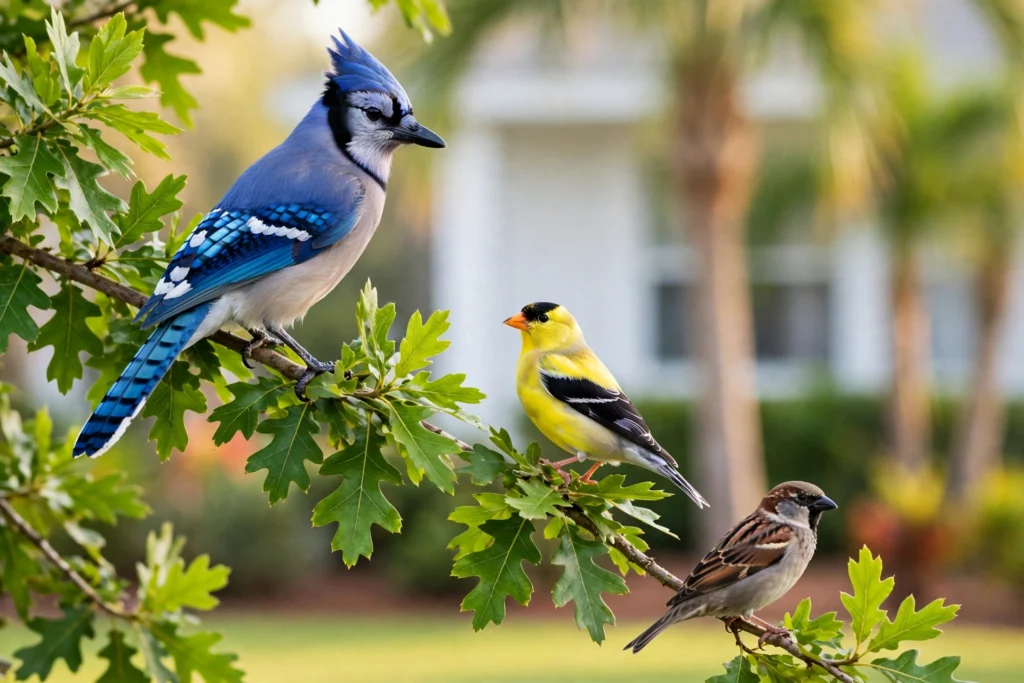
Learn to recognise them before you go. The Blue Jay is bright blue with a tall pointed crest — unmistakable once you see the crest. The American Goldfinch is small and brightly coloured, with striking plumage that stands out against green leaves. The House Sparrow is tiny, grey and brown, and easy to dismiss as “just a bird” — which is why it is the most-missed songbird in the game. The House Finch is the same size, but the male has red plumage on its head. The Monk Parakeet is small and green, with a long tail — the only green songbird in this guide. The Scrub Jay is blue-grey like the blue jay, but it has no crest at all, and that missing crest is the whole identification. The New World Oriole is small and orange, with a thick beak and white bars on its wings. The Orchard Oriole is smaller and darker than the New World Oriole. And the Spot-Breasted Oriole is orange with black spots on its breast. From a distance they can all look like any small shape on a wire — which is why players miss them. But the colour, the crest and the song are the tells once you zoom in with the binoculars.
Do not bring a gun. Songbirds are study-only, and a gunshot does the opposite of what you want: it scatters every bird in the area before you can study one. The binoculars are the tool. Our how to find cardinals in GTA 6 guide covers the same Key Lento backyard walk for the cardinal, and the same slow, quiet approach applies here.
Stop 1: How to Find Songbirds in GTA 6 in Jason’s Key Lento Backyard
This is the best place to start learning how to find songbirds in GTA 6, and it is the only stop on this route where three songbirds share the same street. Jason’s Key Lento backyard is where the Audubon birder found the house sparrow and the monk parakeet wild within minutes of leaving the house, and where GameSpot pins the blue jay near Jason’s home. Here is how to work it:
- Step out of Jason’s stilt house on Key Lento and stop on the back deck. Do not get in a car. The WIRED birder found his first birds right here — a flock of house sparrows on a telephone wire and a blue jay staring down at him from a corner — and the Audubon birder logged the house sparrow, the American crow and the monk parakeet in the same backyard.
- Scan the telephone wires and the rooftops first. House sparrows favour wires, fences and rooftops in urban areas, and a flock on a wire is the easiest songbird sighting in the game. Raise the binoculars the moment you see a small grey-brown bird on a wire — hold L2 or LT, zoom with the D-pad, centre the reticle and hold R1 or RB until the study meter fills.
- Listen for the blue jay. The blue jay is loud, it flocks in the forests around Key Lento, and it often sits in the trees near Jason’s house. IGN calls it “one of the region’s most distinctive birds” — striking blue plumage and an unmistakable crest — and GameSpot lists it as a common spawn across the whole of Lummox County. If you hear a harsh, scolding call from the trees, follow the sound, not the road.
- Check the trees and the garden for the monk parakeet. The monk parakeet is the surprise of this stop: IGN says the ones in Leonida’s southern urban centres are escaped pets, and they are highly intelligent — and the Audubon birder found them wild in Jason’s Key Lento backyard. They are small and green with a long tail, and they perch in the garden trees. They are not the caged bird at the liquor store — that is a different sighting, covered below — these are wild birds, free in the neighbourhood.
- Work the same walk for the robin and the cardinal. The American robin and the northern cardinal both live in this same Key Lento neighbourhood, and both already have their own guides on this site — our how to find robins in GTA 6 guide and our how to find cardinals in GTA 6 guide cover their pinned spots, including the robin south of the supermarket near the Route 1 and 1A split and the cardinal toward the northwest coast near the Arrow Gas Station. One slow walk through Key Lento can log five or six songbirds before you ever start a car.
Stop 2: Belpoint Island and the Coast for the Scrub Jay
The scrub jay is the bird that makes this route worth doing, because it is the one songbird that looks like another songbird and lives somewhere specific. IGN’s description is the identification in one line: similar to the blue jay but lacking its signature crest, the blue-grey scrub jay keeps to wetlands and coastal areas, where it can be seen flocking. No crest, blue-grey, flocks by the coast — that is the scrub jay, and it is not a blue jay with a bad hair day.
GameSpot pins it to Belpoint Island, anywhere on the island west of Capri, and to the coast and surrounding areas around Port Gellhorn airfield, and to the Saint Attaway Islands and Hyde Island in the north-east. Belpoint Island is the best of the three, because the whole island is the spot: there is no single tree to find, you work the island itself. Drive or boat to Belpoint Island, get out on foot, and scan the low coastal scrub and the trees along the shore. Scrub jays flock, so if you see one blue-grey bird without a crest, stop and scan the trees around it — there are usually more. The real-world Florida scrub-jay is endemic to Florida, which is why Rockstar put it on the coast, but that is real-world background — the game itself only says the bird keeps to wetlands and coastal areas.
The same coastal walk is worth doing for the gulls and the waders, and our how to find wading birds in GTA 6 guide covers the Grassrivers and Key Lento shallows for the spoonbill, the heron and the egret. The scrub jay is a land bird of the same coast, and the two guides together cover a full morning of coastal birding.
Stop 3: The Northern Forests and Mount Kalaga for the Goldfinch and the Orioles
This is the long drive, and it is where the route pays off. The American goldfinch and the three orioles all live in the north, and they are the birds most players never see, because most players never leave the city and the coast.
The American goldfinch is the easiest of the four. IGN describes it as easily spotted thanks to its bright plumage, mostly found in northern forests, and surprisingly territorial — and GameSpot lists it as a common spawn in Kelly County, with a pinned spot at the Grassrivers Sunrise RV Park. “Territorial” is the useful word: a goldfinch does not just pass through, it stays in its patch and sings from it, so if you hear bright, twittering song from the trees in the northern forests, stop the car and work that patch. The goldfinch is Birds log number 5 of 60, one of the first entries in the whole list, and it is still one of the most-missed, because players do not look up in the northern forests.
The orioles are the harder half of this stop, and they need their landmarks. The New World oriole is the common one: IGN says it is found mostly in forests, and on occasion in urban centres, a small migratory songbird, recognisable by its striking orange plumage, thick beak and white bars on its wings — and GameSpot lists it as everywhere in Kelly County and in any urban area of Key Lento. If you are driving through the northern forests and see a flash of orange in the trees, it is probably this bird. The orchard oriole is the rarer one: GameSpot pins it to the area southwest of Killtelligence Provisions in Mount Kalaga, and to the north of Port Gellhorn at Farmer Scrumpy’s Apple Orchard. The spot-breasted oriole is the rarest of the three: IGN says it is found in Vice City’s more suburban areas, a small songbird distinguished by the black spots that decorate its orange plumage — and GameSpot pins it to the top of Mount Kalaga. Three orioles, three different answers: the New World oriole is the one you find by driving the forests, the orchard oriole is the one you find at the two pinned landmarks, and the spot-breasted oriole is the one you find at the top of the mountain or in a Vice City suburb.
Mount Kalaga itself is the highest ground in Leonida, and the top of the mountain is a proper destination: drive up, park, and scan the trees on foot. The spot-breasted oriole’s black-spotted orange breast is the confirmation — no other oriole has the spots, and no other orange bird in the game has them either. Take the binoculars, take your time, and do not rush the walk back down: the goldfinch and the New World oriole both live in the same northern forests, and a slow descent can log all three.
Stop 4: Port Gellhorn and Farmer Scrumpy’s Apple Orchard for the House Finch
The house finch is the bird that proves how easy it is to miss a songbird. IGN’s own log entry says it plainly: an invasive species, the tiny house finch is commonly found in habitats including northern forests and urban centers, and can be recognized by the red plumage on its head. Commonly found, in the north and in the cities — and still missing from most players’ logs, because it is tiny, it is brown, and the only thing that marks it is a patch of red on the male’s head.
GameSpot gives it two answers: everywhere in Kelly County, and specifically Port Gellhorn and to the north at Farmer Scrumpy’s Apple Orchard. The orchard is the better of the two, because it is also the orchard oriole’s pinned spot — one visit, two birds. Drive to Port Gellhorn, work the streets and the rooftops for the finch, then drive north to the orchard and scan the fruit trees. The finch favours the orchard trees and the buildings around them, and a small brown bird with a red head in an orchard tree is almost certainly a house finch. The house sparrow is the confusion here, not the other way round: the sparrow is grey and brown with no red at all, and the finch is the one with the red head. If it has no red, it is a sparrow. If it has red on its head, it is a finch.
The same orchard is worth a slow walk for a second reason: the scrub jay’s GameSpot spot on the coast around Port Gellhorn airfield is a short drive away, so a Port Gellhorn morning can log the house finch, the orchard oriole and the scrub jay in one trip, with the house sparrow thrown in on any street you drive down.
Stop 5: Vice City Streets for the Sparrow, the Finch and the Oriole
This is the stop that costs nothing, because you will do it anyway. The house sparrow is the most common songbird in Leonida — IGN says the tiny, grey and brown house sparrow is found everywhere in Leonida, but has come to favour urban environments, and is highly adaptable — and GameSpot lists it as any urban area in Mariana County and everywhere in Kelly County. It is on the wires, on the rooftops, on the fences and on the pavements of Vice City. The trick is not finding it, it is noticing it: players drive past a hundred sparrows a day and log none of them, because a small grey-brown bird on a wire does not look like a collectible. The fix is a habit, not a location: whenever you are on foot in Vice City, look at the wires. The sparrow is there. Raise the binoculars, hold R1 or RB, and it is logged.
The house finch lives on the same streets, and the New World oriole visits them too — IGN says the oriole is found mostly in forests, and on occasion in urban centres, and GameSpot lists Key Lento’s urban areas as one of its spots. The spot-breasted oriole is the suburban one: IGN places it in Vice City’s more suburban areas, so the quiet residential streets, not the downtown towers, are where to look for the orange bird with the black spots. A slow walk through a Vice City suburb, binoculars ready, wires and garden trees scanned as you go, can log the sparrow, the finch, the New World oriole and the spot-breasted oriole without a single fast-travel.
How to Tell the Songbirds Apart
The songbirds are small, and four pairs of them look alike at a glance. This is how to separate them, and it is the section to read before you go, not after you come back with the wrong bird logged.
Blue jay vs scrub jay. The blue jay has a tall pointed crest. The scrub jay has no crest at all. That is the whole identification, and it works every time: crest means blue jay, no crest means scrub jay. The blue jay is also the louder and more common of the two, and it flocks in the forests and the cities. The scrub jay keeps to the wetlands and the coast, and it flocks there. If you are inland and you see a crested blue bird, it is a blue jay. If you are on Belpoint Island and you see a blue-grey bird with a flat head, it is a scrub jay.
House sparrow vs house finch. The sparrow is grey and brown all over, with no bright colour anywhere. The male house finch has red plumage on its head. That red head is the only mark you need, and it is visible through the binoculars from a long way off. The sparrow is also the more urban of the two — it favours wires and rooftops in the city — while the finch is as happy in the northern forests as it is in town. If it has no red, it is a sparrow. If it has red on its head, it is a finch.
The three orioles. The New World oriole is the common orange one, with a thick beak and white bars on its wings. The orchard oriole is smaller and darker, and it lives at the two pinned landmarks — southwest of Killtelligence Provisions in Mount Kalaga, and north of Port Gellhorn at Farmer Scrumpy’s Apple Orchard. The spot-breasted oriole is orange with black spots on its breast, and no other oriole has the spots. Orange with white wing bars means New World oriole. Small and dark at a pinned orchard landmark means orchard oriole. Orange with black spots means spot-breasted oriole.
The goldfinch and the mockingbird. The goldfinch is small and bright, with striking plumage that stands out against green leaves, and it is territorial — it stays in its patch and sings from it. The mockingbird is grey and white, it copies other birds’ songs, and it already has its own guide on this site — our how to find mockingbirds in GTA 6 guide covers its spots and its song. If the bird is bright and stays in one patch, it is a goldfinch. If it is grey and white and singing somebody else’s song, it is a mockingbird.
Study Steps That Actually Log the Bird
How to find songbirds in GTA 6 is only half the job — the other half is logging the bird once you have found it. Songbirds flush fast, so do it in this order:
- Stop the car and get out on foot. Songbirds flush at engine noise and at a running approach, and a bird that has flown is a bird you have to find again.
- Raise the binoculars from a distance. Hold L1 or LB to open the weapon wheel, highlight the binoculars in the bottom-right slot with the right stick, and release. Then hold L2 or LT to look through them.
- Zoom with Up and Down on the D-pad until the bird fills the view. The binoculars are the only reliable way to study a songbird, because the birds sit in trees and on wires a long way off, and they take flight the moment you walk up to them.
- Centre the reticle on the bird and hold R1 or RB until the study meter fills. Do not let go early — if the meter does not fill, the bird is not logged, and the game will not count it.
- Check the Progress menu. Open the pause menu, go to Progress, then Animals, then Birds, and confirm the bird’s name has appeared. The birds are listed in the same order as the Progress menu, so you can compare what you are missing against the PowerPyx all-birds list — the PowerPyx all-birds guide lists all 60 in the game’s own order.
- Move on to the next stop. Songbirds do not stay in one place for long, and a bird you have already logged does not need to be logged again. The route is five stops, and a full run of it should log seven to nine songbirds in a single in-game day.
The Honest Gaps
Four things no guide has published yet, and this guide will not pretend otherwise. First, no published time-of-day window exists for any songbird — no guide says the goldfinch sings at dawn or the oriole feeds at noon, so this article gives no time window and the route is a daylight route on principle, not on evidence. Second, no published respawn timer exists — if you log a blue jay in Key Lento and come back an hour later, no guide says whether the same bird, or another one, will be there. Third, no published Wildland Zoo appearance exists for any songbird — the zoo holds other birds, but no guide has listed a songbird in its aviary, so do not go to the zoo for this family. And fourth, the monk parakeet’s best GameSpot spot is a caged bird: the guide lists it as inside a cage at the back of the liquor store near the Pay ‘n’ Spray on Key Lento, and the same cage also holds a Red-Crowned Parrot and a Scarlet Macaw. That caged bird may or may not count toward the study log — no guide has confirmed it — so this article treats the wild parakeets in Jason’s backyard as the real spot, and the cage as a backup worth trying, not a guarantee. Everything else in this guide is confirmed by at least one published source, and the sources are named in the text.
Frequently Asked Questions
How many songbirds are there in GTA 6?
There are nine songbirds in this guide, out of 60 birds in the game’s Birds log: the blue jay, the American goldfinch, the house sparrow, the house finch, the monk parakeet, the scrub jay, the New World oriole, the orchard oriole and the spot-breasted oriole. The full Birds log also holds the northern cardinal, the northern mockingbird and the American robin, which already have their own guides on this site. Songbirds are study-only animals, and studying 100 of the game’s 255 animals counts toward 100% completion.
What is the fastest way to find songbirds in GTA 6?
Start in Jason’s Key Lento backyard on foot. The house sparrow is on the telephone wires, the blue jay is in the trees near the house, and the wild monk parakeet is in the garden — three birds in one five-minute walk, with the robin and the cardinal in the same neighbourhood. Then drive to Belpoint Island for the scrub jay, and the northern forests for the goldfinch and the orioles.
Do I need binoculars to study songbirds in GTA 6?
Yes, in practice. The binoculars unlock automatically early in Chapter 1, and they live in the bottom-right slot of the weapon wheel. Hold L2 or LT to look through them, zoom with the D-pad, and hold R1 or RB until the study meter fills. You can also study an animal by locking on up close, but songbirds flush the moment you get near them, so the binoculars are the only reliable method.
Can you hunt songbirds in GTA 6?
No. Songbirds are study-only animals, and they are not on Bret Vogel’s 61-animal hunting list. The only huntable birds are the Leonida Wild Turkey, the Leonida Wild White Tom and the two ducks — the Mottled Duck and the Mosaic Mottled Duck. There is no weapon, no carcass and no payout for a songbird, and shooting at one only scatters the flock.
Where is the best place to find a blue jay in GTA 6?
Key Lento, near Jason’s house, is the best pinned spot — the blue jay flocks in the trees around the neighbourhood, and it is loud enough to follow by ear. GameSpot also lists it as a common spawn across the whole of Lummox County, and another pinned spot sits east of Port Gellhorn near the Kelly River North bridge. Look for the tall pointed crest and the bright blue plumage: crest means blue jay, and no crest means scrub jay.
Learning how to find songbirds in GTA 6 is mostly about slowing down. The birds are everywhere — on the wires above Vice City, in the trees behind Jason’s house, in the northern forests and on the coast — and the reason most players miss them is not that the birds are rare, it is that the players are driving too fast to notice them. Walk the Key Lento backyard, listen for the song, raise the binoculars before you get close, and the log fills up. Nine songbirds, five stops, one in-game day — and the northern cardinal, the northern mockingbird and the American robin are already covered in their own guides on this site if you want to finish the family.

Dr Vivek Garg runs drviram.in — a tech blog about AI tools, apps, and online earning. Every guide here is tested hands-on before it is published.