How to Find Woodpeckers in GTA 6: The Complete Guide (2026)
Quick Answer: How to find woodpeckers in GTA 6: listen for tapping in the pine forests, then look up at the tree trunks. The Red-Bellied Woodpecker is the easy one — GameSpot pins it close to Jason’s house in Key Lento, near the North Gellhorn Overpass, between Moreau and Bonanza, north of Belville and Waning Sands, and on Starfish Island. The rarer Red-Cockaded Woodpecker has just two pinned spots: the hills northeast of Port Gellhorn Police Station and west of Millport. Study either one with binoculars (hold L2 or LT, zoom with the D-pad, hold R1 or RB until the meter fills) to log it for 100% completion. Woodpeckers are study-only birds, so there is no hunting, no Bret payout and no carcass to sell.
Grand Theft Auto VI launched on November 19, 2026 for PlayStation 5 and Xbox Series X/S, and its wildlife log tracks 255 animals — with 100 studied species needed for 100% completion. Two of the 60 birds in that log are woodpeckers: the Red-Bellied Woodpecker, bird number 42, and the Red-Cockaded Woodpecker, bird number 43, in the same order as the Progress menu (PowerPyx). They are the only two woodpeckers in the game, they live in the same forests, and they are found the same way — by ear first, then by eye. This guide explains how to find woodpeckers in GTA 6 step by step: the two species, the study steps that actually log one, all six pinned spots GameSpot has published across five counties, the tapping trick that finds a woodpecker before you ever see it, how to tell the two species apart in seconds, and the honest limits — including the things no guide has published yet. Everything below comes from the published guides, and every gap is labelled as a gap rather than filled in with a guess.
How to Find Woodpeckers in GTA 6: The Two Species
The table below is the short version. Everything after it is the step-by-step detail. The spot facts come from GameSpot’s all-animals wildlife guide, PowerPyx’s all-60-birds list and the GTALAB wildlife database.
| Fact | What the guides say |
|---|---|
| Animals | Red-Bellied Woodpecker, bird 42 of 60; Red-Cockaded Woodpecker, bird 43 of 60 |
| Habitat | Forested regions, large trees and pine woods, near Mount Kalaga National Park and the lush edges of Leonida |
| Best spots | Key Lento by Jason’s house; North Gellhorn Overpass; hills northeast of Port Gellhorn Police Station; Moreau to Bonanza; west of Millport |
| Rarity | Red-Bellied is common; Red-Cockaded has only two pinned spawn points |
| Threat | Not dangerous — small insect-eating birds |
| Hunting | Study-only — neither woodpecker is on Bret’s 61-animal hunting list |
| Study | Binoculars, hold L2 or LT + R1 or RB |
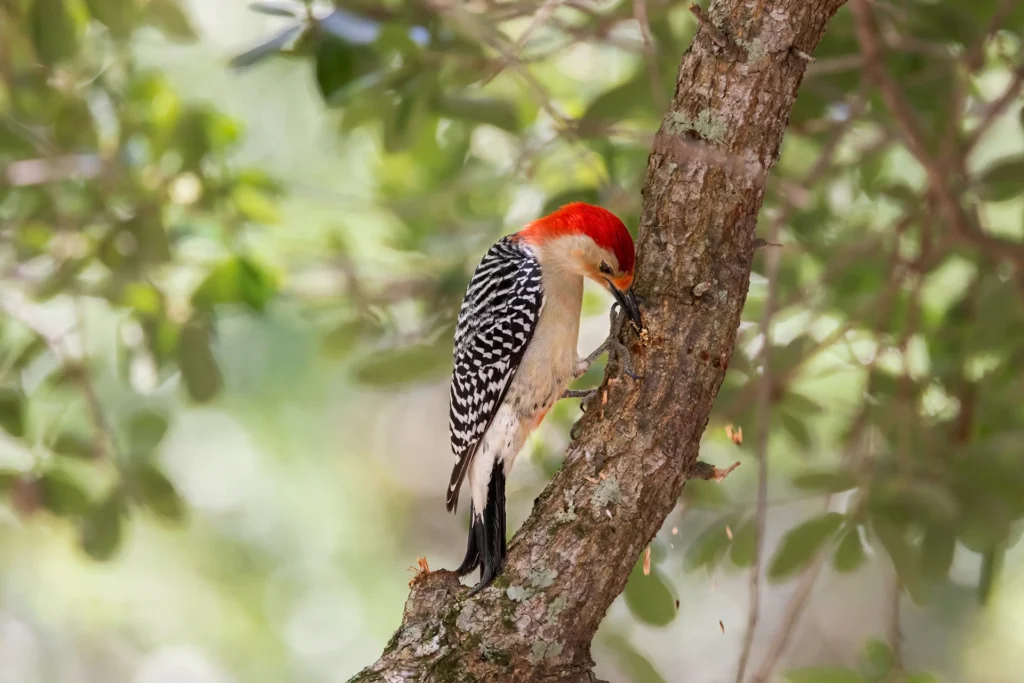
| Behaviour | Clings to tree trunks and pecks at the bark for insects and grubs; often heard before it is seen |
| Log entry | Red-Bellied Woodpecker and Red-Cockaded Woodpecker, in the Birds tab of the Animals menu |
A few honest notes before the spots. First, there is no dedicated woodpecker guide anywhere. The search results for this topic return GameSpot’s wildlife list with one table row per county, the GTALAB and Dexerto wiki pages, compendium lists such as PowerPyx and the Audubon field guide, and one YouTube all-60-birds video. No site has written a how-to-find guide for woodpeckers on its own. That is the whole point of this article: it is the first guide that treats woodpeckers as a topic of their own. Second, woodpeckers are birds you hear before you see. GTALAB puts it plainly: these birds are “frequently identified by sound prior to visual sighting”, and they spend their time attached to tree trunks, “systematically pecking at the bark to locate insects and grubs”. If you walk through a Leonida forest staring at the canopy, you will miss them. If you stop, listen for the tapping, and then look at the trunk the sound is coming from, you will find them. Third, both woodpeckers are study-only. They are not among the four huntable birds in GTA 6 — those are the Leonida Wild Turkey, the Leonida Wild White Tom, the Mottled Duck and the Mosaic Mottled Duck — so there is no Bret payout, no carcass price and no Target Deck for either one. And fourth, do not let the names confuse you. The red-bellied woodpecker’s belly is barely red at all. As one species guide puts it, “despite its name, the best clue is the bright red patch on top of its head, much more striking than the color of its belly”. Look for the red crown, not the belly.
Before You Go: What You Need
Woodpeckers reward patience and good ears more than firepower, so get these three things right before you start searching.
Bring binoculars, and you already have them. The binoculars unlock automatically early in Chapter 1, before the very first mission, and they live in the bottom-right equipment slot of the weapon wheel. Hold L1 or LB to open the wheel, highlight the binoculars with the right stick, and release. Then hold L2 or LT to look through them, use Up and Down on the D-pad to zoom, centre the reticle on the bird, and hold R1 or RB until the study meter fills. Woodpeckers are small birds on big trees, and they move around the trunk as they peck, so the binoculars are not optional here — they are the only reliable way to study one before it hops to the far side of the trunk. If you have not picked the game up yet, a Grand Theft Auto VI for PS5 is the obvious starting point, and the woodpeckers are two of the most satisfying birds to log because you find them by sound.
As an Amazon Associate, we earn from qualifying purchases.
Bring your ears, and turn the game up. The tapping is the whole trick with woodpeckers, and it is much easier to hear than the bird is to see. Turn the music down or off in the audio settings, turn the effects up, and listen for a short, sharp, repeated tapping from the trees as you walk through a forest. A BENGOO G9000 gaming headset helps here — the tapping is a small directional sound, and headphones make it much easier to tell which tree it is coming from than TV speakers do.
As an Amazon Associate, we earn from qualifying purchases.
Go to the trees, not the water. Woodpeckers live in forests, not on coasts or in swamps. GTALAB places them in “forested regions near Mount Kalaga National Park and the lush peripheral zones of Leonida”, the Leonida Explorer field guide puts red-cockaded woodpeckers “in large trees”, and every GameSpot spot is a forest, a hill or a tree-lined road. Do not waste time scanning beaches, docks or rooftops. Pick a wooded area, walk slowly between the big trees, and listen.
How to Study a Woodpecker
The study steps are the same for every bird in GTA 6, and they are the only way to log a woodpecker — there is no other interaction with one.
- Go to one of the spots below, on foot, and walk slowly between the large trees.
- Stop every few steps and listen for tapping. When you hear it, freeze and find the tree the sound is coming from.
- Equip the binoculars from the weapon wheel (hold L1 or LB, pick Binoculars from the bottom-right equipment slot).
- Hold L2 or LT to look through the binoculars, and use Up and Down on the D-pad to zoom in on the bird on the trunk.
- Keep the reticle on the bird and hold R1 or RB until the study meter fills and the species name appears.
- Check the log under Progress, then Animals, then Birds — the Red-Bellied Woodpecker is number 42 and the Red-Cockaded Woodpecker is number 43.
Three practical notes. First, do not run. Woodpeckers are small, skittish birds, and running through a forest scares every bird in it before you get close enough to study one. Walk, stop, listen, look. Second, the bird moves around the trunk as it pecks, so it will keep disappearing behind the tree. Be patient, keep the binoculars up, and wait for it to come back around to your side. Third, if the bird flies off before the meter fills, do not chase it. Woodpeckers return to the same trees, and the same spot will usually have another one within a few in-game minutes. The study meter only counts while the reticle stays on the bird, so a steady aim matters more than a fast one.
Spot 1: Key Lento — Red-Bellied Woodpecker by Jason’s House
This is the easiest woodpecker spot in the game, and it is also the easiest to reach. GameSpot’s Mariana County birds table lists the Red-Bellied Woodpecker at “Key Lento – close to Jason’s house”, and no other woodpecker spot in the game is that close to a safehouse.
- Start at Jason’s stilt house in Key Lento, on the southern coast of the island.
- Walk the trees around the house and the driveway, slowly, listening for tapping.
- Check the large trees along the road south of the house and around the neighbouring houses.
- When you hear tapping, raise the binoculars, zoom in on the trunk, and hold R1 or RB until the study meter fills.
The reason this spot works so well is that it is the same backyard where half the birding in this series starts. The Audubon field guide’s author found his first birds from this same back deck, including the Brown Pelican and the Laughing Gull, and our how to find crows in GTA 6 guide starts in the same backyard — the American Crow is bird number 3, and it is usually sitting on a wire or a rooftop within a minute of leaving the house. The Blue Jay, bird number 13, is also listed by GameSpot at “Key Lento – near Jason’s house”, so one slow walk around the house can log three birds in a single trip. If you only try one spot while learning how to find woodpeckers in GTA 6, try this one first, and give it a few in-game hours — the red-bellied is common here, but it is a small bird on a big tree, and it may take more than one pass to spot it.
Spot 2: North Gellhorn Overpass and the Port Gellhorn Hills
Kelly County holds both woodpecker species, and the two spots here are close enough to cover in one trip. GameSpot’s Kelly County birds table lists the Red-Bellied Woodpecker “close to the North Gellhorn Overpass” and the Red-Cockaded Woodpecker at “one small spawn point in the hills northeast of Port Gellhorn Police Station”.
- Drive to Port Gellhorn in Kelly County and head for the North Gellhorn Overpass.
- Park, get out on foot, and work the trees around the overpass slowly, listening for tapping — this is the red-bellied spot.
- Then drive northeast of the Port Gellhorn Police Station into the hills, and search the large trees there — this is the red-cockaded spot, and it is a small one, so be thorough.
- Study any woodpecker you find the same way: binoculars, zoom, hold R1 or RB until the meter fills.
The red-cockaded spot matters more than the red-bellied one, because it is one of only two pinned red-cockaded spawns in the whole game. The other is west of Millport, in Lummox County, covered in the next section. The red-cockaded is the rarer bird and the harder log entry, so if you are hunting for number 43 specifically, start here. The hills northeast of the police station are pine country, and the Audubon field guide’s author found red-cockaded woodpeckers in the pine-covered areas north of the city — the same kind of habitat. Look for large, mature pine trees rather than small saplings: the Leonida Explorer guide says red-cockaded woodpeckers are found “in large trees”, and in the real world the species nests in living pine trees, which is part of why it is protected as a threatened species in reality. In the game, oddly, it is common — the Audubon writer noted that the red-cockaded woodpecker is common in GTA 6 even though it is protected as a threatened species in the real world. Do not let that fool you into rushing: the spawn point is small, and the bird is small too.
Spot 3: Moreau to Bonanza and West of Millport
Lummox County is the second county that holds both species, and it is the best county for a dedicated woodpecker run. GameSpot’s Lummox County birds table lists the Red-Bellied Woodpecker “between Moreau and Bonanza are the best places to find this bird” and the Red-Cockaded Woodpecker “west of Millport”.
- Drive the road between Moreau and Bonanza in Lummox County, and stop wherever the road passes through big trees.
- Walk the tree line on foot, listening for tapping — the red-bellied is at its best here, and GameSpot calls this stretch the best place in the county for it.
- Then head west of Millport and search the large trees there for the red-cockaded — the second of its two pinned spots.
- Study each bird the same way, and check the log after each one so you know which of the two you still need.
This is the run to do if you already have the red-bellied from Key Lento and only need the red-cockaded. Two pinned spots exist for number 43 in the whole game, and this is one of them. The other is the Port Gellhorn hills spot in the previous section. Between the two counties, a player who checks both has covered every pinned red-cockaded spawn the guides have published. If neither spot produces one on the first visit, leave the area and come back later — birds in GTA 6 respawn on their own schedule, and no guide has published a respawn timer for woodpeckers, so this article will not invent one. The honest advice is to try again on another in-game day rather than to stand in one spot waiting.
Spot 4: North of Belville, Waning Sands and the Vice-Dale Islands
The last two counties add red-bellied spots, not red-cockaded ones, but they are worth knowing if you are already travelling. GameSpot’s Leonard County birds table lists the Red-Bellied Woodpecker “both in areas north of Belville and north of Waning Sands”, and its Vice-Dale County table lists it on “Starfish Island and the cluster of Catalan, Rialto, Vespucci, and Casanova” islands.
- If you are in Leonard County, check the trees north of Belville and north of Waning Sands on foot, listening for tapping.
- If you are in Vice-Dale County, check the trees on Starfish Island and on the Catalan, Rialto, Vespucci and Casanova island cluster.
- Study any woodpecker you find the same way, and remember that these spots are red-bellied only — no red-cockaded spawn has been published in either county.
These are backup spots, not first choices. Key Lento is closer, easier and better documented than any of them, and the Moreau-to-Bonanza stretch is the best red-bellied ground in the game. But if you are already in Leonard or Vice-Dale County for another bird — the eagles around Mount Kalaga, for example, covered in our how to find eagles in GTA 6 guide — then the trees north of Belville or on Starfish Island are worth a slow walk on the way past. One honest note: the Audubon field guide says the red-bellied woodpecker is found “farther north”, which fits these spots, but no guide has published a time-of-day window for either woodpecker, so this article will not invent one. Search in daylight, when the bird is easiest to see against the bark, and when the tapping is easiest to hear over the rest of the game’s soundscape.
Listen First: The Tapping Trick
The tapping trick is the single most useful thing in this guide, and it is the reason woodpeckers are easier to find than they look — it is the fastest way to learn how to find woodpeckers in GTA 6 without wandering the forests blind. GTALAB says these birds are “frequently identified by sound prior to visual sighting”, and that is not flavour text — it is the actual method. A woodpecker announces itself every few seconds with a short burst of pecking, and the sound carries much farther than the bird can be seen.
- Turn the music down or off, and turn the sound effects up.
- Walk slowly through a wooded area and stop every ten steps or so.
- Listen for a short, sharp, repeated tapping — several quick pecks, a pause, then more pecking.
- Turn toward the sound and scan the trunks at eye level and above, not the canopy and not the ground.
- When you find the bird, raise the binoculars before you move any closer — walking up to the trunk will often flush it.
Two things make this work. First, woodpeckers cling to the trunk itself, not to branches, so the sound comes from the trunk and the bird is on the trunk — look at the bark, not the leaves. Second, the bird pecks in bursts while it works a spot, then hops to another spot on the same trunk, so the tapping moves up or around the tree. Follow the sound, not the last place you saw the bird. The tapping is also how you tell a woodpecker area from an empty forest: if you walk a tree line for five minutes and hear nothing, move on to another spot rather than staring at empty trunks. The bird is either there and tapping, or it is not there at all.
Telling the Two Woodpeckers Apart
The two species look similar at a glance — both are small, both cling to trunks, both have black-and-white barred backs — but they are easy to tell apart once you know what to look for.
| Feature | Red-Bellied Woodpecker (bird 42) | Red-Cockaded Woodpecker (bird 43) |
|---|---|---|
| Head | Bright red crown and nape, the most striking mark on the bird | Black cap and white cheek, with only a tiny red streak on the male |
| Back | Black-and-white barred, zebra-like | Black-and-white barred, with large white patches on the back |
| Belly | Pale and barely red, despite the name | Pale, with fine black spots |
| Size | Medium woodpecker, the larger of the two | Smaller, one of the smallest woodpeckers in North America |
| Where | Common across Leonida, five counties with pinned spots | Only two pinned spots: Port Gellhorn hills and west of Millport |
| Habitat | Large trees, forests, backyards and parks | Mature pine forest, large pine trees |
The red crown is the giveaway for the red-bellied. As the species guide says, the bright red patch on top of its head is “much more striking than the color of its belly”, so if the bird on the trunk has a red head, it is the red-bellied. The red-cockaded is the plainer bird: a black cap, a white cheek, and almost no red at all — the “cockade” is a tiny red streak behind the eye on the male, and it is hard to see even through binoculars. In practice, the surest identification is the location: if you are at one of the two red-cockaded spots and the bird has a black cap and a white cheek, it is number 43. If you are anywhere else and the bird has a red crown, it is number 42. Either way, study it before you worry about which one it is — the log entry tells you the species the moment the meter fills, and an unstudied bird only shows its group name until then.
Same Trip: Scrub Jays, Blue Jays and Other Forest Birds
A woodpecker run through Leonida’s forests is also a good run for the small forest birds that share the same trees, and three of them are worth grabbing while you are there.
Scrub Jay, bird 51. GameSpot’s Lummox County table pins the Scrub Jay to “Saint Attaway Islands and Hyde Island (northeast)”, and the Audubon writer found scrub jays in the sand pine areas north of the city — the same pine country where the red-cockaded lives. The Florida scrub-jay is endemic to the state of Florida in the real world, found nowhere else on Earth, which makes it one of the most Florida birds in the whole game. If your woodpecker run takes you through the pine woods north of Port Gellhorn or around Millport, keep an eye out for a blue-grey jay on the low branches and scrub.
Blue Jay, bird 13. GameSpot lists the Blue Jay at “Key Lento – near Jason’s house” and “east of Port Gellhorn, close to the Kelly River North bridge”, and calls it a common spawn across Lummox County. It is one of the easiest birds in the game to identify — bright blue plumage and a crest you cannot miss — and it often moves in flocks through the forests, so where you find one, you usually find several. The Key Lento spot is the same backyard as the woodpecker spot in this guide, so a single slow walk around Jason’s house can log the red-bellied woodpecker, the crow and the blue jay in one trip.
Northern Cardinal, bird 36, and American Robin, bird 7. The Audubon field guide lists both among the birds found farther north, alongside the red-bellied woodpecker, and the wading-birds route in our how to find wading birds in GTA 6 guide covers the wetland birds these forest birds complement. Neither has a pinned spot as precise as the woodpeckers, but both turn up in the same northern forests, so keep the binoculars up as you walk between the woodpecker trees.
What Counts Toward 100%
Woodpeckers count toward 100% completion the same way every studied animal does: one study logs one species, and the game needs 100 of the 255 animals studied for 100%. The two woodpeckers are birds 42 and 43 of the 60 birds, and both sit in the Birds tab of the Animals menu under Progress. There is nothing else to do with them. They are not huntable, so Bret Vogel has no job for them, no Target Deck includes them, and there is no carcass price — the four huntable birds are the Leonida Wild Turkey, the Leonida Wild White Tom, the Mottled Duck and the Mosaic Mottled Duck, and woodpeckers are not among them. They cannot be petted, fed or kept, and there is no mission, event or trophy tied to either one. That is the honest scope of how to find woodpeckers in GTA 6: two study-only log entries, found by ear in the forest, and worth two of the hundred studies the game asks for. If you are working through the bird list systematically, the woodpeckers pair naturally with the owls — our how to find owls in GTA 6 guide covers the two night birds — because the owls are the night shift in the same forests where the woodpeckers work the day shift.
Mistakes to Avoid
Do not run through the forest. Woodpeckers are small and skittish, and running scares every bird in the area before you get close enough to study one. Walk, stop, listen, look. The bird will still be on the trunk when you get there.
Do not look at the canopy. Woodpeckers cling to trunks, not branches, and the tapping comes from the bark. Players who scan the treetops walk straight past the bird. Look at the trunks at eye level and above, and follow the sound to the bark.
Do not confuse the red belly with the red crown. The name is misleading, and the belly is barely red. The bright red patch on the head is the mark that matters, and the species guide says so in so many words. If the bird has a red crown, it is the red-bellied. If it has a black cap and a white cheek, it is the red-cockaded.
Do not expect the red-cockaded everywhere. The red-bellied is common and turns up in five counties. The red-cockaded has exactly two pinned spots in the published guides. If you have searched Key Lento, the overpass and the Moreau-to-Bonanza stretch and only found red-bellied woodpeckers, that is normal — the red-cockaded lives in the Port Gellhorn hills and west of Millport, and nowhere else the guides have pinned.
Do not shoot one. Woodpeckers are study-only birds, and shooting one does not log it, does not pay anything, and does not count toward 100%. The only way to log a woodpecker is to study it with the binoculars or a scoped rifle, holding R1 or RB until the meter fills.
Frequently Asked Questions
Where is the best place to find woodpeckers in GTA 6?
The best place to find woodpeckers in GTA 6 is Key Lento, close to Jason’s house, where GameSpot pins the Red-Bellied Woodpecker — it is the easiest spot to reach and the bird is common there. For the rarer Red-Cockaded Woodpecker, the best places are the hills northeast of Port Gellhorn Police Station and the trees west of Millport, the only two pinned spots in the game.
How many woodpeckers are there in GTA 6?
There are two woodpeckers in GTA 6: the Red-Bellied Woodpecker, bird number 42 of the 60 birds, and the Red-Cockaded Woodpecker, bird number 43. Both sit in the Birds tab of the Animals menu under Progress, and both are study-only.
Can you hunt woodpeckers in GTA 6?
No. Woodpeckers are study-only birds and are not on Bret Vogel’s 61-animal hunting list. The only huntable birds are the Leonida Wild Turkey, the Leonida Wild White Tom, the Mottled Duck and the Mosaic Mottled Duck. Shooting a woodpecker does not log it and pays nothing — study it with binoculars instead.
How do you study a woodpecker in GTA 6?
Equip the binoculars from the weapon wheel (hold L1 or LB, pick Binoculars), hold L2 or LT to look through them, zoom with Up and Down on the D-pad, centre the reticle on the bird on the trunk, and hold R1 or RB until the study meter fills. The binoculars unlock automatically early in Chapter 1, before the first mission.
Why can’t I find the Red-Cockaded Woodpecker?
Because it has only two pinned spawn points in the published guides: the hills northeast of Port Gellhorn Police Station in Kelly County, and west of Millport in Lummox County. It does not spawn at the Key Lento, overpass, Moreau, Belville or island spots, which are all red-bellied only. Check the two pinned spots on foot, listen for tapping on large pine trees, and try again on another in-game day if the first visit comes up empty.

Dr Vivek Garg runs drviram.in — a tech blog about AI tools, apps, and online earning. Every guide here is tested hands-on before it is published.