How to Find Wading Birds in GTA 6: The Complete Guide (2026)
Quick Answer: How to find wading birds in GTA 6: head to the Grassrivers in the morning, where the Roseate Spoonbill, Wood Stork, Whooping Crane and Tricolored Heron all feed in the shallow water — then work the small islands off Key Lento for the Great Blue Heron and the American White Ibis, and Goose Key and the Marquesas Keys for the Great Egret and the Glossy Ibis. Study each bird with binoculars (hold L2 or LT, zoom with the D-pad, hold R1 or RB) from a distance, because wading birds freeze when you approach and take flight if you get too close. No dedicated wading-birds guide existed before this one — every other source only gives these birds a row in a bigger wildlife list, and this is the first guide that strings their spots into one route.
Grand Theft Auto VI launched on November 19, 2026 for PlayStation 5 and Xbox Series X/S, and its wildlife log tracks 255 animals — with 100 studied species needed for 100% completion. The birds log alone holds 60 entries, and the wading birds are one of its biggest families: the long-legged birds of the shallows — spoonbills, herons, egrets, ibises, storks and cranes — that stand motionless in the water and strike at fish. They are also one of the easiest families to miss completely. They do not perch on a dock like a pelican, they do not circle overhead like an eagle, and they do not come to you. They stand still in the reeds, they blend into the water, and the moment you walk up to one it is gone. That is exactly why players keep driving past whole flocks of them without ever logging one. This guide explains how to find wading birds in GTA 6 step by step: the nine wading birds and where each one lives, a five-stop route through the Grassrivers, Key Lento, Goose Key, Buckskin Swamp and the Wildland Zoo, the study steps that actually log the bird, how to tell the lookalikes apart, and the honest limits — including the two wading birds no guide has pinned down yet. Everything below comes from the published guides, and every gap is labelled as a gap rather than filled in with a guess.
How to Find Wading Birds in GTA 6: The Wading Birds at a Glance
The table below is the short version. Everything after it is the step-by-step detail. The spot facts come from GameSpot’s all-animals wildlife guide, cross-checked against the gta6info Birds and Heron wiki pages, the Dexerto Roseate Spoonbill page, the wideangle.tech birds field guide, the Audubon field guide to the birds of GTA 6 and the Exputer Wildland Zoo guide.
| Bird | Best spot | County |
|---|---|---|
| Roseate Spoonbill | Grassrivers, anywhere in the region; also Buckskin Swamp | Mariana / Kelly |
| Great Blue Heron | Key Lento, any island just off the coast near Jason’s home; also the Wildland Zoo aviary | Mariana |
| Great Egret | Goose Key, the larger of the islands west of the Naval Air Station | Mariana |
| American White Ibis | Key Lento, any island just off the coast near Jason’s home; also Draper Island | Mariana / Kelly |
| Glossy Ibis | Marquesas Keys, the small island with the semi-circular shape | Mariana |
| Wood Stork | Grassrivers, anywhere in the region | Mariana |
| Whooping Crane | Grassrivers, anywhere in the region | Mariana |
| Tricolored Heron | Grassrivers, anywhere in the Everglades part of the region | Mariana |
| American White Pelican | Key Lento, any island just off the coast near Jason’s home; also Buckskin Swamp | Mariana / Kelly |
A few honest notes before the spots. First, there are nine wading birds in this guide, and they are not all the same kind of bird. The herons and egrets are solitary hunters that stand still and strike. The spoonbill sweeps its flat bill through the mud. The ibises probe the shallows in small groups. The stork and the crane are the tall ones, and the pelican — the odd one out — floats and dives rather than wading, but it feeds in the same shallow water and every wildlife list files it with the waders, so it is in this route too. Second, no dedicated wading-birds guide exists anywhere. The search results for this topic return only the big wildlife lists, the general bird guides and the wiki pages — GameSpot’s county tables, the gta6info Birds page, the wideangle.tech field guide and the Audubon guide. That is the whole point of this article: it is the first guide that treats wading birds as a topic of their own, and the first to string their spots into a single route. Third, the spots below are not equal. The Grassrivers birds are listed as “anywhere in the region”, which means you will find them if you work the shallows properly — and the route below tells you how. The Key Lento and Goose Key birds have pinned islands, which means a short trip and a real chance of finding one. And fourth, wading birds are study-only animals. They are not on Bret’s 61-animal hunting list — the only huntable birds are the Leonida Wild Turkey, the Leonida Wild White Tom and the two ducks — so there is no weapon, no carcass and no payout in this guide. You go with binoculars, not a rifle.
Before You Go: What You Need
Wading birds reward patience and a slow approach more than firepower, so get these five things right before you leave the city.
Bring binoculars, and you already have them. The binoculars unlock automatically early in Chapter 1, and they live in the bottom-right equipment slot of the weapon wheel. Hold L1 or LB to open the wheel, highlight the binoculars with the right stick, and release. Then hold L2 or LT to look through them, use Up and Down on the D-pad to zoom, centre the reticle on the bird, and hold R1 or RB until the study meter fills. Wading birds stand far out in the shallows, and they take flight the moment you wade up to them — so the binoculars are the only reliable way to log one. If you have not picked the game up yet, a Grand Theft Auto VI for PS5 is the obvious starting point, and the Grassrivers are where the birds log quietly fills up fastest.
As an Amazon Associate, we earn from qualifying purchases.
Go in the morning, and plan for it. The wideangle.tech field guide lists wading birds as active in the morning and midday, feeding in shallow muddy water — the one published activity window for this family. No guide has published a night window for any wading bird, so this article will not invent one. What is known is that these birds feed in daylight, standing in the shallows where the light lets you see them, and a night search of a perfect wading spot is a bad bet: you cannot see a grey heron against dark water, and the binoculars cannot help you find what you cannot see. Plan your trip for the morning, and use the light to scan the shallows from the bank before you step into the water. Real roseate spoonbills and great blue herons are both daytime feeders, but that is real-world behaviour — the game has not published a wading-bird schedule beyond the morning-and-midday window, and this guide does not claim one.
Listen before you look. Wading birds are easier to hear than to see. A heron’s harsh croak, a crane’s bugle and the splash of a spoonbill sweeping its bill all carry over flat water, and they tell you a bird is feeding nearby before your eyes find it. If you play with a headset, you will hear them first — a BENGOO G9000 gaming headset makes the difference between walking past a feeding heron and stopping to study it. Approach on foot once you hear one, and keep the engine off — the wideangle.tech guide warns that an airboat engine must be cut at a distance, because it scatters skittish flocks before you can study them through the lenses.
Bring an airboat for the Grassrivers. The Grassrivers are a maze of shallow waterways, mangrove islets and sawgrass, and the wading birds feed in the middle of it — not on the roads. The airboat is the way in: trade any car for one at Thorpe Adventures, at the north-west end of Pelican Valley, and the map marks the parking spot. Drive it slowly into the shallows, cut the fan well before the birds, and drift or wade the last stretch. Our how to get an airboat in GTA 6 guide covers the swap, the named airboats and the Skunk Ape effigy hunt in the same swamp.
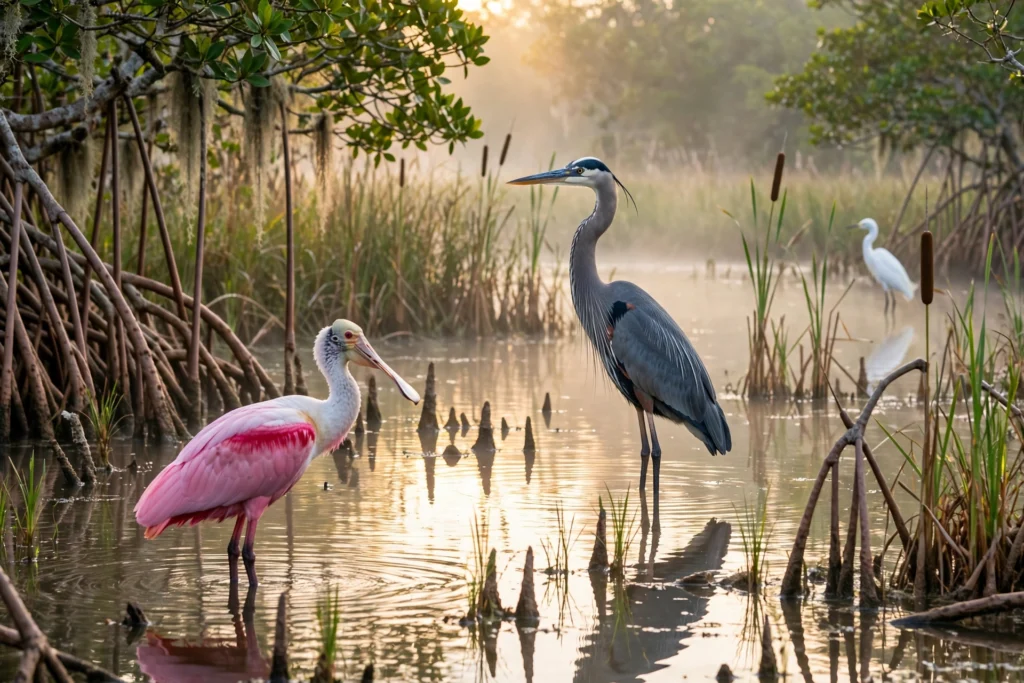
Learn to recognise them before you go. The Roseate Spoonbill is bright pink with a flat, spoon-shaped bill — unmistakable once you see the bill, easy to mistake for a flamingo from far away. The Great Blue Heron is tall and slate-grey-blue with a dagger bill and a white head. The Great Egret is all white, tall and slender, with a yellow bill. The American White Ibis is all white with a long, down-curved red bill. The Glossy Ibis is dark, almost black-green in the shade, with the same curved bill. The Wood Stork is big and white with a bare dark head. The Whooping Crane is the tallest of them all, white with black wingtips and a red crown. The Tricolored Heron is slate-blue with a white belly and a white stripe down its neck. And the American White Pelican is the big white bird with the huge orange bill that floats rather than wades. From a distance they can all look like any pale shape standing in the water — which is why players miss them. But the bill shape, the colour and the feeding behaviour are the tells once you zoom in with the binoculars.
Spot 1: How to Find Wading Birds in GTA 6 in the Grassrivers
This is the best place to start learning how to find wading birds in GTA 6, and it is the only stop on this route where four wading birds share the same water. GameSpot’s wildlife guide lists the Roseate Spoonbill, the Wood Stork, the Whooping Crane and the Tricolored Heron all in the Grassrivers — the spoonbill, the stork and the crane “anywhere in this region”, and the tricolored heron “anywhere in the Everglades part of the region”. Here is how to work it:
- Get an airboat at Thorpe Adventures, at the north-west end of Pelican Valley, and head into the Grassrivers. The swamp sits in Mariana County, west of Hamlet, and the wading birds feed in its shallow waterways and mangrove marshes — not on the roads around it.
- Cut the fan early. The wideangle.tech field guide is explicit about this: explore the waterways by airboat, but cut the engine at a distance, because the fan scatters skittish flocks before you can study them. Drift or pole the last stretch, and stop while the birds are still a long way off.
- Scan the shallows slowly from the boat. Spoonbills sweep their bills side to side through the mud, herons stand frozen with their necks folded, storks and cranes stand tall in the open water. Scan the whole stretch of water in slow sweeps rather than staring at one point — a feeding bird moves slowly, and a slow sweep catches the movement.
- Raise the binoculars the moment you see a long-legged bird. Hold L2 or LT, zoom with the D-pad, centre the reticle on the bird and hold R1 or RB until the study meter fills. The bill is the confirmation: a pink bird with a flat spoon bill is a Roseate Spoonbill, a tall white bird with a bare dark head is a Wood Stork, and the tallest white bird with black wingtips is a Whooping Crane.
- Work the Everglades heart of the region for the Tricolored Heron. GameSpot files it under the Everglades part of the Grassrivers specifically, so push past the fringes into the main marsh — the open shallows with reeds and mangrove islets — rather than the canals near the roads.
- Watch the water while you work. The Grassrivers are alligator country — our how to find alligators in GTA 6 guide covers the same swamp, and the same shallows that hold spoonbills hold alligators. Stay in the boat while you scan, wade only where the water is clear and shallow, and keep an eye on the bank. The birds are the goal, but the alligators are the reason you do this from a boat.
- Come back if the first visit is empty. “Anywhere in the region” is not a promise that a spoonbill is standing in front of you the moment you arrive. The birds move through the shallows as they feed, and a second pass an hour later — or a different channel in the same swamp — is often the one that pays off. The morning window is your friend: the birds are feeding then, and they are out in the open.
The Grassrivers also hold three bonus birds that share the same water. The American Anhinga is listed by GameSpot as “anywhere in this region” — a dark, snake-necked water bird that swims low with only its head above the surface. The Purple Gallinule lives in the main Everglades part of the region — a purple-and-blue marsh bird with a yellow-tipped red bill. And the Killdeer feeds near the lake west of LTF Airfield — a small shorebird with two black bands across its white chest. None of the three is a wading bird in the strict sense, but they are all on the same route, in the same shallows, and they all count toward the same 100 studied species.
Spot 2: The Key Lento Islands — Heron, Ibis and Pelican
The second stop is the easiest one on the route, and it is the one to do first if you are still in Chapter 1. GameSpot’s wildlife guide puts three wading birds on the small islands just off the coast near Jason’s home on Key Lento: the Great Blue Heron, the American White Ibis and the American White Pelican — all three listed as “any island just off the coast near Jason’s home”. Here is how to work it:
- Go to Jason’s house on Key Lento and walk to the dock behind it. The islands sit just off the coast, close enough to reach by boat — Jason’s free fishing boat is moored at the same dock, and it is the easiest way across.
- Take the boat out slowly and scan the islands from the water. Herons stand on the shore or in the shallows at the island edges, ibises probe the mud at the waterline, and pelicans float just offshore. Scan each island from the boat before you land — landing scares the birds, and the boat is the better viewing platform.
- Study from the boat. Hold L2 or LT, zoom with the D-pad, centre the reticle and hold R1 or RB. The islands are small and the birds are close, so this is the easiest study on the whole route — a heron on a Key Lento island is a far simpler target than a spoonbill in the middle of the Grassrivers.
- Check more than one island. The guide says “any island”, which means the birds move between them. If the first island is empty, motor to the next one — there are several small islands in the group, and the herons and ibises spread across them.
- Come back at a different time of day if you strike out. The birds feed in the morning and midday, and an island that is empty at dawn may hold a heron by late morning.
The Key Lento islands are also the best place to practise the study mechanic before the harder spots. The birds are close, the water is calm, and you can take your time. If you are still learning how the binoculars work, do this stop first and the Grassrivers second.
Spot 3: Goose Key and the Marquesas Keys — Egret and Glossy Ibis
The third stop is for the two birds the first two stops do not give you: the Great Egret and the Glossy Ibis. Both have pinned islands, and both are worth the trip.
The Great Egret lives on Goose Key, on the larger of the islands west of the Naval Air Station — GameSpot’s exact words. Goose Key sits in the south-west of the map, and the Naval Air Station — Mile Zero — occupies the south of the island. Take a boat around the west side of the island, away from the base, and scan the larger islands to the west. The egret is all white, tall and slender, and it stands in the shallows at the island edges. Do not approach the base itself: the airspace and the ground around Mile Zero are restricted, and the egret is on the islands west of it, not inside it. Study from the boat, the same way as the Key Lento birds.
The Glossy Ibis lives on the Marquesas Keys, on the small island with the semi-circular shape — GameSpot’s exact words again. The Marquesas Keys are the small island chain west of Key Lento, out toward the open water. Find the island with the semi-circular outline on the map and take a boat to it. The glossy ibis is dark — almost black-green in the shade, with a bronze sheen in the sun — and it feeds in the shallows with the same long, down-curved bill as the white ibis. It is the hardest bird on this route to spot, because a dark bird in dark water at a distance is easy to miss, so scan slowly and use the binoculars on anything long-legged standing in the shallows, even if it looks like a shadow.
These two stops are the reason the route is a route and not a single swamp. The egret and the glossy ibis do not live in the Grassrivers — they live on the Keys, and no amount of searching the swamp will find them. If you only do the Grassrivers, you will finish the trip with four birds and wonder where the rest are. They are here, on the islands west of the base and west of Key Lento.
Spot 4: Buckskin Swamp and Draper Island — The Kelly County Birds
The fourth stop is the northern half of the route, in Kelly County. GameSpot’s Kelly County tables put the Roseate Spoonbill in Buckskin Swamp, the American White Pelican in Buckskin Swamp, and the American White Ibis on Draper Island. Here is how to work it:
- Drive north to Buckskin Swamp, in southern Kelly County. The swamp is the same kind of country as the Grassrivers — shallow water, reeds, mangroves — and the spoonbill and the pelican feed in it the same way.
- Work the shallows on foot or by boat, slowly. The spoonbill is the prize here: a second chance at the pink bird if the Grassrivers visit came up empty, and the same bird in a different swamp. The pelican floats on the open water, so scan the wider stretches, not just the edges.
- Cross to Draper Island for the white ibis. The island sits off the Kelly County coast, and GameSpot lists it as the white ibis spot for the county — the northern counterpart to the Key Lento islands. Scan the shore from a boat, the same way, and study from the water.
- Watch for the swamp’s other residents. Buckskin Swamp holds alligators, cottonmouths and panthers — the same country our how to find panthers in GTA 6 guide covers — so do the scanning from the boat and keep the wading to clear, shallow water.
Buckskin Swamp is also where Bret’s third Target Deck sends hunters for the cane toad, the nutria and the Nile monitor — but the wading birds are not part of that deck. They are study-only, and they share the swamp with the hunting animals without being hunted themselves.
Spot 5: The Wildland Zoo Aviary — The Guaranteed Herons
The fifth stop is the backup that makes the route foolproof. The Wildland Zoo sits on Waxman Island, a small island east of Vice City in Vice-Dale County, and the gta6info Heron page says its walk-through aviary has herons — with the Great Blue Heron named specifically as living in “shallow wetland water, and the Wildland Zoo aviary”. The Exputer zoo guide adds the practical details: a car or taxi gets you there, parking is in the zoo’s car park, and you can enter through the main entrance without anyone stopping you. Once past the gates, a security guard may grow suspicious and declare an area off limits — keep moving where he cannot see you and he leaves you be.
The aviary is the one place on this route where the birds are guaranteed. The wild spots are real, but they are not certain — a spoonbill may not be feeding where you look, and an egret may have moved on. The aviary herons are there, in the walk-through enclosure, and you can study them at close range. If you have done the whole route and you are still missing the Great Blue Heron, the zoo is where you finish the job. The zoo also holds the talking parrots at Parrot Paradise and the other caged birds — the Blue-and-Yellow Macaw, the Scarlet Macaw and the Red-Crowned Parrot all live in cages at the back of the Three Sheets liquor store in Key Lento, and the zoo aviary is where the parrot species are named — but the parrots are a different guide. For this route, the zoo is the heron guarantee.
How to Study a Wading Bird
The study mechanic is the same for every bird in the game, and it is worth getting right once rather than fumbling it at every stop. Follow these steps:
- Equip the binoculars from the weapon wheel. Hold L1 or LB, pick the binoculars from the bottom-right equipment slot, and release.
- Hold L2 or LT to look through them. Use Up and Down on the D-pad to zoom — three zoom levels, and the highest one is for birds standing far out in the shallows.
- Centre the reticle on the bird and hold R1 or RB. A Study prompt appears when the reticle is on an unstudied bird; hold the button until the circle fills and the entry chime rings.
- Check the log. Open Progress, then Animals, and confirm the entry is there. Each bird you study counts toward the 100 animals needed for 100% completion, and the birds are the largest single group in the log — 60 entries — so they are the fastest way to add to the count.
- If the prompt does not appear, you are too far away or the bird is behind reeds. Move closer slowly, or wait for it to step into open water. Do not run at it — wading birds freeze when approached and take flight if you get too close, and a bird in the air is a bird you cannot study.
- Remember the group-name rule. Until you study a bird, the log shows only its group name — the same behaviour the ducks and the vultures show, where an unstudied bird reads as “Duck” or “Seagull” until the study lands. An unstudied wader is just a long-legged shape in the water until the reticle and the study meter turn it into a named entry.
Wading birds are study-only animals, and that is the whole method. There is no weapon, no bait and no trap. The only skill is the approach: slow, quiet, from a distance, with the binoculars doing the work.
Telling Them Apart
The hardest part of this route is not finding a wading bird — it is knowing which one you found. Six pairs of lookalikes cause most of the confusion, and they are all in this guide on purpose.
Roseate Spoonbill vs American Flamingo. The spoonbill is bright pink with a flat, spoon-shaped bill; the flamingo is pink with a bent, downward-curving bill and a much longer neck. From far away they are both pink birds standing in shallow water, and every guide warns that the spoonbill is easy to mistake for a flamingo. The bill is the answer: flat and spoon-shaped means spoonbill, bent and hooked means flamingo. The flamingo’s best spot is the lake in the western part of North Key Largo, and the spoonbill’s is the Grassrivers — so if you are in the swamp and you see a pink bird, it is almost certainly the spoonbill. Note that the flamingo as a topic of its own is muddied by the Cocaine Flamingo collectible guides, which is why this guide treats it only as the spoonbill’s lookalike.
Great Blue Heron vs Great Egret. The heron is tall, slate-grey-blue, with a dagger bill and a white head. The egret is all white, tall and slender, with a yellow bill. The heron stands frozen for long stretches and then strikes; the egret is the brighter, whiter bird, and the one that looks like a white flag in the reeds. The heron’s spot is the Key Lento islands and the zoo aviary; the egret’s is the Goose Key island west of the Naval Air Station.
American White Ibis vs Glossy Ibis. Both have the same long, down-curved bill and the same feeding behaviour — probing the mud in the shallows. The white ibis is all white with a red bill and red legs. The glossy ibis is dark, bronze-green, and much harder to see in the shade. The white ibis is on the Key Lento islands and Draper Island; the glossy ibis is on the small semi-circular island in the Marquesas Keys. If the bird is white, it is the white ibis. If it is dark with a curved bill, it is the glossy ibis.
Wood Stork vs Whooping Crane. Both are tall, white, and found in the Grassrivers. The stork has a bare dark head and a thick, slightly down-curved bill, and it stands with its head held low. The crane is taller, with a red crown, black wingtips and a straight pointed bill, and it stands upright. The crane is the tallest wading bird in the game; the stork is the heavier, bulkier one.
Tricolored Heron vs Great Blue Heron. The tricolored heron is smaller, slate-blue with a white belly and a white stripe running down its neck. The great blue heron is bigger, uniformly grey-blue, with a white head. The tricolored heron lives in the Everglades heart of the Grassrivers; the great blue heron lives on the Key Lento islands and at the zoo.
American White Pelican vs the waders. The pelican does not wade at all — it floats, and it dives for fish. If the big white bird is sitting on the water rather than standing in it, and it has a huge orange bill with a pouch, it is the pelican, not a heron or an egret. The pelican’s spots are the Key Lento islands and Buckskin Swamp.
What Wading Birds Are Not
Three things players expect from this family turn out not to be true, and it is worth saying so plainly before you go.
They are not huntable. The only birds on Bret’s 61-animal hunting list are the Leonida Wild Turkey, the Leonida Wild White Tom, the Mottled Duck and the Mosaic Mottled Duck. No heron, egret, spoonbill, ibis, stork, crane or pelican is on it, and no guide reports a Bret payout for any wading bird. Do not bring the Wortham W-22 for these birds — our how to find ducks in GTA 6 guide covers the two huntable water birds, and this route is binoculars only.
They are not pets. Dogs and cats can be praised and petted, and the Key Lento Mini Mart has a shop cat you can meet in Chapter 1 — but wading birds are wildlife, not domestic animals. There is no praise prompt, no pet prompt and no treat for a heron. The interaction is the study prompt, and nothing else.
They are not a mission. No story mission, side mission or challenge sends you after a wading bird. The only bird-related system in the game is the logbook’s contribution to 100% completion — 100 of the 255 animals studied — and the wading birds are nine entries toward that count. That is the whole reward, and it is a real one: nine birds, all study-only, all available from the start, and all on one route.
Honest Gaps
Four gaps in this guide are worth naming, because they are the places where a future guide will improve on this one.
The Little Blue Heron has no pinned spot. The wideangle.tech field guide lists the Little Blue Heron under Herons and Egrets, alongside the Great Blue Heron and the Great Egret — but no guide has published where to find one. It is a real entry in the birds log, and it is probably in the same shallow water as the other herons, but this article will not guess a spot for it. If you find one while working the Grassrivers or the Key Lento islands, study it and note where — it is the tenth wading bird, and it is still waiting for a pinned location.
The Sandhill Crane is reported, not pinned. The pro-gamer birds guide lists sandhill cranes among the Grassrivers wading birds, alongside the flamingos, spoonbills, egrets, herons and white ibises — but no guide has published a spot for one, and the gta6info Birds table lists only the Whooping Crane. This guide treats the sandhill crane as reported but unpinned, and does not claim it as a tenth bird on the route.
No time window beyond morning and midday. The only published activity window for wading birds is the wideangle.tech note that they are active in the morning and midday, feeding in shallow muddy water. No guide has published a night window, a dusk window or a feeding schedule for any single species. The route in this guide is a morning route for that reason, and it does not claim the birds are absent at other times — only that morning is the window the sources support.
Two source errors to watch for. GameSpot’s wildlife guide spells the spoonbill “Rosate Spoonbill” in its county tables — the correct name is Roseate Spoonbill, and this guide uses the correct spelling throughout. And the same guide’s birds table lists a Bald Eagle “inside a cage at the back of the liquor store near the Pay ‘n’ Spray” — that is the Exotic Animals Front parrot cage, not an eagle, and the parrots are the Red-Crowned Parrot, the Blue-and-Yellow Macaw and the Scarlet Macaw. Our how to find eagles in GTA 6 guide covers the real eagle spots. Neither error changes a wading-bird spot, but both are worth knowing before you trust a table row at face value.
FAQ
Where is the best place to find wading birds in GTA 6?
The Grassrivers, in the morning. The Roseate Spoonbill, the Wood Stork, the Whooping Crane and the Tricolored Heron all feed there, and the wideangle.tech field guide lists wading birds as active in the morning and midday. Take an airboat in from Thorpe Adventures, cut the fan early so you do not scatter the flocks, and scan the shallows slowly with binoculars.
How do you study a wading bird in GTA 6?
Equip the binoculars from the weapon wheel (hold L1 or LB, pick them from the bottom-right equipment slot), hold L2 or LT to look through them, zoom with Up and Down on the D-pad, centre the reticle on the bird and hold R1 or RB until the study meter fills. The birds freeze when approached and take flight if you get too close, so study from a distance and never run at one.
Can you hunt wading birds in GTA 6?
No. The only huntable birds are the Leonida Wild Turkey, the Leonida Wild White Tom, the Mottled Duck and the Mosaic Mottled Duck. Herons, egrets, spoonbills, ibises, storks, cranes and pelicans are study-only — they count toward the 100 studied animals needed for 100% completion, and Bret pays nothing for them.
What is the difference between a Roseate Spoonbill and a flamingo in GTA 6?
The bill. The spoonbill is bright pink with a flat, spoon-shaped bill that it sweeps side to side through the mud. The flamingo is pink with a bent, downward-curving bill and a much longer neck. The spoonbill lives in the Grassrivers and Buckskin Swamp; the flamingo’s best spot is the lake in the western part of North Key Largo.
Where can you find a Great Egret in GTA 6?
On Goose Key, on the larger of the islands west of the Naval Air Station — GameSpot’s exact spot. Take a boat around the west side of the island, away from the base, and scan the shallows at the island edges. The egret is all white, tall and slender, with a yellow bill, and it stands in the shallows where the water meets the shore.
The Route, In Short
How to find wading birds in GTA 6 comes down to one morning and five stops: the Grassrivers for the spoonbill, the stork, the crane and the tricolored heron; the Key Lento islands for the great blue heron, the white ibis and the white pelican; Goose Key for the great egret and the Marquesas Keys for the glossy ibis; Buckskin Swamp and Draper Island for the northern spoonbill, pelican and ibis; and the Wildland Zoo aviary as the guaranteed heron if the wild spots come up empty. Nine birds, all study-only, all on one route, and all counted toward the 100 studied species for 100% completion. Go in the morning, cut the airboat fan early, study from a distance — and leave the rifle at home.
As an Amazon Associate, we earn from qualifying purchases.

Dr Vivek Garg runs drviram.in — a tech blog about AI tools, apps, and online earning. Every guide here is tested hands-on before it is published.