How to Find Vultures in GTA 6: The Complete Guide (2026)
Quick Answer: How to find vultures in GTA 6: head to the hills east of Farmer Scrumpy’s Apple Orchard, northeast of Port Gellhorn, where a cluster of Turkey Vultures circles over the farmland — or look up anywhere in northern Leonida during the day, where vultures ride the thermals high above the roads. Vultures are study-only birds, so once you spot one, study it with your binoculars (hold L2 or LT, zoom with the D-pad, hold R1 or RB) and the species logs itself in your wildlife journal. One warning before you go: an unstudied vulture shows up as a Seagull in the log, so do not trust the name on screen until you have studied the bird.
Grand Theft Auto VI launched on November 19, 2026 for PlayStation 5 and Xbox Series X/S, and its wildlife log tracks 255 animals — with 100 studied species needed for 100% completion. The vulture is one of the quietest entries on that list. It does not attack you, it does not pay out at Bret Vogel’s hunting cabin, it has no mission attached to it, and it spends most of its time as a dark speck circling a long way above your head. That is exactly why players keep missing it: you can drive past a vulture a dozen times and never look up, and even when you do look up, the game itself may tell you the bird is a seagull. This guide gives you the one pinned cluster spot any guide has published, the habits that separate the two vulture species, the study steps that actually log the bird, and the honest gaps — including the fact that there is no guaranteed Black Vulture spawn point published anywhere yet. Everything below comes from the published guides, and every gap is labelled as a gap rather than filled in with a guess.
How to Find Vultures in GTA 6: The Two Vultures at a Glance
The table below is the short version. Everything after it is the step-by-step detail.
| Fact | What the guides say |
|---|---|
| Species in the log | Black Vulture (#12 of 60 birds) and Turkey Vulture (#56 of 60 birds) |
| Group | Birds — study-only, not huntable |
| Best pinned spot | Turkey Vulture cluster in the hills east of Farmer Scrumpy’s Apple Orchard, northeast of Port Gellhorn |
| Black Vulture range | Occasionally spotted in various regions of Leonida; no fixed spawn published |
| Turkey Vulture range | Occasionally seen across Leonida, most frequently in the north |
| How to log it | Study with binoculars (L2 or LT, then hold R1 or RB) or up close with L2 or LT + R1 or RB |
| The trap | An unstudied vulture shows as a Seagull in the log until you study it |
| Habitat | Open sky over farmland, hills and highways; carrion birds that circle over carcasses and roadkill |
| Threat | None — vultures do not attack and are not hunted |
| Why you need one | Bird-log entry toward the 100 studied species for 100% completion |
A few honest notes before the spots. First, there are exactly two vultures in the 60-bird log: the Black Vulture at number 12 and the Turkey Vulture at number 56, according to the full birds list that orders them the same way as the in-game Progress menu. One compendium counts 62 bird entries rather than 60, so the numbering can shift by a couple of places depending on the source — but the two species themselves are agreed on by every guide. Second, only one of the two has a pinned location. The Turkey Vulture cluster east of Farmer Scrumpy’s Apple Orchard is the single spot any guide has published for either vulture, and it appears in two independent sources. The Black Vulture has no published fixed spawn at all: the databases say only that it is “occasionally spotted in various regions of Leonida”. Third, vultures are daytime birds. They soar on thermals, and thermals need sun, so the search is a morning-to-afternoon job — the opposite of the owls, which only come out at night. If you go looking for a vulture after dark, you are looking at the wrong time of day entirely.
Before You Go: What You Need
Vulture watching rewards preparation more than speed, so get these five things right before you leave the city.
Go in the daytime, and set the time yourself. Vultures ride rising warm air, and that only happens while the sun is up. The best window is late morning through the afternoon, when the thermals are strongest and the birds are circling highest and longest. If you wake up at night, do not waste the trip — sleep until Morning, 7:00 AM, and drive out in daylight. Our guide to how to change time of day in GTA 6 covers the four wake-up times and the 144-minute in-game day, and the Morning option is the one you want here. A Grand Theft Auto VI for PS5 is the obvious starting point if you have not picked the game up yet, and Leonida’s northern farmland is where the bird log quietly fills up fastest.
As an Amazon Associate, we earn from qualifying purchases.
Bring binoculars, and you already have them. The binoculars unlock automatically early in Chapter 1, and they live in the bottom-right equipment slot of the weapon wheel. Hold L1 or LB to open the wheel, highlight the binoculars with the right stick, and release. Then hold L2 or LT to look through them, use Up and Down on the D-pad to zoom, centre the reticle on the bird, and hold R1 or RB until the study meter fills. Before you study a vulture, the game only shows you the group name — and, as the next section explains, it may show you the wrong group name entirely. Study it and the log shows the species name, and the entry is yours. Binoculars are the only reliable way to log a vulture, because the bird is usually a long way above you and you cannot get close to it on foot.
Bring a car and a full tank. The pinned cluster is in the hills northeast of Port Gellhorn, and the Black Vulture search covers the whole northern half of the map. You will be driving between hilltops, farm roads and highway overlooks, and stopping often to scan the sky. A fast car with a full tank saves real time here, because the search is mostly driving and looking up. Fuel is cheap at the 57 gas stations around Leonida, and running out of fuel on a farm road in the middle of nowhere is the one way to turn a short birding trip into a long walk.
Bring a save and patience. Vultures are not guaranteed at any spot, including the pinned cluster. They circle when they circle, and a visit can come up empty even in the right place at the right time. Save manually before you leave Port Gellhorn, and plan to try the cluster, wait or circle the area, and come back later if the sky is empty. Reloading a save is a legitimate way to re-roll a spawn, and it beats driving in circles for an hour. The vulture is a study-only bird with no mission timer and no reward for speed, so there is no penalty for taking your time.
Learn the two species before you go. The Black Vulture has black plumage and a gray-black head, and it is the more territorial of the two, with excellent eyesight and a strong sense of smell. The Turkey Vulture is named for its red, turkey-like face and has brownish feathers. In the air at a distance they look similar — both are big dark birds with broad wings — but the face colour and the feather tone are the tells once you zoom in with the binoculars. Knowing which one you are looking at matters, because the log counts them as two separate entries, and the Turkey Vulture is the one with the pinned spot while the Black Vulture is the one you will have to hunt for.
Spot 1: The Turkey Vulture Cluster — Hills East of Farmer Scrumpy’s Apple Orchard
This is the one pinned vulture spot in the published guides, and it is the place to start learning how to find vultures in GTA 6. The wildlife-spawn guide that maps animals county by county puts a Turkey Vulture cluster in the hills east of Farmer Scrumpy’s Apple Orchard, northeast of Port Gellhorn, and the big wildlife list agrees. Here is how to work it:
- Drive to Port Gellhorn, on the west coast of Kelly County, and head northeast out of town toward Farmer Scrumpy’s Apple Orchard. The orchard is farm country — open fields, low hills, and long sightlines — which is exactly the kind of ground vultures patrol.
- Climb into the hills east of the orchard. You want height, because vultures circle high and a hilltop puts you closer to them and gives you a clear view of the sky in every direction. Park where you can see the valley below and the sky above it.
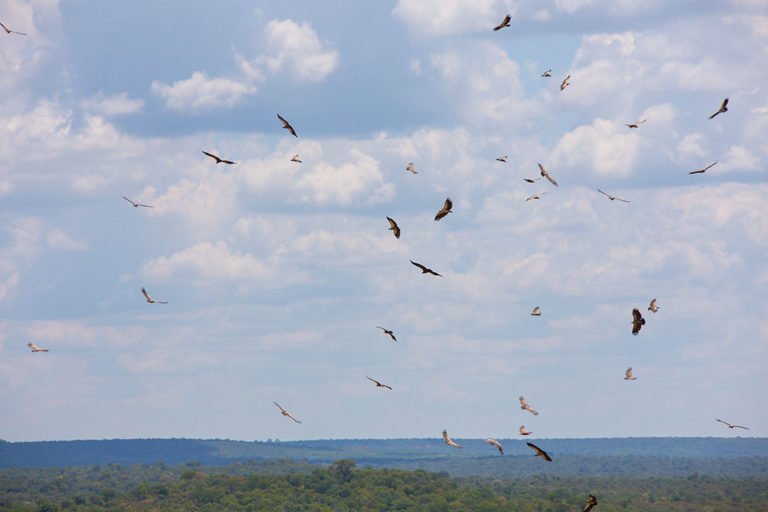
- Stop the car, get out, and look up. Do not scan the ground first — the birds are in the air, circling slowly on the thermals, often in a loose group. A cluster means several birds in the same patch of sky, which is much easier to spot than a single bird.
- Watch for the circling pattern. Vultures do not flap much; they ride the rising air in slow, wide circles, wings held flat and steady, barely moving. A bird flapping hard across the sky is probably something else. A bird hanging in the same circle for a minute is a vulture.
- Raise the binoculars, centre the reticle on a circling bird, and hold R1 or RB until the study meter fills. The study prompt only appears when the bird is centred and in range, so zoom in with the D-pad and track the bird as it circles. Study one bird and the Turkey Vulture entry is yours.
- If the sky is empty, wait or circle the area. Vultures are not on a fixed timer that any guide has published, and an empty sky does not mean the spot is wrong — it means the birds are not up right now. Drive a short loop through the orchard roads and come back, or reload your save and try again. The cluster is reported by two sources, so it is worth a second visit before you write it off.
One more reason this spot is worth the trip: the same orchard area is also a Barn Owl spot at night, which means the hills east of Farmer Scrumpy’s Apple Orchard are one of the few places in Leonida where two different bird entries live in the same patch of ground. Our guide to how to find owls in GTA 6 covers the night shift — Barn Owls on the water tanks and around the orchard after dark. Do the vultures by day, sleep until night, and do the owls in the same area. Two log entries, one trip, and a much better return on the drive out of Port Gellhorn.
Spot 2: Black Vultures Across Northern Leonida
The Black Vulture is the harder of the two, and the honest truth is that no guide has published a fixed spawn point for it. The database entry says only that it is “occasionally spotted in various regions of Leonida”, and the wiki page that tracks it lists its location as “in flight” — which is another way of saying the bird is found in the air, not on the ground, and not in one place. That does not mean it cannot be found. It means you have to search by habitat and behaviour instead of by a map pin, and the Turkey Vulture’s range gives you the best starting point: Turkey Vultures are seen across Leonida but “most frequently in the north”, and the Black Vulture’s sightings follow the same pattern. Work the north.
Start in the northern farmland and hills. The Turkey Vulture cluster sits northeast of Port Gellhorn, and the northern counties — Kelly, Lummox and Leonard — are where both species turn up most often. Drive the farm roads and hill roads of the north in the daytime, stop at high ground, and scan the sky the same way you did at the orchard. The Black Vulture is territorial, so it tends to work the same patch of sky rather than wandering, which means a bird you see circling over the same hills on two different days is likely the same bird — and a bird you study once is logged for good.
Check the highways and the roadkill. Vultures are carrion birds, and their real-world behaviour in Florida is to soar on thermals scanning for carrion, then gather at roadkill and landfills. In Leonida that means the highways: a dead animal on the roadside, a crash site, or any carcass in the open will draw vultures down from the sky. Drive the northern highways slowly and watch for dark birds circling low over one spot by the road — that tight, low circle over a fixed point on the ground is the signature of birds working a carcass, and it is very different from the high, lazy circles of birds just riding a thermal. Pull over at a safe distance, raise the binoculars, and study the birds before they scatter.
Look for them in flight, not on the ground. Every source that has logged a Black Vulture found it in the air. Vultures spend their time soaring, not perching in the open, and a vulture on the ground is usually on a carcass and will flush quickly if you approach. The binoculars are the tool here, not your feet: spot the circle in the sky, zoom in, and study from a distance. If you drive up to a carcass and the birds lift off before you can study them, back off, wait, and let them come back down — or study them while they are still circling above, which is the easier shot anyway.
Do not confuse the Black Vulture with the Turkey Vulture. At a distance both are big dark birds, and both circle the same way. The difference is in the details the binoculars reveal: the Black Vulture’s gray-black head against black plumage, against the Turkey Vulture’s red face and brownish feathers. If you study a bird at the orchard cluster and it logs as a Turkey Vulture, that is expected — the cluster is a Turkey Vulture spot. The Black Vulture is the second entry, and it takes a separate sighting in the wider north. Log both, and the vulture section of the bird log is done.
How to Study a Vulture in GTA 6
Studying is the whole mechanic, and it is the same for every bird in the log. Here are the steps, in order:
- Equip the binoculars from the weapon wheel. Hold L1 or LB, highlight the binoculars in the bottom-right equipment slot with the right stick, and release.
- Hold L2 or LT to look through the binoculars. Use Up and Down on the D-pad to zoom in and out. The zoom is what makes a bird a hundred metres up studyable at all.
- Centre the reticle on the bird and keep it there. A circling bird moves across your view, so track it smoothly with the right stick rather than snapping the reticle to it. The study prompt appears when the bird is centred and in range.
- Hold R1 or RB until the study meter fills. Do not release early — the meter resets if you let go, and a circling bird will have drifted out of the reticle by the time you re-centre it.
- Check the log. Open Progress, then Animals, then Birds, and confirm the entry now shows the species name — Black Vulture or Turkey Vulture — instead of a group name. If it still shows a group name, the study did not complete, and you need to try again.
- If the bird is close enough, you can also study without the binoculars: hold L2 or LT to focus on it, then hold R1 or RB. This works for a vulture that has come down to a carcass, but the binoculars are the safer method for a bird in the air.
A BENGOO G9000 gaming headset helps here in a small way: the study chime that confirms a log entry is easy to miss over TV speakers, and hearing it means you know the bird is logged without opening the menu. It is a minor thing, but on a long birding run across the north, the audio cues save a lot of menu-checking.
The Seagull Mix-Up: Why Your Vulture Logs as a Seagull
This is the strangest part of the vulture hunt, and it is the reason some players think they have never seen a vulture when they actually have. According to the vulture wiki page, which draws on the MeowDB animal database, an unstudied vulture shows as a Seagull in the log until you study it — and only after the study does it log as a Black Vulture. The vulture wiki page that documents this quirk lists the in-game entry as Black Vulture and notes the Seagull label as the pre-study display, and the same page confirms the two species in the log.
What that means in practice is simple: if you point your binoculars at a big dark bird circling over the farmland and the prompt says Seagull, do not believe it and do not walk away. Seagulls live on beaches, docks and the coast, and they are smaller, paler, and far more likely to be flapping than soaring. A large dark bird circling high over inland farmland is not a seagull, whatever the unstudied label says. Study it anyway. If it logs as a Black Vulture, you have just found the harder of the two species by accident, and the quirk is the reason nobody else noticed it. If it really is a seagull, you have lost thirty seconds and learned the difference.
The quirk also explains why the Black Vulture has no pinned location: players have been seeing the bird for days and logging it as a seagull, so nobody built up a reliable set of sightings to pin down. Now that the quirk is documented, the honest advice is to study every large dark bird you see circling inland, especially in the north, and let the log sort out which ones are vultures. The full birds list that orders all 60 species the same way as the Progress menu puts the Black Vulture at number 12 and the Turkey Vulture at number 56, so you can check exactly which of the two you are still missing.
Follow the Circles: Carrion, Roadkill and Thermals
Vultures do not wander randomly. They work, and the work has a pattern you can read from the ground.
Circles over a fixed point mean food. A vulture riding a thermal circles high and drifts slowly with the wind. A vulture working a carcass circles low and tight over one spot on the ground, and other vultures join it. If you see two or three dark birds circling low over the same patch of roadside or field, drive toward that point — there is almost certainly a carcass there, and the birds will be low enough to study easily. This is the fastest way to find a Black Vulture without a pinned spot: let the birds tell you where the food is.
Roadkill is the bait you do not have to set. Leonida’s highways produce roadkill constantly, and vultures are the cleanup crew. The northern highways are the best place to look, because the Turkey Vulture is most frequent in the north and the Black Vulture’s sightings follow the same range. Drive at a moderate speed, watch the sky ahead of you rather than the road, and pull over the moment you see a low circle. The birds will scatter if you stop too close, so park a little way off and use the binoculars.
Thermals are a daytime-only tool. The rising warm air that lets a vulture soar without flapping only exists while the sun is heating the ground, which is why the whole search is a daytime job. Early morning thermals are weak, so the birds stay low and close to the hills; by midday they are high and wide. If you arrive at the orchard cluster at dawn and see nothing, that may be the thermals, not the spot — come back at midday before you decide the cluster is empty. And if the day is overcast or raining, the thermals are weaker still, so a clear day is worth waiting for.
Landfills and farm yards are worth a look. In the real Florida that Leonida is built on, vultures gather at landfills as well as roadkill, and the same logic applies in the game: any place with waste, carcasses or slaughter will draw them. No guide has published a landfill vulture spot for GTA 6, so treat this as a lead rather than a confirmed location — but if you are driving past a dump or a farm yard and see dark birds circling low, stop and study them. The Black Vulture’s territorial habit means a bird that works one landfill will likely be there again tomorrow.
Vultures vs Eagles: Do Not Mix Up the Big Dark Birds
Leonida has more than one large dark bird, and the one players most often confuse with a vulture is the eagle. The table below is the short comparison.
| Bird | Where to look | How to tell it apart |
|---|---|---|
| Black Vulture | Various regions, most often the north; in flight | Black plumage, gray-black head, broad wings, soars in slow circles, often in a group |
| Turkey Vulture | Hills east of Farmer Scrumpy’s Apple Orchard, NE of Port Gellhorn; most frequent in the north | Red turkey-like face, brownish feathers, soars in slow circles, often in a group |
| Golden Eagle | Soaring over the Mount Kalaga area; no confirmed pinned spot yet | Larger, golden-brown, powerful flapping flight as well as soaring, usually alone |
The eagles are a separate hunt: the only concrete sighting published so far is a Golden Eagle soaring over the Mount Kalaga area, and no guide has pinned a location for any eagle yet, so they are a thinner target than the vultures right now. The practical difference is behaviour. Eagles are hunters that fly alone and flap powerfully between glides; vultures are scavengers that circle in groups and barely flap at all. If the bird is circling slowly with two or three others and never flapping, it is a vulture. If it is flying alone with strong wingbeats, it is probably an eagle, and it is not what you came for. Study the circling groups, ignore the lone flapping birds, and the vulture entries will come faster.
Mistakes to Avoid
Going at night. Vultures are daytime birds, and the owls own the night. Our guide to how to find owls in GTA 6 covers the Barn Owl and the Great Horned Owl, both night-only, and the orchard area serves both hunts — vultures by day, owls by night. Do not mix up the schedule, or you will spend a night staring at an empty sky wondering where the vultures went. They went to roost.
Trusting the Seagull label. An unstudied vulture shows as a Seagull, and players have been walking away from vultures for days because of it. Study every large dark bird circling inland, whatever the label says, and let the log correct itself. The seagull is a coastal bird; a big dark bird circling over northern farmland is not one.
Trying to hunt one. Vultures are not on Bret Vogel’s hunting list. The huntable birds in the published hunting lists are the Leonida Wild Turkey, the Leonida Wild White Tom, the Mottled Duck and the Mosaic Mottled Duck — vultures are not among them, there is no recommended weapon for one, and there is no carcass payout. Hunting opens in Chapter 2 through Bret, after the mission Coffee Break, and it covers 61 animals — the vulture is not one of them. If you shoot at a vulture, you will only scare it and waste the trip. Study it, do not shoot it. Our guide to how to find bears in GTA 6 covers an animal you can hunt, with the SM-69 and Bret’s payouts; the vulture is the opposite kind of entry.
Searching the coast. Seagulls, pelicans and herons own the coast. Vultures own the inland farmland, hills and highways. If you are scanning the beaches and the docks for a vulture, you are in the wrong habitat — drive inland, climb a hill, and look up. The Turkey Vulture cluster is in farm country for a reason, and the Black Vulture’s sightings follow the same inland pattern.
Expecting a guaranteed spawn. Even the pinned cluster is not a guaranteed spawn. Vultures circle when they circle, and a visit can come up empty in the right place at the right time. Save before you go, try the cluster, loop the orchard roads, and come back later or reload if the sky is empty. The bird is a study-only entry with no mission timer, so there is no penalty for a second visit — only for assuming the first empty sky means the spot is wrong.
Forgetting the second species. The cluster is a Turkey Vulture spot. Logging it gives you one of the two vulture entries, and the Black Vulture is a separate sighting in the wider north. Do not finish the cluster, see one entry tick over, and assume the vulture section is done. Check the bird log, see which of the two numbers — 12 or 56 — is still missing, and keep searching the north until both are filled.
Frequently Asked Questions
Where is the best place to find vultures in GTA 6?
How to find vultures in GTA 6 starts with one pinned spot: the Turkey Vulture cluster in the hills east of Farmer Scrumpy’s Apple Orchard, northeast of Port Gellhorn. Go in the daytime, climb a hill east of the orchard, and look for several large dark birds circling slowly on the thermals. The Black Vulture has no pinned spot published anywhere, so for the second species, work the northern farmland and highways and study every large dark bird circling inland.
Why does my vulture show up as a Seagull in GTA 6?
Because an unstudied vulture shows as a Seagull in the log until you study it, and only then does it log as a Black Vulture. The quirk is documented in the vulture wiki page from the MeowDB animal database. Do not trust the label: a large dark bird circling high over inland farmland is not a seagull, whatever the screen says. Study it with the binoculars and the log corrects itself.
Can you hunt vultures in GTA 6?
No. Vultures are study-only birds and are not on Bret Vogel’s hunting list. The huntable birds are the Leonida Wild Turkey, the Leonida Wild White Tom, the Mottled Duck and the Mosaic Mottled Duck. There is no recommended weapon for a vulture, no carcass to sell, and no payout. Study the bird with binoculars and leave it alone.
What time of day do vultures appear in GTA 6?
During the day. Vultures soar on thermals, which need the sun heating the ground, so the best window is late morning through the afternoon. At night they roost, and the night sky belongs to the owls instead. If you wake up at night, sleep until Morning, 7:00 AM, and drive out in daylight.
How do you study a vulture in GTA 6?
Equip the binoculars from the weapon wheel, hold L2 or LT to look through them, zoom with Up and Down on the D-pad, centre the reticle on the circling bird, and hold R1 or RB until the study meter fills. Binoculars unlock automatically early in Chapter 1. You can also study up close by holding L2 or LT and then R1 or RB, but the binoculars are the reliable method for a bird in the air. Check Progress, then Animals, then Birds, to confirm the species name is logged.
The Short Version
How to find vultures in GTA 6 comes down to one pinned spot, one habit, and one quirk. The spot is the Turkey Vulture cluster in the hills east of Farmer Scrumpy’s Apple Orchard, northeast of Port Gellhorn — go in the daytime, climb a hill, and look for several large dark birds circling slowly on the thermals. The habit is to follow the circles: low tight circles over a fixed point on the ground mean a carcass, and that is where the Black Vulture, which has no pinned spot of its own, is most likely to come down low enough to study. The quirk is that an unstudied vulture shows as a Seagull, so study every large dark bird circling inland and let the log correct itself. Vultures are study-only, not huntable, and the two entries — Black Vulture at number 12 and Turkey Vulture at number 56 — are two separate sightings, so do not stop after the first one. Go by day, bring the binoculars, study before you do anything else, and do the owls in the same orchard area after dark for a second log entry on the same trip. The vulture is a quiet bird with no mission and no payout — but it is two entries in a 255-animal log, and now you know where to look up.
As an Amazon Associate, we earn from qualifying purchases.

Dr Vivek Garg runs drviram.in — a tech blog about AI tools, apps, and online earning. Every guide here is tested hands-on before it is published.