How to Find a Manta Ray in GTA 6: The Complete Guide (2026)
Quick Answer: How to find a manta ray in GTA 6: take a boat out past Corsair Key until the area name on screen changes to Atlantic Ocean, then watch the surface for wingtips curling out of the water beside the hull — that is the Giant Oceanic Manta Ray, and it is far wider than Jason is tall. Jump in and swim alongside it to study it. GameSpot’s wildlife list gives a second spot: the water south-east of Key Lento, near the island’s north-east harbour and Kenton’s Fence. You need a boat and scuba gear, which Kenton gives you in the Chapter 1 mission Island Dreams.
Grand Theft Auto VI launched on November 19, 2026 for PlayStation 5 and Xbox Series X/S, and its ocean holds 18 Aquatic entries in the wildlife log, from tiger sharks to moon jellyfish. The manta ray is the biggest of the three rays in that list, and it is also one of the least covered: no dedicated guide existed for it at the time of writing, only a section in a sea-creatures roundup filmed on PS5, one row in GameSpot’s wildlife list, and a line in PowerPyx’s all-aquatic list. That is exactly why this guide exists. For the official game page, see Rockstar’s Grand Theft Auto VI site. This guide covers how to find a manta ray in GTA 6, the two confirmed spots for the Giant Oceanic Manta Ray, where its two smaller cousins — the Spotted Eagle Ray and the Atlantic Stingray — live, how to study a ray, and the sharks sharing the same water.
How to Find a Manta Ray in GTA 6: The Three Ray Spots
There are three ray entries in the Aquatic log, and each one has its own water. The table below is the short version; the sections after it walk through each spot step by step.
| Ray | Where | How to spot it | Study confirmed |
|---|---|---|---|
| Giant Oceanic Manta Ray | Past Corsair Key, open Atlantic; also south-east of Key Lento | Wingtips curling out of the water beside the boat | Yes, close swim |
| Spotted Eagle Ray | Reef off Corsair Key; Key Lento southern coast; Leonida Straits | Group gliding over divers just below the surface | Yes, close swim |
| Atlantic Stingray | Key Lento, water north of the Cheeky Mutineer; sea east of the southern-coast islands | Small ray on the seabed in shallow coastal water | Yes, close swim |
The Giant Oceanic Manta Ray is the one this guide is about, and the two spots for it are the open Atlantic past Corsair Key and the water south-east of Key Lento. The eagle ray and the stingray are the bonus: they live on the same reef and the same coast, so a single trip can log all three rays in one outing. That is how to find a manta ray in GTA 6 in one paragraph. The rest of this guide covers each spot in full, the gear you need before you go, how studying works underwater, and what to do about the sharks in the same water.
Spot 1: The Giant Oceanic Manta Ray Past Corsair Key
The reliable way to find a manta ray in GTA 6 is the open Atlantic past Corsair Key. The sea-creatures guide, which filmed its whole roundup on PS5 in the launch version, found its mantas there, and the method is simple: most of the wildlife lives off the coast of Vice-Dale County, and the open water past Corsair Key is where the big animals are. Here is the trip, step by step:
- Get scuba gear in Island Dreams. The Chapter 1 mission Island Dreams, with Kenton Rees, hands you the scuba gear along with the Arras Bullhead harpoon gun and the metal detector. Without the gear you cannot stay down long enough to work with a manta ray. See how to get a harpoon gun in GTA 6 for the full Island Dreams route, including the shark fight and the doubloon payouts.
- Take a boat out past Corsair Key. Jason’s free fishing boat sits at the dock behind his Key Lento house, and Kenton keeps boats at the dock behind his shop. Head out from Corsair Key until the area name on screen changes to Atlantic Ocean — that change is your sign that you are in the manta ray’s water.
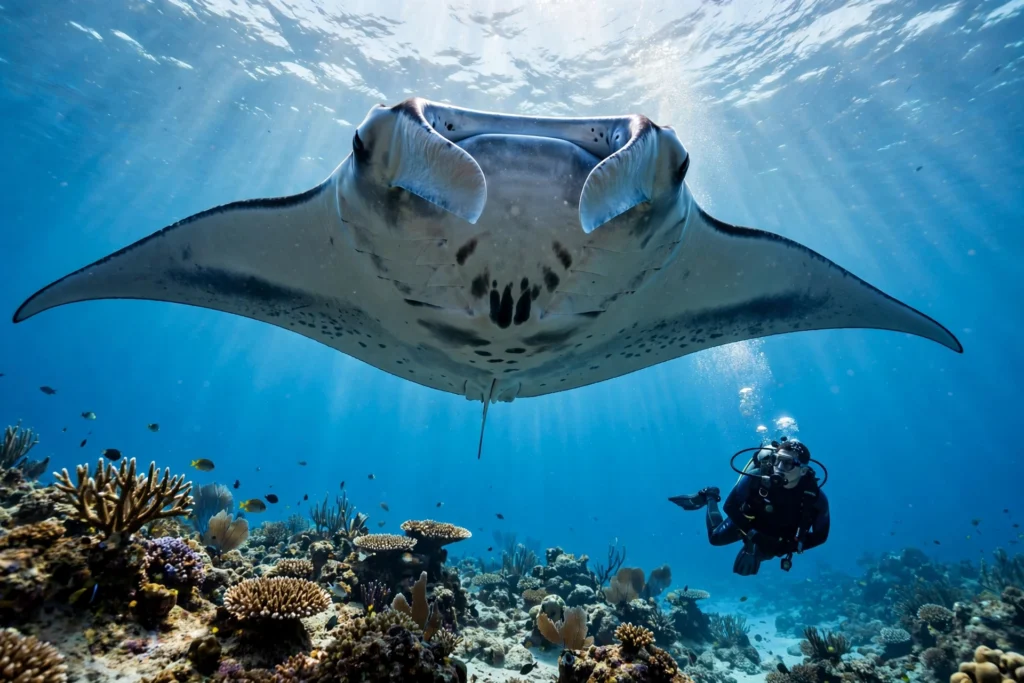
- Watch the surface beside the hull. The manta ray gives itself away before you ever get in the water: its wingtips curl out of the surface right beside the boat. The guide that filmed it puts it plainly — take a boat out past Corsair Key and you can spot them from the surface, wingtips curling out of the water right beside the hull.
- Jump in and swim alongside it. The manta ray is enormous — far wider than Jason is tall — and it glides rather than swims, propelled by its massive wing-like fins. Swim up beside it slowly and it will keep gliding. It does not attack, and it does not flee the way a shark might.
- Study it while you are close. Swim close and a Study prompt pops up. Hold R1 or RB until the meter fills and the game logs the species. Before you study it, you only get the group name Ray; study it and the log shows Giant Oceanic Manta Ray, entry 8 of the 18 Aquatic animals.
A Grand Theft Auto VI for PS5 is the obvious starting point if you have not picked the game up yet, and the open Atlantic past Corsair Key is one of the first places the game rewards you for leaving the shore behind.
As an Amazon Associate, we earn from qualifying purchases.
Spot 2: South-East of Key Lento, by Kenton’s Fence
The second confirmed spot for the Giant Oceanic Manta Ray comes from GameSpot’s wildlife list, which gives one best location per animal. For the manta ray it is the water south-east of Key Lento, near the island’s north-east harbour and Kenton’s Fence. Here is how to work it:
- Unlock the scuba gear first. Same rule as Spot 1: finish Island Dreams in Chapter 1, then take a boat. The spot is close to Key Lento, so Jason’s fishing boat behind his house is the shortest trip.
- Head to the water south-east of the island. Kenton’s Fence is the landmark — Kenton runs a shop in Key Lento, and his fence is the reference point the wildlife list uses. Work the water around the north-east harbour and the fence, watching the surface the same way you would past Corsair Key.
- Look for the wingtips, not the whole animal. A manta ray at the surface shows its wingtips curling out of the water before anything else. From the boat, scan the surface in slow sweeps rather than racing across it — the ray glides, so it covers ground, and a fast pass can miss it.
- Dive in and study it. Same as Spot 1: swim close, wait for the Study prompt, hold R1 or RB until the meter fills. The manta ray does not attack, so you can take your time and get the study right.
Two honest notes about this spot. First, animals in GTA 6 swim around, so treat the map as a place to start looking rather than an exact spawn point — the sea-creatures guide says so directly, and it applies to the manta ray as much as to the whales. If the water by Kenton’s Fence is empty, leave and come back, or reload the save; the ray moves through its habitat and is not guaranteed at one spot. Second, the two spots are not rivals. Corsair Key is the filmed, on-camera sighting; Key Lento is the wildlife-list location. If one is empty, try the other — both are in the same stretch of open water off Vice-Dale County.
Spot 3: The Other Two Rays — Spotted Eagle Ray and Atlantic Stingray
The manta ray is not the only ray in the Aquatic log. Two smaller rays share its water, and they are worth logging on the same trip, because all three count toward the 100 species you need studied for 100% completion.
Spotted Eagle Ray. The eagle ray lives on the reef off Corsair Key — the same reef that holds the dolphins and the sea turtles — and off the southern coast of Key Lento. The sea-creatures guide filmed a group of them gliding over divers in the Leonida Straits, just below the surface. They travel in groups, so where you see one, look for the rest. They do not attack. Study them the same way: swim close, wait for the prompt, hold R1 or RB.
Atlantic Stingray. The stingray is the small one, and the most common. GameSpot’s list puts it in the water north of the Cheeky Mutineer on Key Lento, and in the sea east of the islands near Key Lento’s southern coast. The wildlife database describes it as a common sight in coastal waters to the north and west, dwarfed by the region’s other ray species. Look for it on the seabed in shallow coastal water rather than at the surface — it rests on the bottom, and you will spot it by swimming low over the sand.
The three rays together are a good test of the study system. The manta ray is the giant that shows itself at the surface. The eagle ray is the group that glides over you on the reef. The stingray is the small one on the seabed. One boat trip off Corsair Key and Key Lento can log all three, and the same water holds the dolphins, the sea turtles and the sharks our other guides cover.
How to Study a Manta Ray
Studying is how the animal collection works, and the manta ray follows the same rules as every other animal in the game. Here is the method, and the two things that catch players out:
- Swim close and watch for the prompt. Swim up to the ray until the Study prompt appears, then hold R1 or RB until the meter fills. Before you study it, the game only shows the group name Ray. After you study it, the log shows Giant Oceanic Manta Ray. The prompt only shows up when you are close, and a gliding animal can move out of range while you wait, so approach slowly and stay with it.
- Binoculars work too, if you are far away. You can study from a distance with binoculars by holding L2 or LT and then holding R1 or RB until the meter fills. Binoculars unlock automatically in the Chapter 1 mission Gone Fishing, and they share the bottom-right equipment slot with the flashlight and the fishing rod. Underwater, though, swimming close is the method that works — the manta ray is big enough that you will be close before the binoculars matter.
- Check the log after. Open Progress, then Animals, then Aquatic. The manta ray is entry 8 of the 18 Aquatic animals, and the log shows whether it registered. The wildlife log holds 255 species in total, and 100 studied counts toward 100% completion, so every ray you log is progress.
- Rays do not attack. The wildlife database is clear on this: rays do not attack. That is what makes the manta ray one of the safest big animals to study — you can swim right beside it without the shark rules applying. The danger in the same water is the sharks, not the ray.
Gear You Need Before You Go
The manta ray lives in open water, so the gear list is short but non-negotiable. You need a boat and scuba gear, and both come from the same early mission:
- Scuba gear from Island Dreams. The Chapter 1 mission Island Dreams, with Kenton Rees, hands you the scuba gear along with the harpoon gun and the metal detector. The gear lives on your boats after that — Jason’s free fishing boat, Kenton’s boat, and any boat you own. Without it, you cannot stay down long enough to study a ray properly.
- A boat to reach the open water. Kenton keeps boats at the dock behind his shop, and Jason’s fishing boat sits at the dock behind his Key Lento house. The manta ray is past Corsair Key or south-east of Key Lento, in open water, so take the boat out and dive from it rather than swimming from the beach.
- The harpoon gun for the sharks. The same open water holds tiger sharks, bull sharks and hammerheads, and the Arras Bullhead is the only underwater weapon. Two bolts drive off the shark in Island Dreams, and the harpoon is worth carrying on every open-water trip after that. See how to find sharks in GTA 6 for the shark spots and the survival rules.
- Health and Zombix. A shark encounter costs health, and a long swim back to the boat costs time. Carry Zombix — $15 at convenience stores, five at a time — and sleep at a safehouse for a free full restore before a long session in the water.
A BENGOO G9000 gaming headset helps on the open-water trips: the shark’s approach and the low-health warning are sounds you hear before you see anything, and hearing them first is the difference between a calm study and a panicked swim back to the boat.
As an Amazon Associate, we earn from qualifying purchases.
Manta Ray vs the Other Reef Wildlife
The manta ray shares its water with the reef animals our other guides cover, and it is worth knowing how they differ, because the same trip can meet all of them. The reef off Corsair Key holds the dolphins, the sea turtles and the eagle rays. The open Atlantic past it holds the sharks, the whales and the manta rays. The shipwrecks south of Key Lento hold the jellyfish. The table below is the quick comparison:
| Animal | Where | Behaviour | Study confirmed |
|---|---|---|---|
| Giant Oceanic Manta Ray | Past Corsair Key; south-east of Key Lento | Glides past, enormous, does not attack | Yes, close swim |
| Spotted Eagle Ray | Reef off Corsair Key; Key Lento southern coast | Glides in groups over divers | Yes, close swim |
| Atlantic Stingray | Key Lento, north of the Cheeky Mutineer | Rests on the seabed, common | Yes, close swim |
| Bottlenose Dolphin | Reef off Corsair Key | Circles the reef, jumps at the surface | Yes, binoculars or close swim |
| Green Sea Turtle | Reef off Corsair Key, Key Lento southern beach islands | Swims beside you, friendly | Yes, close swim |
| Tiger Shark | Open Atlantic off Corsair Key | Mostly ignores divers, can attack | Yes, binoculars or close swim |
| Moon Jellyfish | Shipwrecks south of Key Lento | Drifts, drains health on contact | Unconfirmed |
The pattern is simple: everything on the reef can be studied, and the manta ray is one of the easiest big animals to log, because it shows itself at the surface and does not attack. If you are working through the animal collection, our other wildlife guides cover the animals that share its water. How to find dolphins in GTA 6 covers the reef off Corsair Key, how to find sea turtles in GTA 6 covers the same reef and the Key Lento islands, and how to find jellyfish in GTA 6 covers the shipwreck dives south of Key Lento. One boat trip can log a turtle, a ray, a dolphin and a manta ray in a single stretch of water.
What Not to Do on a Manta Ray Trip
The manta ray rules are short, and they are all about not wasting the trip:
- Do not swim out from the beach. The manta ray is in open water past Corsair Key or south-east of Key Lento. Take a boat. Swimming out from the beach wastes your time and your stamina, and you will arrive too tired to study anything.
- Do not dive without scuba gear. Island Dreams is a Chapter 1 mission, so there is no reason to attempt an open-water study before you have the gear. Free diving will not give you the time to find a ray, study it and get back to the surface.
- Do not ignore the sharks. The manta ray will not hurt you, but the tiger sharks in the same water can. Bring the harpoon gun, keep an eye on the open water while you study the ray, and get back to the boat if a shark starts circling.
- Do not chase the ray at full speed. The manta ray glides, and it covers ground. Sprint-swimming after it burns stamina and scares nothing — the ray is not fleeing, it is just moving. Swim steadily alongside it and let the Study prompt come to you.
- Do not assume one empty trip means the spot is wrong. Animals swim around, and the manta ray moves through its habitat. If the water by Kenton’s Fence is empty, leave and come back, or reload the save. The spot is confirmed; the animal just was not there that time.
FAQ: How to Find a Manta Ray in GTA 6
Where do you find a manta ray in GTA 6?
Take a boat out past Corsair Key until the area name changes to Atlantic Ocean, then watch the surface for wingtips curling out of the water beside the hull. GameSpot’s wildlife list gives a second spot: the water south-east of Key Lento, near the island’s north-east harbour and Kenton’s Fence. Both spots need a boat and scuba gear from the Chapter 1 mission Island Dreams.
Do manta rays attack you in GTA 6?
No. Rays do not attack in GTA 6. The Giant Oceanic Manta Ray glides past you and lets you swim alongside it, which is what makes it one of the safest big animals to study. The danger in the same water is the sharks — tiger, bull and hammerhead — so bring the Arras Bullhead harpoon gun.
Can you study a manta ray in GTA 6?
Yes. Swim close to the ray until the Study prompt appears, then hold R1 or RB until the meter fills. It logs as Giant Oceanic Manta Ray, entry 8 of the 18 Aquatic animals in the wildlife log. You can also study from a distance with binoculars, but swimming close is the method that works underwater.
Do you need scuba gear to find a manta ray?
Yes, for a proper study. You can spot the wingtips from the boat without getting in the water, but to swim alongside the ray and study it you need the scuba gear from Island Dreams, and you need a boat to reach the open water past Corsair Key or south-east of Key Lento.
What is the difference between a manta ray, an eagle ray and a stingray in GTA 6?
Size and water. The Giant Oceanic Manta Ray is enormous — far wider than Jason is tall — and lives in the open Atlantic past Corsair Key and south-east of Key Lento. The Spotted Eagle Ray is smaller, travels in groups, and lives on the reef off Corsair Key and the southern coast of Key Lento. The Atlantic Stingray is the smallest and most common, resting on the seabed in shallow coastal water north of the Cheeky Mutineer. All three are separate entries in the Aquatic log.
The Bottom Line
How to find a manta ray in GTA 6 comes down to two confirmed spots and one method. Take a boat out past Corsair Key until the area name changes to Atlantic Ocean, watch the surface for wingtips curling out of the water beside the hull, then jump in and swim alongside the Giant Oceanic Manta Ray — it is far wider than Jason is tall, it does not attack, and studying it logs entry 8 of the 18 Aquatic animals. If that water is empty, try the second spot: the water south-east of Key Lento, near the north-east harbour and Kenton’s Fence, from GameSpot’s wildlife list. Either way, finish Island Dreams first for the scuba gear, take a boat, bring the harpoon gun for the sharks, and do not chase the ray — swim steadily beside it and let the Study prompt come to you. While you are out there, the same water holds the eagle ray on the reef, the stingray on the seabed, and the dolphins, sea turtles and sharks our other guides cover, so one boat trip can log half the reef in a single outing.

Dr Vivek Garg runs drviram.in — a tech blog about AI tools, apps, and online earning. Every guide here is tested hands-on before it is published.