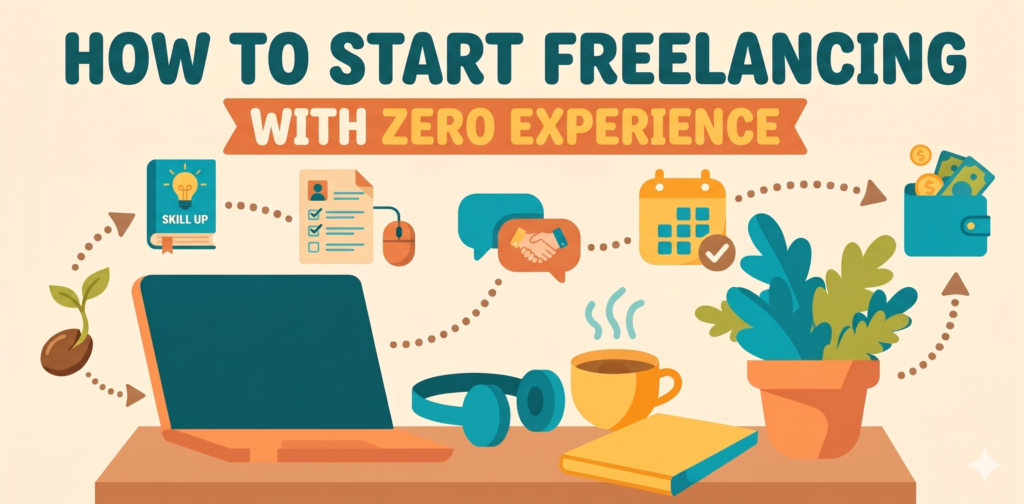
Freelancing with Zero Experience
The traditional employment compact has fundamentally ruptured. Across the globe, millions of ambitious university students, working professionals, and career transitioners are recognizing that relying on a single corporate employer for 100% of their livelihood is an unnecessary financial risk. Layoffs, rigid commute routines, geographic limitations, and capped salary structures have driven a historic migration toward independent digital freelancing.
Yet, when complete beginners decide to start freelancing, they immediately run into a paralyzing mental paradox: “Every client requires past experience, but how do I get my first client if nobody will hire someone without experience?”
This single misconception derails 95% of aspiring freelancers before they ever send a proposal. The truth? In the modern global digital economy, legitimate business clients do not care about your age, your geographic location, your formal university degree, or how many years you sat in an office cubicle. Clients care about a single commercial reality: Can you solve their specific business problem reliably, communicate professionally, and make them more money than they pay you? When you pair foundational digital abilities—such as those explored in our comprehensive roadmap on high-income digital skills—with modern generative resources like our list of best free AI tools, launching a high-margin freelance career becomes a repeatable, step-by-step engineering process.
In this exhaustive, 4,000-word master blueprint, we dismantle the “zero experience” myth. We analyze how to select a marketable niche, construct proof-of-work portfolios from thin air, navigate freelance platforms, master cold outreach psychology, structure pricing tiers, and land your first $500 to $2,000 in client contracts within the next 60 to 90 days.
The Freelance Skill-to-Service Monetization Matrix
You cannot “freelance” as a broad concept; you must offer a concrete, deliverable service that solves a measurable business pain point. Use the pricing matrix below to understand how entry-level skills convert into commercial services and realistic earnings:
| Service Discipline | Concrete Beginner Deliverable | Target Buyer / Niche | Beginner Project Rate | Monthly Retainer Potential |
|---|---|---|---|---|
| Content & SEO Writing | 1,500-word search-optimized articles & blog guides | SaaS platforms, digital marketing agencies, e-commerce blogs | $40 – $80 per post (₹3,000 – ₹6,500) | $600 – $1,200 (8–12 posts/mo) |
| Short-Form Video Editing | Vertical 60-second Reels/Shorts with kinetic captions & sound | Podcasters, business coaches, local clinics, YouTubers | $25 – $50 per video (₹2,000 – ₹4,000) | $800 – $1,800 (20–30 videos/mo) |
| WordPress & No-Code Design | 5-page responsive business websites using Elementor/Astra | Local service contractors, dentists, consultants, boutiques | $250 – $600 per site (₹20,000 – ₹50,000) | $150/mo Maintenance Retainer |
| Social Media Management | 15 monthly graphic carousels, caption writing, and DM replies | Local restaurants, gyms, realtors, beauty salons | $200 – $400 per account (₹15,000 – ₹30,000) | $500 – $1,000 per brand |
| Email Copywriting & Newsletters | Weekly customer nurture emails & automated welcome flows | E-commerce Shopify stores, info-product creators | $35 – $75 per email (₹2,500 – ₹6,000) | $700 – $1,500 (8–12 emails/mo) |
The “Zero Experience” Myth: Proof-of-Work vs. Resume Experience
When beginners say “I don’t have experience,” what they really mean is “Nobody has paid me yet.” These are two completely different realities.
Consider the hiring perspective of a digital business owner. If they receive two job proposals:
- Candidate A: Submits an academic resume stating they have a “B.A. in English Literature” and completed a 3-month online certification course, but includes zero written samples.
- Candidate B: States they are an independent writer, attaches three published articles analyzing real market trends, includes a Google Drive link showing exact keyword research, and provides an outline showing how they would improve the client’s current blog.
Candidate B wins the contract 100% of the time, regardless of formal background. In freelancing, Proof-of-Work completely trumps past employment history.
The 3 Mock Projects Rule (How to Build a Portfolio in 7 Days for Free):
To eliminate the lack-of-experience objection before reaching out to paying clients, execute the 3 Mock Projects Framework:
- Mock Project 1 (The Theoretical Masterpiece): Choose an industry you find fascinating (e.g., fitness, SaaS, finance). Create an exhaustive, publication-grade asset from scratch as if a client paid you $1,000 for it. If you are a writer, write a 2,500-word deep-dive guide. If you are a designer, build a complete 5-screen mobile app prototype in Figma.
- Mock Project 2 (The Redesign / Audit): Find an existing real business with a mediocre digital presence. Redesign their homepage, rewrite their email sequence, or re-edit three of their video clips with professional sound design. Record a 3-minute video walkthrough explaining the strategic reasoning behind your changes.
- Mock Project 3 (The Case Study / Experiment): Run a personal mini-experiment. Launch your own niche blog, grow a test Instagram page to 500 followers, or configure a multi-step automation workflow. Document the process, capture screenshots, and package the results into a 2-page PDF case study.
Platform Comparison Matrix: Where Should Beginners Hunt for Clients?
Different client acquisition channels operate on vastly different psychological rules. Beginners frequently fail because they choose channels incompatible with their temperament and risk profile:
| Acquisition Channel | Competition Level | Client Quality & Budgets | Time to First Dollar | Key Success Factor |
|---|---|---|---|---|
| Upwork | High (Global bidding) | Moderate to Very High | 14 to 45 Days | Specific niche specialization, hyper-customized proposals (Earning Resources) |
| LinkedIn Direct Outreach | Low to Moderate | High to Enterprise Tier | 30 to 60 Days | High-authority personal profile, consultative DM messaging |
| Fiverr | Extremely High (Price wars) | Low to Moderate | 30 to 90 Days | Gig SEO optimization, high initial review volume, fast delivery |
| Cold Email Outreach | Zero Platform Middleman | High (Direct Founder Access) | 14 to 30 Days | Personalized video audits, high-deliverability email domains |
| Local Offline Businesses | Almost Zero Digital Competition | Moderate (Predictable Cash Flow) | 7 to 14 Days | In-person meetings, addressing immediate operational bottlenecks |
The Anatomy of an Irresistible Cold Pitch (With Copy-Paste Templates)
The primary reason beginner freelancers send 50 proposals without receiving a single reply is that their pitches are entirely self-centered. A typical bad proposal reads: “Hello sir, I am a beginner freelancer looking for work. I know HTML, CSS, and writing. Please give me a chance.” This screams desperation and provides zero business value.
High-converting proposals adhere to the Value-First Framework: acknowledge the client’s current situation, identify a specific visible leak in their digital funnel, provide a free customized solution, and invite a low-friction conversation.
Template 1: The Upwork Job Proposal That Wins
Hi [Client Name],

I noticed you are looking to revamp your blog content to rank for [Specific Topic/Keyword].

I actually took 15 minutes before submitting this proposal to review your current site ([Client Website URL]). I noticed two specific quick-win opportunities your current articles are missing:
1. Your headings are missing secondary long-tail keywords that competitors like [Competitor Name] are ranking for.
2. Your internal linking structure currently leaves 4 of your best cornerstone articles orphaned without links.

Here are two live writing samples in your exact niche that demonstrate how I structure 2,000+ word guides with comprehensive research:
- [Link to Sample 1 - Google Docs / Notion]
- [Link to Sample 2 - Google Docs / Notion]

If you'd like, I can write a 300-word sample introduction on [Topic Client Mentioned in Post] completely free so you can evaluate my tone and research depth before making any hiring decision.

Best regards,
[Your Name]
Portfolio: [Clean Notion / Drive Link]
Template 2: The Cold Email Audit Pitch (For Agency Owners & Founders)
Subject: Quick idea for [Company Name]'s short-form video strategy

Hi [Founder First Name],

Love the recent episode of your podcast with [Guest Name]—the breakdown on [Specific Insight from Episode] was pure gold.

I noticed you aren't currently repurposing those 60-minute podcast conversations into vertical YouTube Shorts and Instagram Reels. Brands like [Competitor Brand] are currently driving thousands of views by clipping 45-second retention hooks from long interviews.

To show you what this could look like, I took a 40-second audio clip from your last interview, color-graded the footage, added kinetic subtitles, and mixed sound effects:
[Loom Video Link / Google Drive Link to 40-Second Sample Video]

If you like the editing style and pacing, I'd love to edit 10 of these clips for you this month on a simple trial package.

Either way, hope the sample clip brings value to your team!

Best,
[Your Name]
[Phone Number / WhatsApp Link]
Pricing Models: Hourly vs. Fixed-Project vs. Monthly Retainer
How you charge dictates your earning ceiling, your stress levels, and your client dynamics. As your career matures, transition through these three distinct pricing models:
| Pricing Model | How It Works | Advantages | Fatal Flaw / Trap | When to Use |
|---|---|---|---|---|
| Hourly Billing | Client pays a set rate per hour worked (e.g., $15 – $35/hr) tracked via software. | Guaranteed pay for extra time spent on difficult tasks. | Penalizes efficiency: As you become faster and better, you earn less money for the same deliverable. | Only during initial trial tasks or consulting calls. |
| Fixed Project-Based | Client pays a flat fee for a defined scope of work (e.g., $500 for a website). | Rewards speed and automation; higher profit margins. | Scope Creep: Clients continually asking for “one small extra revision” without paying more. | Standard projects with strictly defined milestones. |
| Monthly Retainer | Client pays a recurring fee monthly for an ongoing bundle of deliverables (e.g., $1,000/mo). | Predictable cash flow: You know your income on the 1st of every month; zero proposal hunting. | Requires consistent communication and monthly performance reporting. | The Holy Grail: Transition every satisfied client onto a retainer. |
Financial Safety, Contracts & Scam Prevention
The freelance world contains unscrupulous bad actors who prey on inexperienced beginners. Adhering to official standards outlined by professional advocacy organizations like the Freelancers Union ensures that your intellectual labor is legally protected and reliably compensated:
The 4 Non-Negotiable Financial Rules for Beginners:
- The 50% Upfront Deposit Rule: When working outside protected escrow platforms like Upwork, never open a software file or type a single word of deliverable work without receiving a 50% non-refundable upfront deposit. Serious commercial businesses routinely pay 50% deposits; clients who protest are invariably the ones who refuse to pay the final invoice.
- Beware the “Telegram / WhatsApp Test Task” Scam: If an unknown individual on LinkedIn, Upwork, or Freelancer.com asks you to communicate exclusively on Telegram, promises exorbitant salaries for simple typing jobs, or demands that you pay an “insurance/registration fee” to release payment, it is 100% a fraudulent scam. Real companies never ask candidates to pay money for equipment or registration.
- Milestone Escrow Protection: When using Upwork or Fiverr, ensure that the project milestone is actively funded in escrow before submitting deliverables. If a milestone says “Active” but has zero dollars funded, the platform cannot guarantee payment.
- Clean Simple Contracts: For private direct clients, draft a 1-page agreement specifying: the exact scope of deliverables, the revision limit (maximum 2 rounds of edits), payment terms (net-7 days upon completion), and an explicit clause stating that copyright ownership transfers to the client only upon receipt of final full payment.
The 30-Day Step-by-Step Freelance Launch Calendar
Eliminate decision fatigue by executing this structured 4-week calendar:
Week 1: Discipline Selection & Foundational Setup
- Pick one single marketable service from the Matrix table above based on your natural inclination.
- Set up clean, dedicated professional profiles on LinkedIn and Upwork using high-resolution headshots and benefit-driven headlines.
- Configure reliable cross-border payment accounts (such as PayPal, Payoneer, or Wise) and link them to your local bank account.
Week 2: Proof-of-Work Sprint (The 3 Mock Projects)
- Dedicate 4 hours daily to build your 3 Mock Projects using the framework outlined in this guide.
- Upload your finished assets into a minimalist, clean Notion workspace or Google Drive folder labeled “[Your Name] – Professional Portfolio [Year]”.
- Test all portfolio links inside an incognito private browser window to guarantee that clients do not encounter permission-denied errors.
Week 3: The Outreach Engine (5 Targeted Pitches Daily)
- Send 5 personalized proposals daily across your chosen acquisition channel (e.g., 2 customized Upwork job proposals + 3 cold video audit emails to founders).
- Maintain a simple spreadsheet tracking: Company Name, Contact Person, Date Contacted, Pitch Angle, and Follow-up Date.
- If an outreach recipient does not reply within 4 business days, send a polite 2-sentence follow-up sharing a helpful industry article.
Week 4: Closing, Delivery & Transition to Retainers
- Conduct your first discovery conversations via text chat or a brief 15-minute Zoom call.
- Over-deliver on your initial project: submit work 24 hours ahead of deadline, format documents cleanly, and include a video walkthrough explaining your deliverables.
- Upon delivery, send a polite message: “So glad you loved the work! If you need this done on a recurring basis, I have an opening for one monthly retainer client where I handle [Deliverable] every week. Would you like to review what that looks like?”
14 Comprehensive Frequently Asked Questions (FAQ)
1. Do I need a formal college degree or expensive certification to start freelancing?
No. In the global remote digital freelance economy, clients evaluate you on your portfolio, your communication speed, and your ability to meet deadlines. A self-taught designer with a stunning portfolio will consistently beat an uninspired university graduate with zero practical samples.
2. How much money can a complete beginner realistically earn in their first 3 to 6 months?
According to economic data from the Upwork Freelance Economic Impact Report, earnings scale directly with skill specialization. Dedicated beginners who execute daily outreach typically land their first small $50 to $150 trial gig within 30 to 45 days. By month 3 to 6, maintaining 2 or 3 recurring retainer clients routinely generates between $500 and $2,000 (₹40,000 to ₹1,60,000) in predictable monthly income.
3. Which freelance skill is easiest to learn quickly with zero technical background?
Content Writing, SEO Blog Writing, and Short-Form Video Clipping have the fastest learning curves. You can understand the foundational mechanics within 14 days and begin producing acceptable portfolio samples immediately using free tools.
4. How do I receive international payments from foreign clients in the USA, UK, or Europe?
For private direct clients, use cross-border payment platforms like Wise (low conversion fees), Payoneer, or standard PayPal. If working through platforms like Upwork or Fiverr, the platform handles currency conversion automatically and transfers funds directly to your local domestic bank account.
5. What should I do if a client asks for unlimited revisions without paying extra?
Prevent this by defining revision boundaries in your initial agreement: “This project includes up to 2 rounds of minor revisions to ensure complete satisfaction. Any fundamental scope changes or additional revisions beyond that are billed at [Rate] per hour/revision.”
6. Should I start on Upwork or try cold email outreach first?
If you want immediate access to clients who are actively holding open budgets and looking to hire today, start with Upwork. If you want zero competition and direct relationships with high-paying founders without platform commission fees, master Cold Email and LinkedIn Outreach.
7. Is Upwork Connects worth paying for as a beginner?
Yes. Think of Upwork Connects as minor digital advertising costs for your business. Spending $15 to $30 (₹1,500 to ₹2,500) on Connects to land a single $500 project represents an extraordinary 1,500% return on capital. Treat freelancing like a real business, not a free hobby.
8. How many hours a day do I need to invest if I have a full-time job or university classes?
You can launch a thriving freelance side-income by dedicating 2 focused, uninterrupted hours every evening and a 4-hour block on Saturdays. Consistency across 90 days matters infinitely more than erratic 12-hour weekend binges followed by two weeks of inactivity.
9. How do I overcome the fear of imposter syndrome when pitching clients?
Imposter syndrome disappears when you stop pretending to be a giant agency and embrace your identity as an enthusiastic, diligent junior specialist. Position yourself honestly: “While I am newly independent, I dedicate 100% of my focus to a small roster of clients and will work tirelessly to ensure this project exceeds your standards.” Clients appreciate transparency and raw work ethic.
10. Can I freelance using only my smartphone?
While you can handle client communication, write basic copy, and manage social media from a smartphone, owning a desktop computer or basic laptop is strongly recommended for sustained professional workflows, file management, and intensive multi-tasking.
11. What should I do if a client suddenly stops responding after I submit work?
If you followed Rule #1 and secured a 50% upfront deposit, you are already protected. Send a polite follow-up after 3 business days: “Hi [Client], just following up to ensure you received the completed files. Let me know if you need any adjustments; otherwise, I will generate the final invoice on Friday.”
12. How do I transition from low-paying $20 gigs to high-paying $500+ projects?
Stop pitching commodity tasks (e.g., “I will write words for you”) and start pitching commercial business outcomes (e.g., “I will write search-optimized guides that capture organic customer leads”). Clients pay high fees for revenue generation, not raw hours.
13. When is it safe to quit my day job and freelance full-time?
Never quit your primary employment on emotional impulse. Wait until your freelance income equals or exceeds your full-time salary for three consecutive months, and maintain an emergency savings fund covering at least 6 months of basic living expenses.
14. Where can I ask technical questions or get feedback on my proposals?
Our editorial team provides comprehensive guides and actionable digital growth strategies across the DrViram portal. Feel free to connect directly via our contact page for personalized feedback on your portfolio structure.
Conclusion: Your Immediate 24-Hour Action Item
Freelancing is not an elusive, mysterious lottery reserved for elite tech prodigies. It is the purest, most egalitarian commercial trade in human history: master a valuable digital skill, package it into an undeniable proof-of-work portfolio, communicate like a reliable professional, and help businesses solve bottlenecks.
Do not close this guide and return to passive social media consumption. Take your first physical step right now:
- Choose your single skill from the Matrix table.
- Open a clean document and begin drafting your first Mock Project today.
- Commit to sending your first 5 proposals within the next 14 days.
The global freelance economy is generating billions of dollars in remote value every single month. Your seat at the table is waiting—claim it through disciplined execution starting today.