How to Catch Yellowfin Tuna in GTA 6: The Complete Guide (2026)
Quick Answer: How to catch yellowfin tuna in GTA 6: buy the Large Saltwater Lure for $112, take a boat out into the Gulf of Leonida west of Tola Bay in Mariana County, drop the anchor through the vehicle menu, cast with the Large Saltwater Lure fitted, work the lure slowly, wait past the first light nibble, then press R2 or RT on the strong bite and fight the fish in — push the left stick against the pull and reel only during the pauses. The yellowfin tuna is fish number 34 of the 35 species in the Fishing tab, a large deep-water saltwater fish that only takes the biggest lure in the game. No dedicated yellowfin tuna guide existed before this one: every other source gives the fish a single row in a bigger all-fish list.
Grand Theft Auto VI launched on November 19, 2026 for PlayStation 5 and Xbox Series X/S, and its wildlife log tracks 255 animals — with 100 studied species needed for 100% completion. Thirty-five of those entries are fish, and the yellowfin tuna is the deep-sea catch of the saltwater set: it is not a starter fish, it is not a rivalry fish, and it does not bite in the shallows. It lives in the open water of the Gulf of Leonida, west of Tola Bay, where a player needs a boat, the most expensive lure in the game, and enough story progress to buy that lure at all. If you have not picked up Grand Theft Auto VI for PS5 yet, the tuna is one of the best reasons to get out on the water once the story opens up.
As an Amazon Associate, we earn from qualifying purchases.
How to Catch Yellowfin Tuna in GTA 6: The Best Spots
There are three named spots for the yellowfin tuna, and two of the three sources that list the fish agree on the first one. IGN’s all-fish guide names the Gulf of Leonida, west of Tola Bay in Mariana County, as the best location, with the Large Saltwater Lure. GTA Boss’s all-fish table repeats the same water — “Gulf of Leonida west of Tola Bay” — and adds a second spot of its own: deep water south of Belpoint. Player Manual’s fishing map adds a third: the Sandbars, north of the islands off Port Gellhorn, on map grid E2, also with the Large Saltwater Lure. That is three spots from three sources, all of them open Gulf water, and none of them on the coast or in a river.
| Spot | County | Lure | Source |
|---|---|---|---|
| Gulf of Leonida, west of Tola Bay | Mariana County | Large Saltwater Lure | IGN, GTA Boss |
| Deep water south of Belpoint | Mariana County | Large Saltwater Lure | GTA Boss |
| Sandbars, north of the islands off Port Gellhorn (Grid E2) | Kelly County | Large Saltwater Lure | Player Manual |
The three spots look different on the map, but they describe the same kind of water: open, deep Gulf water, away from the coast. The Gulf of Leonida is the big stretch of sea on the west side of the map, and Tola Bay sits on its eastern edge, near Bobcat Bight and Bobcat Key. West of Tola Bay means out into the Gulf itself, past the bays and the inshore water, where the water is deep enough for a big open-water fish. Belpoint is the island south of that same Gulf water, and deep water south of it is the same open sea from a different landmark. The Sandbars north of the islands off Port Gellhorn are the third way into the same water, from the Kelly County side. Start with the first spot — the Gulf west of Tola Bay — because it is the only one two independent sources agree on, and it is the one IGN calls the best location. If the tuna is not biting there, work the other two before you change anything else: the fish is a deep-water fish, and the answer is almost always “further out”, not “a different lure”.
How to Catch Yellowfin Tuna in GTA 6 Step by Step
This is the best place to start learning how to catch yellowfin tuna in GTA 6, because it is the spot two independent sources agree on and the one IGN calls the best location. IGN’s all-fish guide gives the yellowfin tuna one best location: “In the Gulf of Leonida, west of Tola Bay in Mariana County.” Here is how to work it:
- Buy the Large Saltwater Lure before you leave land. The yellowfin tuna takes the Large Saltwater Lure, which costs $112, and it is the most expensive lure in the game. Buy it at an Ammu-Nation branch with a fish icon under Features on its map card — one stocked branch is Chuck’s Tackle and Shot in Key Lento, a short drive from Jason’s house. Do not set out without it: the rod comes with a Small Saltwater Lure fitted, and that lure only draws small saltwater fish. One warning before you go: GTA Boss reports the Large Saltwater Lure stays sold out until Chapter 3 or later in the story, so if the shop will not sell it to you yet, keep playing the story and come back — the tuna will still be there.
- Take a boat. You cannot catch a yellowfin tuna from the shore: it lives in open Gulf water, and you need a boat to reach it. In Chapter 1, Jason’s fishing boat is moored at the dock behind his Key Lento house. After Chapter 1 that boat is gone, so steal one — the docks by The Rusty Anchor usually have a couple of fishing boats tied up. Take a boat with a clear deck and a working engine, because the run out into the Gulf is a long one and you do not want to be fighting the boat as well as the fish.
- Travel west of Tola Bay, into the Gulf of Leonida. Head out into the Gulf west of Tola Bay, in Mariana County, until the water around you is open sea with no coast in casting range. Tola Bay sits near Bobcat Bight and Bobcat Key on the eastern edge of the Gulf, so west of the bay means out past the bays and the inshore water. If you can still see the beach clearly, you are not far enough out: the tuna is a deep-water fish, and the deep water starts where the coast stops mattering.
- Drop the anchor before you cast. Open the vehicle menu and choose Anchor so the boat does not drift while you fish. An unanchored boat drifts with the current, and drifting takes you out of the hotspot while you are working the lure. Anchor first, cast second, every time.
- Use Focus to find the fish before you cast. Press both sticks together (L3 and R3 on PlayStation, LS and RS on Xbox) to turn Focus on: it shows glowing pale patches in the water where fish are gathering. In open Gulf water this matters more than it does in a river, because the water is deep and you cannot see the fish under the surface without it. Cast toward the glowing patch, not at random water.
- Cast and work the lure slowly. Hold L2 or LT and press R2 or RT to cast, then rotate the right stick gently to work the lure. The yellowfin tuna is a big open-water fish that takes a slow, steady retrieve — do not reel in fast and do not leave the lure sitting still. Turn the right stick slowly and steadily, and watch for the bite.
- Wait past the first nibble, then set the hook and fight it properly. The first light tug is the fish testing the lure, not the bite: wait for the strong bite, the one that makes the controller rumble, and then press R2 or RT to set the hook. Then push the left stick in the opposite direction to where the fish is pulling, and reel in with the right stick during the pauses when the fish stops fighting. Do not reel while it is running: reeling while the fish fights is how the line snaps, and a tuna runs harder than any freshwater fish in the log. Land the fish and it goes into the log as fish number 34 of 35 — fish you land in free roam go back in the water, and you cannot keep, eat or sell them.
What You Need: the Large Saltwater Lure and the Chapter 3 Gate
The yellowfin tuna is the most expensive fish in the game to chase, because the lure it takes is the most expensive lure in the game — and because that lure may not be for sale yet when you first want it. Every rod in GTA 6 comes with a Small Saltwater Lure already fitted, and you also start out owning a Small Freshwater Lure — the two starter lures, one for each kind of water. The yellowfin tuna takes the Large Saltwater Lure, which costs $112, and GTA Boss reports that it stays sold out until Chapter 3 or later in the story. That is the gate on this fish: it is not a skill gate or a money gate, it is a story-progress gate, and no amount of grinding will open it early. If the shop shows the Large Saltwater Lure as sold out, the answer is to keep playing the story, not to keep checking the shop.
| Lure | Cost | What it catches |
|---|---|---|
| Small Freshwater Lure | Owned from the start | Small freshwater fish, including the bluegill |
| Medium Freshwater Lure | $40 | Medium freshwater fish, including the channel catfish |
| Small Saltwater Lure | Fitted to every rod | Small saltwater fish |
| Medium Saltwater Lure | $50 | Medium saltwater fish, including the red lionfish |
| Large Saltwater Lure | $112 | Large saltwater fish, including the yellowfin tuna |
| Candy Cane Lure | Found, not bought | The Candy Fish, in Lake Leonida and the Nehrling River |
Lures are sold at Ammu-Nation, but only at some branches: hover over a shop on the map and look for the fish icon under Features. One stocked branch is Chuck’s Tackle and Shot in Key Lento, a short drive from Jason’s house. The Candy Cane Lure is the exception: it is not bought at all, but found in a garage in a house in Ambrosia. Prices vary by shop, so treat the table prices as guide prices — GTA Boss lists the Large Saltwater Lure at $112, and other sources list $125 at some branches. The rod sits in the bottom-right equipment slot of the weapon wheel, the slot it shares with the binoculars and the flashlight, and it is always in your inventory, even if you never pick one up. There is also a free rod on the wooden dock behind Jason’s house in Key Lento. If you are fishing for a long session in open water, a comfortable headset helps more than any lure: a BENGOO G9000 gaming headset keeps the bite sounds clear while you wait between casts. One more setting is worth knowing before a long session: the reeling controls can be changed in Settings, under Gameplay, then Fishing, where you can switch between Hold, Tap and Pull reeling.
How to Study a Yellowfin Tuna Without Catching It
Catching the yellowfin tuna is not the only way to log it, and for a completion run the faster way is often the better one. To add a fish to the Progress menu you need to swim near it and study it: hold R1 or RB while you are close to the fish in the water, and the study logs the species without a catch. Catching it also adds it to the progress menu, but it is not necessary — swimming underwater and studying the fish is enough, and PowerPyx confirms the same for all 35 species. Studying also counts toward the 100 studied species needed for 100% completion. If your goal is the log rather than the catch, study first and fish second: the study is instant, the catch is a minigame, and the log does not care which one you did. The same method works for every fish in the log, and our how to catch mahi-mahi in GTA 6 guide covers it in full for the other big open-water fish of the Gulf. One honest note: studying a tuna means getting into the same deep Gulf water the tuna lives in, and that water is shark water too — the tiger, bull and hammerhead sharks cruise the open Atlantic off Corsair Key, so study from the boat where you can and dive only when you are sure of the water.
The Other Large Saltwater Fish You Will Meet
The Large Saltwater Lure does not catch only yellowfin tuna, and the Gulf of Leonida does not hold only yellowfin tuna. The same lure in the same water will draw in the other large saltwater species, and that is a feature, not a problem: every one of them is a separate entry in the Fishing tab, and a session that starts as a yellowfin tuna trip can end with three or four species logged.
| Fish | Lure | Best spot |
|---|---|---|
| Yellowfin Tuna | Large Saltwater Lure | Gulf of Leonida, west of Tola Bay |
| Atlantic Tarpon | Large Saltwater Lure | Northwest Port Gellhorn, Kelly County |
| Great Barracuda | Large Saltwater Lure | Leonida Straits near Key Lento |
| Mahi-Mahi | Large Saltwater Lure | South of Riquezas Keys, west of Mile Zero Air Station |
| Cobia | Large Saltwater Lure | Atlantic Ocean, east of Vice Beach |
| Permit | Large Saltwater Lure | Leonida Straits south of Vice-Dale County |
| Atlantic Thread Herring | Large Saltwater Lure | Atlantic Ocean northeast of Vice Beach |
The mahi-mahi is the closest neighbour to the yellowfin tuna in the log: it takes the same lure, and its spot is the open water south of the Riquezas Keys and west of Mile Zero Air Station, in the same Gulf. Our how to catch mahi-mahi in GTA 6 guide covers it in full. The tarpon is the same story again, and our how to catch tarpon in GTA 6 guide covers it in full, with the northwest Port Gellhorn spot — which is also the area Player Manual’s Sandbars spot sits in, so a tuna trip that starts at the Sandbars can turn into a tarpon trip without moving far. The barracuda is the same story a third time, and our how to catch barracuda in GTA 6 guide covers it in full, with the Leonida Straits spot near Key Lento. If you catch something that is not a yellowfin tuna, do not move: keep casting in the same water, and check the log after each catch. The Angler challenge — four different species in under six minutes — is built for exactly this water, where four large saltwater species can bite in one short session.
Yellowfin Tuna and Cal Hampton’s Fishing Dares
The yellowfin tuna is not part of Cal Hampton’s fishing dares, and that is worth saying plainly because the dares are the reason many players fish at all. Cal’s challenges arrive by text, and the first of them — Catch a Bigger Fish — arrives after Feng Shui in Chapter 1, played as Jason: land a Stoplight Parrotfish heavier than 2 lb at a marked spot in Gambit Bay, and when you land a fish that beats Cal’s, press Cross on PlayStation or A on Xbox to take a photo, and the game sends it to him automatically. The second dare is the Atlantic Spadefish over 6 lb in the Leonida Straits south of Key Lento, and the third — reported by GTA Boss — is the channel catfish on the Medium Freshwater Lure. IGN marks the rivalry fish with a pink highlight in its all-fish guide, and the yellowfin tuna is not one of them. The yellowfin tuna is still the best fish to practise the big-fish fight on before the dares arrive, because it uses the same method with the biggest lure — and because a tuna that runs hard teaches the fight better than any small fish ever will. Our how to catch channel catfish in GTA 6 guide covers the third dare in full.
Challenges a Yellowfin Tuna Counts Toward
Fishing has three Survivalist challenges in GTA 6, plus the Pro Angler goal that sits above them, and the yellowfin tuna counts toward all four — with one honest gap.
| Challenge | What it asks for | How the yellowfin tuna fits |
|---|---|---|
| Big Fish | Catch a fish weighing 20 pounds or more | The yellowfin tuna is the strongest Big Fish candidate in the log: it is a large-lure fish, and no small-lure fish can reach 20 lb. But no yellowfin tuna weight has been published, so do not take the tick as guaranteed until you land one over 20 lb |
| Catch of the Day | Catch 3 fish using each size of freshwater and saltwater lure in a day | The yellowfin tuna is your large-saltwater tick: three large-saltwater fish in a day covers the biggest size |
| Angler | Catch 4 different species of fish in under 6 minutes | Yellowfin tuna plus mahi-mahi, barracuda and tarpon in one Gulf run is the fastest route |
| Pro Angler | Catch every species of fish | The yellowfin tuna is fish number 34 of 35, and the log does not complete without it |
The Big Fish challenge is the honest gap in this guide: no source has published a yellowfin tuna weight, and the fish’s in-game weight is unconfirmed. The 20 lb target belongs to the big saltwater fish — the tarpon, the barracuda, the mahi-mahi and the tuna — and the tuna is the largest of the large-lure fish in the log, so it is the best bet in the game for the tick. But a bet is not a guarantee, and this guide will not claim a weight no source has published. Catch of the Day is the most practical of the three: three fish on each lure size in a single in-game day, and the yellowfin tuna is the hardest large-saltwater catch to start with, because the lure is the most expensive and the water is the furthest out. Fishing also feeds the wider completion picture: the wildlife log tracks 255 animals, and 100 studied species are needed for 100% completion. The Off the Hook magazine in the shed under Jason’s house adds fishing spots to the pause map — other copies sit at Billie’s Key Lento Gift Shop and Wasteland Off-Road in Port Gellhorn.
While You Are in the Gulf: the Lionfish and the Tarpon
The Gulf of Leonida holds more than tuna, and the two fish that share its water are worth catching on the same trip. The red lionfish lives in the same Gulf water west of Bobcat Bight, Bobcat Key and Tola Bay — the same Tola Bay the tuna spot sits west of — and it takes the Medium Saltwater Lure at $50, not the Large. Our how to find red lionfish in GTA 6 guide covers it in full, with the Gloriana Key hotspot and the Key Lento southern-beach islands. The tarpon lives at the other end of the same coast: northwest Port Gellhorn, in Kelly County, on the Large Saltwater Lure — and Player Manual’s third tuna spot, the Sandbars north of the islands off Port Gellhorn, sits in the same water. Fish the Gulf west of Tola Bay for the tuna first, then work the Sandbars for the tuna again and the tarpon second, and the two species fall in one trip. The lionfish is the backup catch for the same water on a cheaper lure, and the tarpon is the second large-lure fish for the same boat. Our how to catch tarpon in GTA 6 guide covers it in full.
Yellowfin Tuna in the Real World
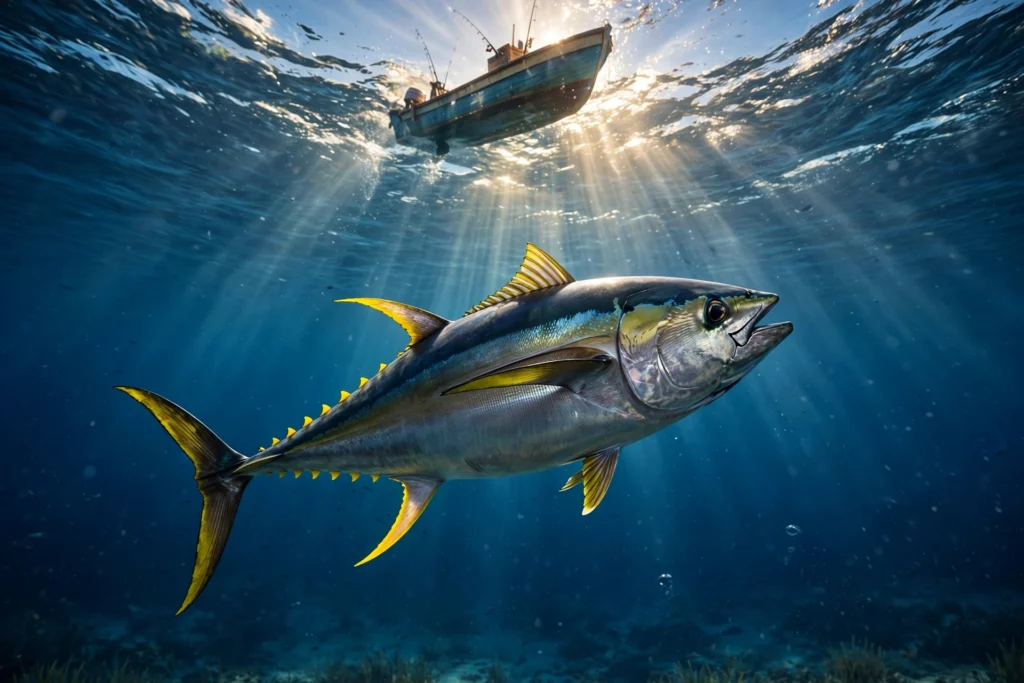
The real-world yellowfin tuna is a torpedo-shaped open-ocean fish with a metallic blue back, a silver belly, and bright yellow dorsal and anal fins with long yellow finlets running down its back and belly — the yellow fins are the feature that gives the fish its name. It is one of the fastest fish in the ocean, built for long chases in open water, and it schools in the warm open sea rather than hugging the coast. A big one in the real world can weigh well past 400 lb, and the world record is heavier still. None of that is in-game information: the in-game yellowfin tuna has no published weight, and the real-world fish says nothing about what the game will weigh your catch at. What the real-world fish does explain is the in-game design: a fast, open-water, deep-sea fish that only takes the biggest lure and only bites in the open Gulf is exactly what a real yellowfin tuna would do.
Common Mistakes When Fishing for Yellowfin Tuna
Learning how to catch yellowfin tuna in GTA 6 is forgiving once you are in the right water with the right lure, but the same six mistakes cost players the catch again and again, and all six are avoidable.
- Trying to buy the Large Saltwater Lure too early. GTA Boss reports the Large Saltwater Lure stays sold out until Chapter 3 or later in the story. If the shop will not sell it to you yet, that is not a bug and it is not a money problem — it is a story-progress gate. Keep playing the story and come back.
- Fishing with the wrong lure fitted. The rod comes with the Small Saltwater Lure fitted, and that lure only draws small saltwater fish. If you cast into the Gulf with it fitted, you will fish deep water with a small-fish lure and catch nothing big. Switch to the Large Saltwater Lure before you cast — the D-pad, while holding the rod.
- Fishing from the shore instead of a boat. The yellowfin tuna lives in open Gulf water, west of Tola Bay and south of Belpoint, and you cannot reach that water from the beach. Take a boat, and anchor it through the vehicle menu before you cast.
- Not anchoring the boat. An unanchored boat drifts with the current, and drifting takes you out of the hotspot while you are working the lure. Anchor first, cast second, every time.
- Setting the hook on the first nibble. The first light tug is the fish testing the lure. Wait for the strong bite, the one that makes the controller vibrate, and then press R2 or RT. Setting the hook early is the single most common reason a yellowfin tuna gets away.
- Reeling while the fish is fighting. When the fish thrashes and the controller vibrates, stop reeling and push the left stick against the direction it pulls. Reeling while it fights is how the line snaps — and a tuna runs harder than any freshwater fish in the log, so this mistake costs more here than anywhere else.
Frequently Asked Questions
These are the questions players ask most about how to catch yellowfin tuna in GTA 6, answered in brief.
Where is the best place to catch yellowfin tuna in GTA 6?
The best place to catch yellowfin tuna in GTA 6 is the Gulf of Leonida, west of Tola Bay in Mariana County. IGN and GTA Boss both name that water as the best location, with the Large Saltwater Lure. Two backup spots are deep water south of Belpoint (GTA Boss) and the Sandbars north of the islands off Port Gellhorn, on map grid E2 (Player Manual). All three are open, deep Gulf water — not the coast and not a river.
What lure do you need for yellowfin tuna in GTA 6?
You need the Large Saltwater Lure, which costs $112. Buy it at an Ammu-Nation branch with a fish icon under Features on its map card — one stocked branch is Chuck’s Tackle and Shot in Key Lento. GTA Boss reports the Large Saltwater Lure stays sold out until Chapter 3 or later in the story, so if the shop will not sell it yet, keep playing the story and come back. The rod comes with the Small Saltwater Lure fitted, and that lure only draws small saltwater fish — switch to the Large Saltwater Lure before you cast.
Can you catch yellowfin tuna anywhere in GTA 6?
You can catch yellowfin tuna in the open, deep saltwater of the Gulf of Leonida, according to every source that lists the fish — the Gulf west of Tola Bay, deep water south of Belpoint, and the Sandbars north of the islands off Port Gellhorn. You cannot catch it in freshwater, and you will not find it in the shallows off the beach either: the fish wants deep, open Gulf water, so look for the water furthest from the coast, with a boat and the Large Saltwater Lure.
Is yellowfin tuna part of Cal Hampton’s fishing dares?
No. Cal Hampton’s dares are the Stoplight Parrotfish over 2 lb in Gambit Bay, the Atlantic Spadefish over 6 lb in the Leonida Straits, and — reported by GTA Boss — the channel catfish on the Medium Freshwater Lure. IGN marks the rivalry fish with a pink highlight, and the yellowfin tuna is not one of them. The yellowfin tuna is still the best fish to practise the big-fish fight on before the dares arrive, because it uses the same method with the biggest lure.
Do you keep the yellowfin tuna after you catch it?
No. Fish you land in free roam go back in the water, and you cannot keep, eat or sell them. The catch is weighed, it goes into the Fishing tab of the wildlife log as fish number 34 of 35, and then it is released. Studying the fish by swimming near it and holding R1 or RB logs it the same way, without a catch at all.
As an Amazon Associate, we earn from qualifying purchases.

Dr Vivek Garg runs drviram.in — a tech blog about AI tools, apps, and online earning. Every guide here is tested hands-on before it is published.