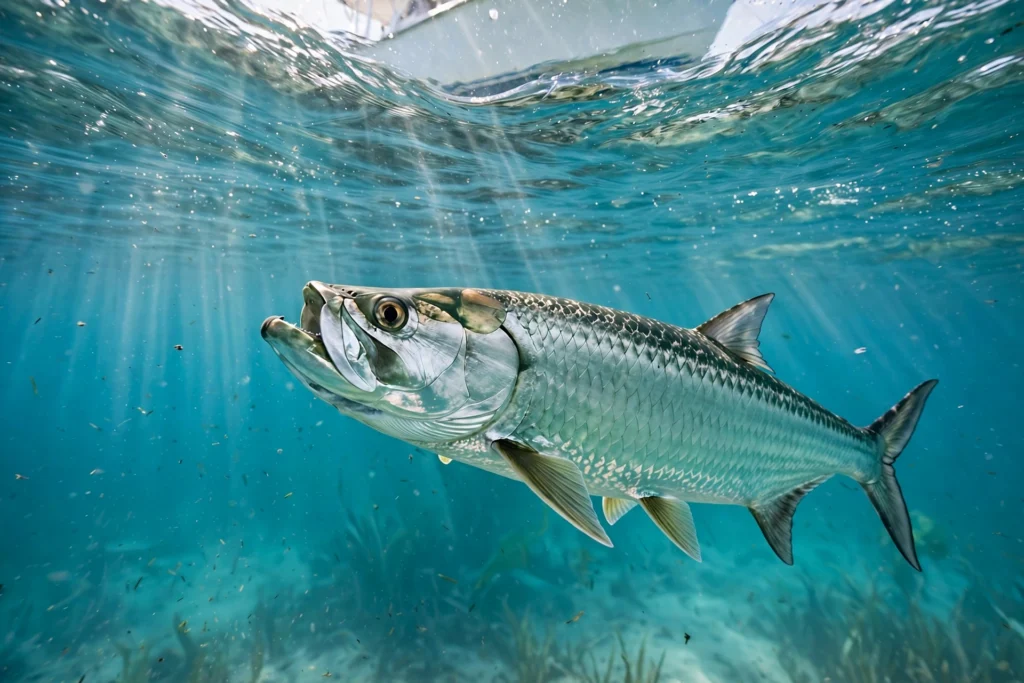
How to Catch Tarpon in GTA 6: The Complete Guide (2026)
Quick Answer: How to catch tarpon in GTA 6: buy the Large Saltwater Lure for $112 at an Ammu-Nation that stocks fishing gear, sail to the water northwest of Port Gellhorn in Kelly County — or east of Abismo Key in map grid M6 — cast with the lure fitted, and work it slowly until a tarpon bites, then set the hook with R2 or RT and fight it with the left stick against the pull while you reel with the right stick in the pauses. The tarpon — the Atlantic Tarpon in the in-game log, fish number 4 of the 35 species in the Fishing tab — is a large-mouthed silver-green game fish found in Leonida’s oceans, in both coastal and deeper waters. No dedicated tarpon guide existed before this one: every other source gives the tarpon a single row in a bigger all-fish list.
Grand Theft Auto VI launched on November 19, 2026 for PlayStation 5 and Xbox Series X/S, and its wildlife log tracks 255 animals — with 100 studied species needed for 100% completion. Thirty-five of those entries are fish, and the tarpon is one of the most famous of them: in the real world it is known as the silver king, a hard-fighting game fish that can grow past 100 pounds and is famous for leaping clear out of the water when hooked; that is real-world context, not a game mechanic, and it is the reason this guide treats the tarpon as the strongest Big Fish candidate in the series so far rather than just another log entry. This guide answers how to catch tarpon in GTA 6 properly — it is the dedicated tarpon guide the search results do not have: the three reported spots with the directions each source gives, the lure and the rod, the step-by-step fishing method, the other large saltwater fish you will meet in the same deep water, the challenges a tarpon counts toward, Cal Hampton’s rivalries and whether the tarpon is one of them, and the honest limits — including the one number no guide has published yet.
How to Catch Tarpon in GTA 6: The Best Spots
There are three reported spots for the tarpon, and they disagree with each other in a way that matters: the big fishing guides do not point at the same water. One of them points at the Gulf coast west of Leonida, one of them points at the open water east of Abismo Key in the Leonida Keys, and one of them puts the tarpon’s hotspot on Key Lento itself. The table below gives all three, with the source for each, so you can see which spot is the best documented and which one is only a single-source claim.
| Spot | County | Lure | Source |
|---|---|---|---|
| Northwest of Port Gellhorn | Kelly County | Large Saltwater Lure | IGN all-fish guide |
| East of Abismo Key, Grid M6 | Mariana County | Large Saltwater Lure | Player Manual fishing map |
| Key Lento hotspot | Mariana County | Large Saltwater Lure | paradrew animals guide |
The in-game description of the fish, from IGN’s all-fish guide, is the first thing to learn: the Atlantic tarpon is a large-mouthed fish with silver-green scales, and it is found everywhere in Leonida’s oceans, in both coastal and deeper waters. That everywhere range is the key to all three spots — the tarpon is an ocean fish, not a reef fish like the lionfish and not a freshwater fish like the bass, so you will not find it in Gullet Marsh or the rivers of Mariana County. The spots below are ordered by how well documented they are, with the marked hotspot first.
Spot 1: Northwest of Port Gellhorn — the IGN Spot
This is the best place to start learning how to catch tarpon in GTA 6, because it is the one spot the game’s biggest guide marks for you. IGN’s all-fish guide gives the tarpon one best location: “In northwest Port Gellhorn in Kelly County.” Port Gellhorn is the town on the Gulf coast in the west of Leonida — the same town where the airboat lives at Thorpe Adventures, on the far side of the map from Vice City — so the spot is the open Gulf water off the northwest side of the town. The whee.games fishing tracker repeats the same spot, word for word, which makes it the best-agreed pin in the whole guide. Here is how to work it:
- Buy the Large Saltwater Lure before you leave land. The tarpon takes the Large Saltwater Lure, which costs $112 at an Ammu-Nation branch that stocks fishing gear — look for the fish icon under Features when you hover over the shop on the map. Chuck’s Tackle and Shot in Key Lento is one stocked branch. Do not set out with the Medium Saltwater Lure: the wrong lure means no bites at all, and the tarpon is a large fish that only takes the large lure.
- Take a boat to the water northwest of Port Gellhorn. This is open Gulf water, not shore water — a boat is not optional here the way it is at Key Lento. Our how to get a speedboat in GTA 6 guide covers the fastest way onto the water, and our how to get a jet ski in GTA 6 guide covers the cheapest — but for a long run out to the Gulf coast, a speedboat is the better choice.
- Look for the purple fish icon on your map. Each of the 35 species has one marked hotspot, and the game marks it with a purple fish icon once you have discovered it — fishing magazines and fishing posts on Snapmatic also mark hotspots. If the icon is already on your map, sail straight to it; if it is not, use the landmarks: the open water northwest of Port Gellhorn, on the Gulf side of Kelly County.
- Anchor the boat before you cast. Open the vehicle menu and choose Anchor so the boat does not drift while you fish — a drifting boat pulls your lure out of the hotspot and into empty water.
- Cast with the Large Saltwater Lure fitted and work it slowly. Hold L2 or LT and press R2 or RT to cast, then rotate the right stick gently to work the lure. The tarpon is a big ocean predator that chases a moving lure, so a slow, steady retrieve through the hotspot is the method — do not reel in fast and do not leave the lure sitting still.
- When a fish takes the bait, press R2 or RT again to set the hook, then fight it properly: push the left stick in the opposite direction to where the fish is pulling, and reel in with the right stick during the pauses when the fish stops fighting. The tarpon is a large fish, so expect a longer, harder fight than a lionfish or a bass — it pulls steadily and runs, and reeling while it is running is how the line snaps.
- Land the fish and it goes into the log. Catching a tarpon adds it to the Fishing tab of the wildlife log as fish number 4 of 35, and the game weighs it and releases it back into the water.
Spot 2: East of Abismo Key — Grid M6
The second spot for learning how to catch tarpon in GTA 6 comes from Player Manual’s fishing map, which puts the tarpon hotspot east of Abismo Key, in map grid M6, on the Large Saltwater Lure — farther out than the Bluegill pin. Abismo Key is one of the Leonida Keys, the island chain south of the mainland, between Key Lento and the Mile Zero Air Station — so this spot is the open water on the east side of the key, further out to sea than the inshore bluegill water. This spot has one advantage the IGN spot does not: a map grid reference, M6, which lets you find the exact square on the in-game map instead of navigating by landmarks alone. Here is how to work it:
- Sail to Abismo Key and head for the water on its east side. Use the map grid to find square M6, and fish the open water east of the key — not the sheltered water between the keys, and not the shallow water near the shore. Player Manual is explicit that the tarpon water is farther out than the Bluegill pin, so keep going until you are properly out at sea.
- Use Focus to find the fish before you cast. Press both sticks together (L3 and R3 on PlayStation, LS and RS on Xbox) to turn Focus on: it shows glowing green patches in the water where fish are gathering, so you can see whether tarpon are actually in the water in front of you instead of casting blind.
- Cast from an anchored boat. The tarpon is an open-water fish, so the bank is too far from the fish here — anchor the boat once you are in the spot, so it does not drift while you fish.
- Work the Large Saltwater Lure slowly through the open water. The same slow retrieve applies — rotate the right stick gently, keep the lure moving, and wait for the take. If nothing bites after several casts, move around the next key: fish move inside their habitat, and a tarpon that is not in front of you now may be a few hundred yards along the shore.
- Watch for a big fish, not a school. The tarpon is a solitary hunter in the game, not a schooling fish like the mahi-mahi — so where there is one, there may not be a second right behind it. If you hook one and lose it, keep casting in the same water, but do not expect a second bite at once.
Spot 3: Key Lento — the Single-Source Hotspot
The third spot is the weakest of the three, and this guide says so plainly. The paradrew animals guide says the Atlantic tarpon is a large sea fish and that its fishing hotspot is on Key Lento — Jason’s home island, at the southern end of the Leonida Keys. That is a single-source claim: no fishing map pins a tarpon hotspot at Key Lento, and IGN and Player Manual both point at other water. Here is how to treat it:
- Fish at Key Lento only if you are already there for another reason. The Key Lento water is the same kind of coastal ocean water the tarpon lives in, and a hotspot is claimed there — so it is a real lead, not a rumour — but it is not a marked hotspot on any fishing map, and the Port Gellhorn and Abismo Key spots are both better documented.
- Use Focus to check the water before you commit. If you cannot see fish beneath the surface after a few minutes of scanning, move on to one of the confirmed spots — the Key Lento claim may be a misread of the hotspot list, and this guide will not pretend a single-source claim is a fixed spawn.
- If you do catch a tarpon at Key Lento, the spot becomes confirmed by your own game. The fishing guides are still being written by players, and the Key Lento claim is exactly the kind of lead that gets confirmed or dropped as more players report back.
- Pair the trip with the other Key Lento wildlife. The same water holds the spadefish of Cal’s second rivalry in the Leonida Straits just south of the island, and the barracuda in the straits near Key Lento — so a Key Lento trip can log the tarpon and more in one visit. Our how to find red lionfish in GTA 6 guide covers the reef fish of the same southern water, and our how to catch mahi-mahi in GTA 6 guide covers the deep-water game fish of the same ocean.
Before You Go: What You Need
The rod is already in your inventory. The Fishing Rod sits in the bottom-right equipment slot of the weapon wheel, in the slot it shares with the Binoculars and the Flashlight — and the rod is always there, even if you never pick one up. Hold L1 or LB to open the Loadout menu, highlight the Binoculars and Flashlight slot (the one below your Unarmed fist), and press L2 or LT or R2 or RT to cycle to the Fishing Rod, then release L1 or LB to confirm. You do not need to buy a rod, and you do not need to unlock one — fishing is open as soon as Jason can move around freely. If you have not picked the game up yet, a Grand Theft Auto VI for PS5 is the obvious starting point.
As an Amazon Associate, we earn from qualifying purchases.
The lure is the whole decision. Every fish in GTA 6 needs a particular lure, and the tarpon takes the Large Saltwater Lure — that is the one fact every source agrees on. The lure sizes are the whole system: a small lure draws small fish, a bigger lure draws bigger fish, and the wrong lure means no bites at all. The table below gives the four lures IGN lists, with the prices it publishes.
| Lure | Price | What it is for |
|---|---|---|
| Small Freshwater Lure | Not published | Small freshwater fish |
| Medium Freshwater Lure | $40 | Medium freshwater fish |
| Medium Saltwater Lure | $50 | Medium saltwater fish — including the red lionfish |
| Large Saltwater Lure | $112 | Large saltwater fish — including the tarpon |
Two honest notes on that table. First, no source publishes a price for the Small Freshwater Lure, so this guide does not invent one — and you start the game owning one anyway. Second, the rod comes with a Small Saltwater Lure already fitted, which only draws in small saltwater fish — so make sure the Large Saltwater Lure is the one fitted before you cast for a tarpon. One more price note: the GTABase fishing guide lists the Large Saltwater Lure at $125, not $112, and its medium lures at $45 and $56 against IGN’s $40 and $50 — so expect the price to vary slightly by shop, and do not be surprised if the Large Saltwater Lure costs a little more than $112 at one branch. Buy lures at Ammu-Nation branches that stock fishing gear: hover over a shop on the map and look for the fish icon under Features. Chuck’s Tackle and Shot in Key Lento is one stocked branch.
Bring a boat — and make it a fast one. You cannot cast from the shore for a tarpon: all three spots are open ocean water, off Port Gellhorn, east of Abismo Key, and around Key Lento, and the fish is an ocean predator that holds far from land. A boat also lets you anchor in the hotspot instead of drifting out of it, and a fast boat matters because the run out to Port Gellhorn or Abismo Key is a long one — a jet ski gets you there, but a speedboat gets you there and back without a trailer and without the long, slow ride. Our how to get a speedboat in GTA 6 guide covers the fastest way onto the water. A BENGOO G9000 gaming headset helps while you fish: the splash of a tarpon taking the lure is the cue to set the hook, and the quiet of the open water after dark is the cue to slow down.
As an Amazon Associate, we earn from qualifying purchases.
Learn the game in Chapter 1, with Cal. Fishing is taught in the Chapter 1 mission Gone Fishing, which hands you the binoculars and the basics, and the mission Recalibration takes Cal Hampton out on the boat and grills the catch at his place afterwards. Cal is Jason’s friend and fishing rival: after the mission Feng Shui in Chapter 1, he texts you to say he has set a record catch and dares you to beat it. Each of those texts puts a purple fish icon on your map, marking the area where that species can be caught. You do not need Cal to catch a tarpon — the tarpon is not one of his rivalry fish — but the two missions are the fastest way to learn the casting, the hook-set and the fight before you go after the tarpon on your own.
How to Fish for a Tarpon, Step by Step
The fishing method is the same for every fish in the game, and the tarpon is a good fish to learn how to catch tarpon in GTA 6 on, because it is a large fight in open water — the hardest of the single-fish guides in this series so far. Here is the full method, step by step:
- Equip the Fishing Rod from the weapon wheel. Hold L1 or LB, highlight the bottom-right equipment slot, cycle to the rod with L2 or LT or R2 or RT, and release.
- Fit the Large Saltwater Lure. The rod comes with a Small Saltwater Lure already fitted, which only draws in small saltwater fish — so make sure the Large Saltwater Lure is the one fitted before you cast for a tarpon. The Large Saltwater Lure costs $112 at a stocked Ammu-Nation.
- Sail to the spot and anchor the boat. Open the vehicle menu and choose Anchor so the boat does not drift while you fish. All three tarpon spots are open water, so a boat is not optional the way it is at Key Lento.
- Find the fish with Focus. Press both sticks together to turn Focus on and look for fish beneath the surface — the guides describe glowing green patches in the water where fish are gathering. If you can see fish, cast there; if you cannot, move along the coast or around the next key.
- Cast. Hold L2 or LT and press R2 or RT to cast the line out.
- Work the lure. Rotate the right stick gently to work the lure through the water. The tarpon is a big ocean predator — in the real world it chases baitfish at speed and leaps when hooked — and the game rewards the same slow, steady retrieve that draws a strike.
- Set the hook. When a fish takes the bait, press R2 or RT again to set the hook. Do it at once: wait too long and the fish lets go.
- Fight the fish. Push the left stick in the opposite direction to where the fish is pulling, and reel in with the right stick during the pauses when the fish stops fighting. Do not reel while the fish is running — that is how the line snaps. A tarpon runs harder and longer than a bass or a lionfish, so expect several runs before it tires.
- Land it and the game weighs it and releases it back into the water. The catch is logged in the Fishing tab as fish number 4 of 35, and the hotspot is marked on your map with a purple fish icon. You can also get hotspots marked by reading fishing magazines and checking fishing posts on Snapmatic.
Tarpon vs the Other Large Saltwater Fish
The tarpon does not live alone. The same deep water holds half a dozen other large fish, and knowing which one is on your line matters, because each one takes the Large Saltwater Lure and each one counts separately toward the Angler and Pro Angler challenges. The table below gives the other large saltwater fish you are most likely to meet while fishing for tarpon, with the lure and the best spot each source gives — all of them from IGN’s all-fish guide.
| Fish | Lure | Best spot |
|---|---|---|
| Atlantic Tarpon | Large Saltwater Lure | Northwest Port Gellhorn, Kelly County |
| Mahi-Mahi | Large Saltwater Lure | South of Riquezas Keys, west of Mile Zero Air Station |
| Cobia | Large Saltwater Lure | Atlantic Ocean, east of Vice Beach |
| Great Barracuda | Large Saltwater Lure | Leonida Straits, near Key Lento |
| Yellowfin Tuna | Large Saltwater Lure | Gulf of Leonida, west of Tola Bay |
| Permit | Large Saltwater Lure | Leonida Straits, south of Vice-Dale County |
| Green Moray Eel | Large Saltwater Lure | Millport Basin, off the east coast of Lummox County |
Three things to take from that table. First, every fish on it takes the same Large Saltwater Lure, so one $112 lure covers seven species — which is why the Angler challenge (four species in under six minutes) is very doable in the deep water if you move fast between spots. Second, the mahi-mahi and the tuna are the other two big-game fish on the list, and both are also Big Fish candidates — the mahi-mahi lives in the deep water south of the keys and the tuna in the Gulf west of Tola Bay, so a tarpon trip and a tuna trip are different runs to different water. Third, the barracuda is the closest neighbour: it lives in the Leonida Straits near Key Lento, which is the same strait the spadefish rivalry fish lives in, so a barracuda trip can double as a rivalry-fish trip. Our how to catch largemouth bass in GTA 6 guide covers the freshwater side of the same system — the bass, the Small Freshwater Lure and the northern spots — if you want the full picture of all 35 fish.
Fishing Challenges a Tarpon Counts Toward
Fishing feeds into four Survival challenges, and the tarpon is one of the few fish that plausibly counts toward all four of them. The table below gives each challenge, what it asks for, and how the tarpon fits in.
| Challenge | What it asks for | How the tarpon counts |
|---|---|---|
| Big Fish | Catch a fish weighing 20 pounds or more | Best candidate in this guide — a large ocean game fish, but no source publishes a tarpon weight |
| Catch of the Day | Catch 3 fish using each size of freshwater and saltwater lure in a day | A tarpon is one of the 3 Large Saltwater Lure fish |
| Angler | Catch 4 different species of fish in under 6 minutes | A tarpon is one of the 4 species |
| Pro Angler | Catch every species of fish | A tarpon is 1 of the 35 species |
The honest note is the Big Fish row. Big Fish needs a fish of 20 pounds or more, and no guide publishes a weight for the tarpon in GTA 6 — so this guide does not claim a tarpon clears 20 pounds. What it can say honestly is that the tarpon is the right class of fish for the challenge: it is a large ocean game fish that only takes the Large Saltwater Lure, the same lure the mahi-mahi, the tuna and the cobia take, and in the real world a tarpon commonly weighs 40 to 100 pounds, with the biggest ones past 200 — so if any fish in Leonida’s oceans clears 20 pounds, the tarpon is one of the likeliest. Do not plan a Big Fish run around the tarpon alone, but do treat it as the best Big Fish lead in this guide. The Angler challenge is the one to plan around: four species in under six minutes means fishing fast in water that holds several species at once, and the deep water off Port Gellhorn holds the tarpon alongside the tuna, the cobia and the barracuda. Catch the tarpon first, then switch spots fast and keep casting — that is how to catch tarpon in GTA 6 and three more species in a single six-minute run.
Cal Hampton’s Fishing Rivalries — Is the Tarpon One of Them?
No — and that is worth saying plainly, because the rivalry system is the part of fishing most players misunderstand. Cal Hampton texts Jason twice with a record catch to beat, and both times the fish is a named species with a marked spot. The first dare arrives by text after the Feng Shui mission in Chapter 1, and it is a Stoplight Parrotfish heavier than 2 pounds at a marked spot in Gambit Bay. The second dare follows later: a 6-pound Atlantic Spadefish, which needs the Medium Saltwater Lure, at a spot in the Leonida Straits south of Key Lento — and Cal only sends the location once you own that lure. When you land a fish that beats Cal’s, press Cross on PlayStation or A on Xbox to take a photo, and the game sends it to him automatically. The tarpon is not one of Cal’s two documented rivalry fish, and no guide lists a tarpon rivalry text. IGN’s all-fish guide marks the rivalry fish with a pink highlight, and the tarpon is not one of them. That does not make the tarpon less worth catching — it makes it a pure log fish, one of the 35 species for Pro Angler and one of the 100 studied animals for 100% completion, without a rivalry attached to it. Beating Cal’s first challenge unlocks the Baited My Tackle trophy and raises Focus, so do the parrotfish first, then come back for the tarpon with the trophy already earned.
Study a Tarpon Without Catching It
Here is the shortcut most players miss: you do not have to catch a tarpon to log it. PowerPyx’s all-fish guide is explicit — to add a fish to the Progress Menu you need to swim near it and study it by holding R1 or RB, and catching it also adds it but is not necessary. Just swimming underwater and studying the fish is enough. That means the tarpon can be logged the same way the sharks, the rays and the sea turtles are logged in our other guides: get in the water, get close, and hold the study button until the circle fills. The study screen shows the species and the log entry, and it counts toward the 100 studied animals needed for 100% completion. Catching is still the better route for the tarpon, because the catch is what feeds the Angler and Pro Angler challenges — a study alone does not count as a catch — and because the tarpon is a Big Fish candidate, which only a catch can prove. But if you only need the log entry, a swim in the open water northwest of Port Gellhorn with no rod at all will do it, and that is the shortcut version of how to catch tarpon in GTA 6 for the collection alone. The same rule applies to all 35 fish: the Fishing tab of the log is filled by studying or catching, and either one works. One warning: the tarpon lives in the same open water as the tiger, bull and hammerhead sharks, so bring the Arras Bullhead harpoon if you plan to swim for the study — the sharks mostly ignore divers, but the open Atlantic is their water, not yours.
Honest Gaps and What We Do Not Know Yet
This guide is built on the sources named in it, and the gaps are part of the guide, not hidden from it. First, no source publishes a weight for the tarpon in GTA 6, so there is no honest way to say whether a tarpon clears the 20-pound Big Fish challenge — do not plan a Big Fish run around the tarpon alone, and treat it as the best lead, not a guarantee. Second, no source publishes a time-of-day window for the tarpon, so there is no dawn or dusk rule to follow — the tarpon is a daytime surface feeder in the real world, but the game has not been shown to gate it by time, and this guide will not invent a window. Third, the three spots disagree: IGN says northwest of Port Gellhorn, Player Manual says east of Abismo Key in grid M6, and paradrew puts the hotspot on Key Lento — all three are the same kind of open ocean water, but no guide has pinned one hotspot with coordinates the way the lionfish hotspot was pinned, so treat all three as leads and fish the two marked spots first. Fourth, no source publishes a respawn timer for fishing spots, so there is no honest answer to how long you should wait before recasting the same water — if a spot goes quiet, move to the next key or try the other spot. Fifth, the Key Lento claim is a single-source hotspot, not a marked spot on any fishing map, so it is a lead, not a destination — do not sail across the map for it alone. The fishing guides are still being written by players, and these gaps will close as more of them report back.
Frequently Asked Questions
What lure do I need for tarpon in GTA 6?
The Large Saltwater Lure, which costs $112. Every source that lists the tarpon gives the same lure, and it is the only lure the tarpon is documented to take. Buy it at Ammu-Nation branches that stock fishing gear — look for the fish icon under Features when you hover over the shop on the map. Do not bring a medium lure to Port Gellhorn: the wrong lure means no bites at all.
Where is the best place to catch tarpon in GTA 6?
The marked hotspot northwest of Port Gellhorn in Kelly County — that is the spot IGN’s all-fish guide gives for the tarpon, and the whee.games fishing tracker repeats it. The second spot is the water east of Abismo Key in map grid M6, from Player Manual’s fishing map. A third spot on Key Lento is claimed by the paradrew animals guide, but no fishing map pins it there.
Can you catch tarpon without a boat?
No, not realistically. All three tarpon spots are open ocean water — northwest of Port Gellhorn, east of Abismo Key, and around Key Lento — and the fish is an ocean predator that holds far from land. A speedboat is the best choice for the long run out, and a jet ski works too. Anchor the boat once you are in the spot, so it does not drift while you fish.
Does catching a tarpon count toward 100% completion?
Yes, twice over. Catching a tarpon adds it to the Fishing tab of the wildlife log as fish number 4 of 35, and the log counts toward the 100 studied animals needed for 100% completion — you can also log a tarpon by swimming near it and studying it with R1 or RB, without catching it at all. A tarpon catch also counts toward the Angler challenge (four species in under six minutes), the Catch of the Day challenge (three fish with each lure size in a day) and Pro Angler (all 35 species).
Is the tarpon part of Cal Hampton’s fishing rivalries?
No. Cal’s two documented rivalry dares are a Stoplight Parrotfish heavier than 2 pounds in Gambit Bay and a 6-pound Atlantic Spadefish in the Leonida Straits south of Key Lento. The tarpon is not one of his rivalry fish, and no guide lists a tarpon rivalry text — it is a pure log fish for the 35-species collection and the 100% completion count, and a candidate for the Big Fish challenge.

Dr Vivek Garg runs drviram.in — a tech blog about AI tools, apps, and online earning. Every guide here is tested hands-on before it is published.